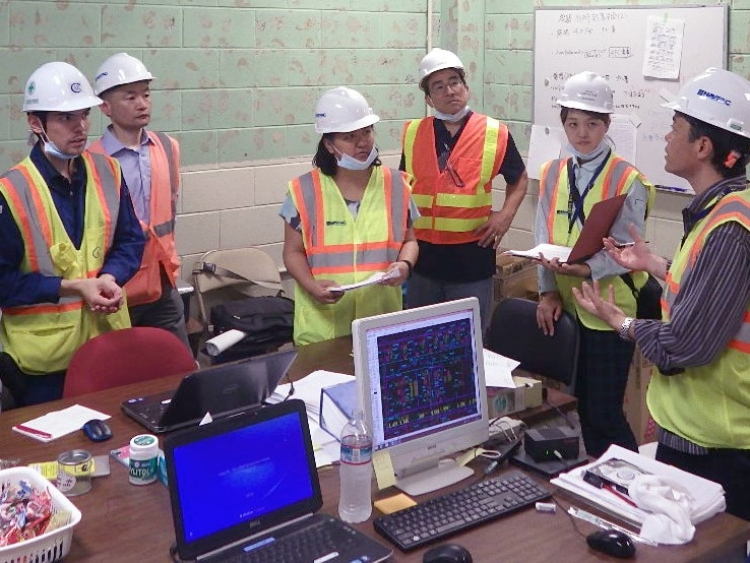

The Future in Cambodia’s Construction Industry – Facilities Management

By: Daniel Tan and Ngu Kea Yuan

In the past, development has been described as property to be designed, constructed and sold to the end user, which marks the end of the development. Today, facilities management is the next generation of services to improve the development after the post construction period.

Asset Management
Jones (2008) defines asset management in the RICS Public Sector Asset Management Guidelines as a structured process that seeks to ensure the best value for money from property assets in serving the strategic needs of local authorities. Part of the strategy includes principles of asset management, building services and green technology. These courses provide the fundamental to achieve value for money for assets.

Facilities Management
Atkins (2009) defines facilities management as an integrated approach to operating, maintaining, improving and adapting the buildings and infrastructure of an organisation in order to create an environment that strongly supports the primary objectives of that organisation. The principles, refurbishment and sustainable practices will be the core modules in the facilities management courses. It emphasises maintenance, refurbishment of old buildings and creating a sustainable environment for our next generation.

Construction Technology
Construction of normal houses might require normal footings, concrete, brickwork, painting etc. while high rise, green and sustainable building requires advanced technology and long-term maintenance to sustain or improve the building’s value. Moreover, the safety required for the construction site and post construction maintenance often require close attention so that minimal to zero injuries is achieved.

Procurement
A facilities manager or property manager do not appoint an anonymous group to refurbish or maintain the building. It is not systematic and ethical to maintain the building as if the building will be taken care of when it is sick. For better prevention, contracts are awarded to securities, suppliers and subcontractors who achieve the eternal triangle requirement, which are time, cost and quality, so that the tenants can stay comfortably in residential, commercial buildings or hotels etc. Either traditional, design and build or management procurement are selected to appoint the responsible and ethical subcontractors for specific works.

RCI – Associate Degree in Facility Management
Royal Chartered Institute (RCI) is taking this opportunity to offer our readers who want to understand more about the course the chance to visit RCI on the 1st floor at Steung Mean Chey Market. You can meet us to understand more about the course structure, study pattern and prospects for occupation with the Facility Management course.

References:
Jones, Keith et. al. (2008), RICS Public Sector Asset Management Guidelines – A guide to best practice, Royal Institute of Chartered Surveyors, UK
Atkin, Brian and Brooks, Adrian (2009), Total Facilities Management, 3rd Edition, Wiley Blackwell, UK.

- Video Advertisement -

Related Post

Julien Moutte: The Tech Leader Breaking Down Barriers to Build a Better World

Julien Moutte, the Chief Technology Officer of Bentley Systems, lives by a simple philosophy: removing barriers is the best way to move forward. Unlike many top executives, you won’t find him in a private corner office. Instead, he sits at a plain wooden desk in the middle of an open-plan floor, surrounded by his team […]
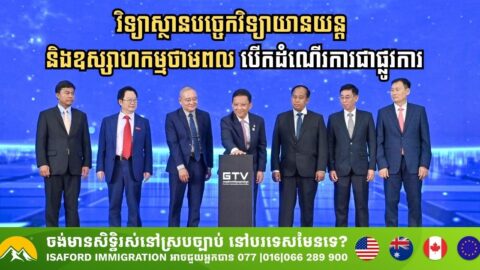
Cambodia Launches Institute of Automotive Technology and New Energy Industry

In a significant step towards bolstering innovation in the automotive sector, Cambodia officially inaugurated the Institute of Automotive Technology and New Energy Industry, led by HE Hem Vandy, Minister of Industry, Science, Technology, and Innovation. During the launch event, Minister Vandy highlighted that the institute aims to equip individuals with essential skills, foster industrial innovation, […]
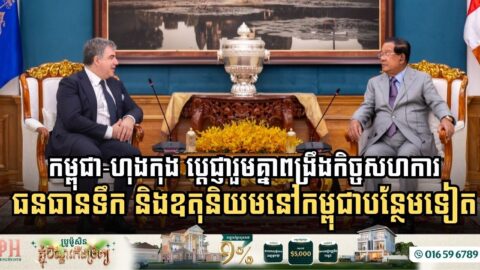
Nobel Prize Winner in Physics Plans to Establish Laboratory in Cambodia to Empower Youth

In a groundbreaking announcement, Professor Sir Konstantin (Kostya) S. Novoselov FRS, an esteemed Nobel Prize winner in physics, has unveiled his ambition to set up a state-of-the-art laboratory in Cambodia. This initiative aims to nurture and expand the skills of Cambodian youth in the fields of science and technology. During a pivotal discussion with Samdech […]

Cambodia and China Join Forces to Enhance Vocational Training Standards

In a significant move to elevate vocational training standards, Cambodia and China have announced the joint establishment of a Vocational Development and Skills Enhancement Center. The initiative was formalized through a Memorandum of Understanding (MoU) signed between the Ministry of Labor and Vocational Training of Cambodia and the Education Development Foundation of Anhui Province, China. […]
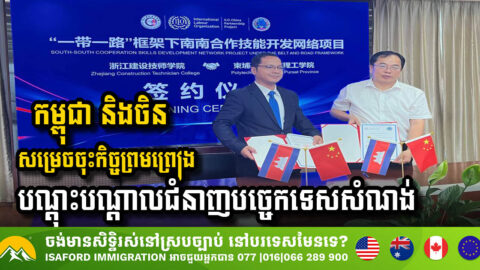
Cambodia and China Sign Skills Training Pact to Enhance Workforce Readiness

Cambodia and China celebrated a significant milestone in skills development with the signing of a Memorandum of Understanding (MoU) between Zhejiang Construction Technician College (ZCTC) and Cambodia’s Polytechnic Institute of Pursat Province (PIPP) in Zhejiang. This agreement aims to bolster Cambodia’s technical and vocational education and training (TVET) system to meet the demands of emerging […]
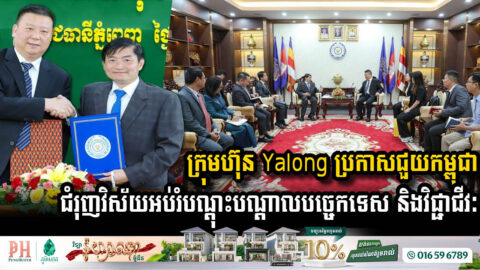
Yalong Partners with the Cambodian Ministry of Labor to Enhance Technical Education

In a significant move to elevate technical and vocational education in Cambodia, Yalong Intelligent Equipment Group Co., Ltd has officially signed a memorandum of understanding with the Ministry of Labor and Vocational Training. The agreement aims to foster international learning exchanges and collaborative efforts geared towards improving the quality of training in this vital sector. […]