

How Can Foreigners Buy Land in Cambodia?

The 1993 Cambodian Constitution states that only persons or legal entities of Khmer nationality have the right to own land. However, this law does not prohibit foreigners from investing in land in Cambodia. So, how can foreigners buy land in Cambodia?

1) Through Khmer National Nominee

This method allows a foreigner to buy land by having a Cambodian representative hold the title for them. This means the land title deed is in the representative’s name. Thus, to secure the right of the foreigner over the property, both parties must have a contract which can be in form of a mortgage or hypothec agreement, loan agreement, or long-term lease agreement, among others.

For example, through a mortgage or hypothec agreement, it acts as though the Khmer representative bought that land using a loan from the foreigner. Thus, the land title deed has to go through a mortgage or hypothec procedure at the cadastral office. The title will have the name of that foreigner as a lender, meaning the representative has no right to sell or transfer the property without approval from that foreigner.

This process is exactly similar to when you get a home loan from a bank to buy a property, and this is by far the easiest and most secure way to own land in Cambodia without going through a complicated process.

Learn more about mortgage or hypothec agreement (Read more and more)

2) Through Land Holding Company

This method fits most with those who prefer to invest in a large-scale plot of land. The foreigner can form a landholding company with at least 51% Cambodian shareholders. Again, the foreigner is secured through the shareholder agreement.

However, forming a company can be costly, between US$4,000 to US$12,000 depending on lawyer. Moreover, owners also must pay taxes such as the 20% income tax, just like other registered firms registered in Cambodia.

On the other hand, if the foreigner does not want to form a company, they can also use a landholding company as the nominee, for which the procedure will be the similar to first method described above.

3) Through Trust Company

The newly enforced 2019 Trust Law allows foreigners to purchase land in Cambodia through a ‘Trust Company’. This method is quite similar to a landholding company method but less complicated as the foreigner does not have to deal with forming a company and other expenses such as tax.

To protect the foreigner, the trust company must be a high-credit firm with property registration with the Ministry of Economy and Finance. Meanwhile, both parties will also have to enter a trust agreement as stated in the Trust Law.

With the trust agreement, the trust company holds and manages the property, whereby the person setting up the trust (called the grantor, settlor, or trustor) transfers the property to a trustee, who manages the property for the benefit of others (called beneficiaries).

4) Becoming Cambodian Citizen

This is the most secure method, but you have to go through a lot of processes to become a Cambodian citizen. Under the 1996 Cambodian Nationality Law, foreigners who have obtained Cambodian citizenship from the King have the right to purchase land and become owner just like Cambodian citizens.

Nevertheless, for those foreigners who do not want to deal with complicated procedures of buying landed property, they can easily and legally buy other property such as units in co-owned buildings from the first floor upwards such as a condo or strata-title office.​ (Read more)


- Video Advertisement -

Related Post

Julien Moutte: The Tech Leader Breaking Down Barriers to Build a Better World

Julien Moutte, the Chief Technology Officer of Bentley Systems, lives by a simple philosophy: removing barriers is the best way to move forward. Unlike many top executives, you won’t find him in a private corner office. Instead, he sits at a plain wooden desk in the middle of an open-plan floor, surrounded by his team […]
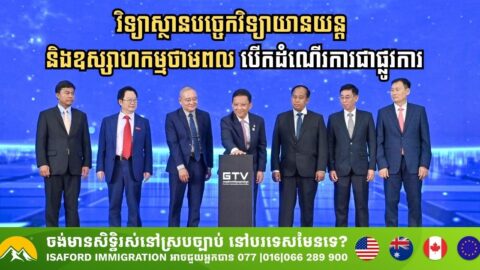
Cambodia Launches Institute of Automotive Technology and New Energy Industry

In a significant step towards bolstering innovation in the automotive sector, Cambodia officially inaugurated the Institute of Automotive Technology and New Energy Industry, led by HE Hem Vandy, Minister of Industry, Science, Technology, and Innovation. During the launch event, Minister Vandy highlighted that the institute aims to equip individuals with essential skills, foster industrial innovation, […]

Nobel Prize Winner in Physics Plans to Establish Laboratory in Cambodia to Empower Youth

In a groundbreaking announcement, Professor Sir Konstantin (Kostya) S. Novoselov FRS, an esteemed Nobel Prize winner in physics, has unveiled his ambition to set up a state-of-the-art laboratory in Cambodia. This initiative aims to nurture and expand the skills of Cambodian youth in the fields of science and technology. During a pivotal discussion with Samdech […]

Cambodia and China Join Forces to Enhance Vocational Training Standards

In a significant move to elevate vocational training standards, Cambodia and China have announced the joint establishment of a Vocational Development and Skills Enhancement Center. The initiative was formalized through a Memorandum of Understanding (MoU) signed between the Ministry of Labor and Vocational Training of Cambodia and the Education Development Foundation of Anhui Province, China. […]
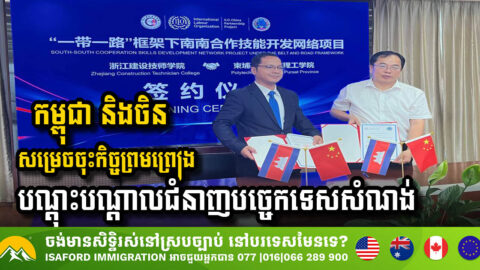
Cambodia and China Sign Skills Training Pact to Enhance Workforce Readiness

Cambodia and China celebrated a significant milestone in skills development with the signing of a Memorandum of Understanding (MoU) between Zhejiang Construction Technician College (ZCTC) and Cambodia’s Polytechnic Institute of Pursat Province (PIPP) in Zhejiang. This agreement aims to bolster Cambodia’s technical and vocational education and training (TVET) system to meet the demands of emerging […]
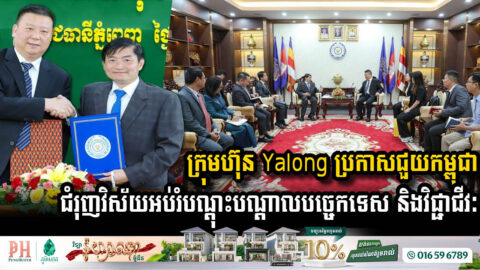
Yalong Partners with the Cambodian Ministry of Labor to Enhance Technical Education

In a significant move to elevate technical and vocational education in Cambodia, Yalong Intelligent Equipment Group Co., Ltd has officially signed a memorandum of understanding with the Ministry of Labor and Vocational Training. The agreement aims to foster international learning exchanges and collaborative efforts geared towards improving the quality of training in this vital sector. […]