





Cambodia Pushes for Greener Urban Landscapes with Low-Carbon Building Initiative
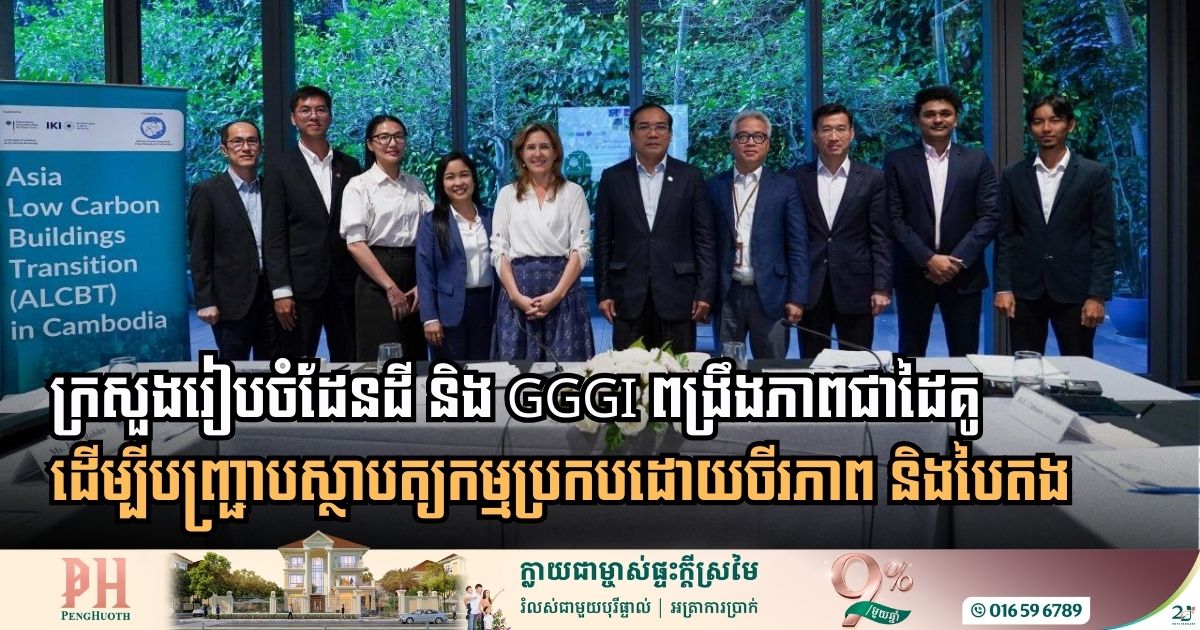
Ministry of Land Management and GGGI strengthen partnership to integrate sustainable architecture and climate-resilient practices into the national development framework
Cambodia is accelerating its journey toward sustainable urban development as high-level officials and international partners convened to advance the Kingdom’s low-carbon building strategy. On January 29, 2026, His Excellency Ros Salin, Secretary of State at the Ministry of Land Management, Urban Planning and Construction, presided over the second meeting of the Cambodia Low Carbon Building Project. The assembly brought together key project leaders, the implementation working group, and steering committee members, all unified in their commitment to promoting eco-friendly urban growth.
A primary focus of the session was deepening the strategic collaboration with the Global Green Growth Institute (GGGI), which continues to play a pivotal role in providing technical expertise and driving the project’s environmental objectives. Participants engaged in detailed discussions regarding the practical implementation of low-carbon building standards, reflecting a robust national commitment to green growth and the sustainable management of urban infrastructure.
During the meeting, the project highlighted key achievements to date, including the launch of the Building Emission Assessment Tool (BEAT) and ASEAN BUILT (Building Investment for Low-Carbon Transition in ASEAN) online platforms, completion of the net-zero building modelling and energy assessment in 250 buildings, and delivery of the Low-Carbon Buildings (LCB) Training Program to public and private sector professionals. The PSC also took note of progress made on development of the National Green Building Certification Scheme, preparation of Green Public Procurement (GPP) Guidelines for energy-efficient air conditioners, deployment and localization of BEAT to establish building emission benchmarks, and the development of a pipeline of bankable low-carbon building projects for potential investors.
Reflecting on project progress, H.E. Dr. Ros Salin noted, “Since our first PSC meeting, the project has delivered tangible results, including the establishment of a strong governance structure and close collaboration with private sector, the launch of the Building Emission Assessment Tool, progress on the national green building certification scheme, and strengthened capacity across public and private sectors.”
He added, “Looking ahead to 2026, the PSC welcomes the proposed priorities, encourages continued focus on synergy of project outputs with the government initiatives, and proposes developing a roadmap in the local language to guide LCB development in Cambodia.”
Nathalie Andre, Country Representative of GGGI Cambodia, stated, “This year will be a critical year for the project. With strong guidance from the PSC, GGGI Cambodia will build on the extensive work carried out in 2025 and focus on scaling practical low-carbon building solutions, supporting national policy priorities, and strengthening pathways for private sector and financial engagement.”
The meeting concluded with the PSC reaffirming its commitment to continued coordination and collaboration to support project implementation, ensuring that the progress achieved contributes meaningfully to Cambodia’s low‑carbon and energy‑efficient building development.