



Government Extends Vital Stamp Duty Exemptions to Propel Cambodian Real Estate Sector through 2026

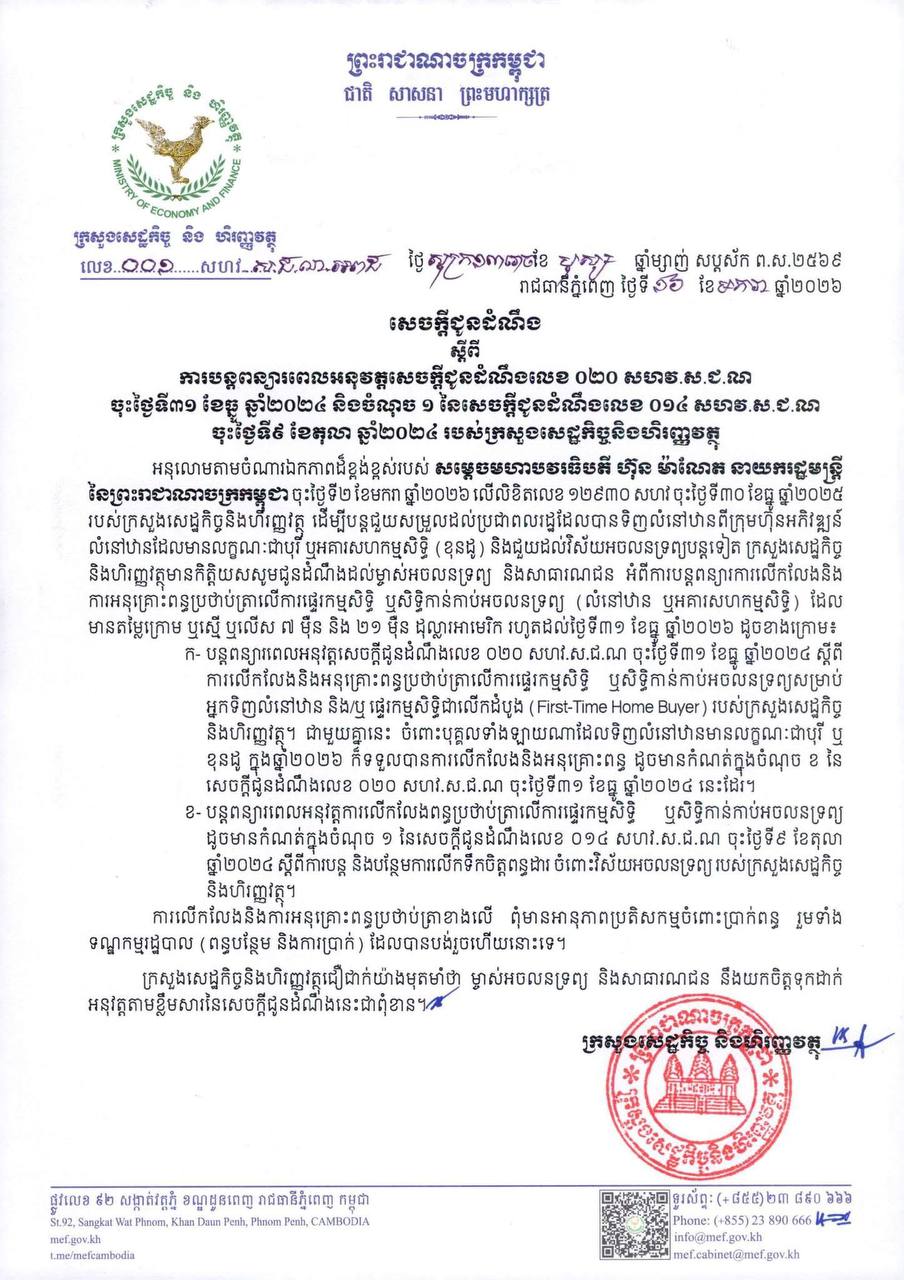
The Royal Government of Cambodia has officially extended the stamp duty tax exemption for property buyers until December 31, 2026, providing a significant boost to the national real estate landscape. According to a formal announcement by the Ministry of Economy and Finance on January 22, 2026, this decision follows a directive from Prime Minister Hun Manet intended to support citizens in attaining affordable housing while maintaining the momentum of the construction and property industries. The exemption specifically applies to the transfer of ownership or possession of residential properties, including those within gated communities known as Boreys and co-owned buildings such as condominiums.

Under the updated regulations, the full four percent stamp duty is waived for properties valued at or below seventy thousand dollars. Furthermore, for properties priced between seventy thousand and two hundred and ten thousand dollars, a deduction of seventy thousand dollars is applied to the taxable base before the stamp duty is calculated. This tiered approach ensures that a broad spectrum of middle-income families can benefit from reduced closing costs when purchasing their first or primary residence from licensed residential developers.

The extension comes at a critical time for the Cambodian property market, which has faced a period of stabilization following rapid expansion. Industry experts suggest that the continued tax relief will encourage potential buyers who were previously hesitant due to high transaction costs. By lowering the barrier to entry, the government hopes to clear existing inventory in major urban centers like Phnom Penh and Sihanoukville, thereby supporting the financial health of developers and the thousands of workers employed in the construction sector.

To qualify for these incentives, the Ministry of Economy and Finance specifies that the property must be purchased from a developer registered with the Real Estate Business and Pawnshop Regulator. This requirement serves as a dual measure to protect consumers by promoting investment in legitimate, regulated projects. As Cambodia navigates the economic complexities of 2026, this proactive fiscal policy underscores the administration’s commitment to ensuring that homeownership remains an attainable dream for the general public while fostering a resilient and transparent real estate environment. (read more)

- Video Advertisement -

Related Post

Cambodian Government Extends Capital Gains Tax for Real Estate Sector Until 2027

Strategic decision aims to sustain momentum in the property market as authorities defer 20% tax on real estate profits for another year The Royal Government of Cambodia has officially announced a further extension of the tax for capital gains on real estate, pushing the implementation date to January 1, 2027. This directive, issued through the […]
Cambodia Postpones Property Tax Obligations Until December 31, 2025

In a significant move for property owners, the General Department of Taxation in Cambodia has announced a postponement of property tax payments for the year 2025, extending the deadline to December 31, 2025. This announcement was made on October 9, 2025, providing much-needed relief to property stakeholders across the nation. The General Department urges all […]

Government Introduces 20% Capital Gains Tax Effective January 1, 2026

In a significant policy shift, the Ministry of Economy and Finance has announced the introduction of a 20% tax on capital gains, set to take effect on January 1, 2026. This announcement was made through Prakas No. 496, សហវ.ប្រក issued on July 18, 2025. Capital gains are defined as taxable income earned from the sale […]

Cambodian Government Extends Property Tax Exemptions for New Cities & Agricultural Land

In a significant move to support economic growth and agriculture, the Cambodian government has announced the extension of property tax exemptions and reductions for specific areas across the country. According to Letter No. 6402 from the General Department of Taxation, property tax exemptions will apply to newly established cities and unused agricultural land exceeding 5 […]