Installing the Right Fire Safety System
While fire safety system are crucial to preventing or extinguishing fires in buildings and thereby saving lives, installation can vary depending on the type of structure. It’s important to know what’s right for what kind of structure.
According to Kien Nareth, mechanical and electrical manager at Canadia Bank, it’s important to analyze the fire safety system that is the best fit for your building and the exact technical requirements before beginning installation. Those recommendations are based on his experience and also on advice from the National Fire Alarm Protection Association (NFPA), one of the world’s leading advocates of fire prevention and an expert on fire, electrical and building safety.
A fire safety system contains two main elements: the fire alarm and fire protection systems. According to national fire alarm code NFPA 72, the fire alarm system warns occupants when a fire is about to break out or after one has already started. This system includes smoke detectors, heat detectors, alarm bells, strobe bells, manual pull stations, and control alarm panels.
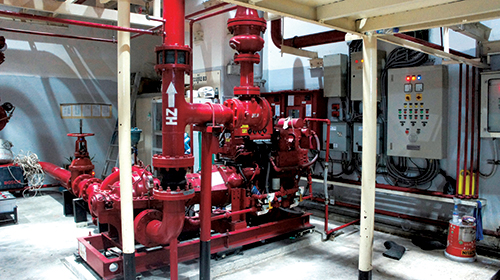
According to fire alarm code NFPA 1, the fire protection system is the larger unit installed in the building to take water from a tank or reservoir to extinguish a fire. A standpipe carries water multiple floors of a building with the help of pressure supplied by pumps; fire sprinklers spray water from the ceilings; hose reel cabinets/hydrants are used to spray water inside the building; and fire extinguishers, including the Clean Agent Fire Extinguishing system technically known as (FM200), are devices to put out flames.
These two systems are installed and connected in the building in tandem. When a fire ignites, the alarm system will be activated, sending an electronic report to the fire protection system to activate sprinklers or other fire-protection devices.
The structure of a building determines what systems are appropriate for it, Nareth says, adding that the plumbing engineer, who generally decides on a fire safety system, must understand the building inside and out before choosing which system to use.
He adds that the designer must keep in mind three main parts of the system installation: the tank or reservoir must store enough water to fight a fire for at least two hours; the standpipes must be in good working order; and fire alarm and protection systems must be properly installed.
A few examples: restaurant kitchens and condos require gas detectors since these are buildings where gas leaks often occur. For high-rise commercial or office buildings where occupants are inside during daytime but the structures are largely empty at night, automatic sprinklers and horse reel cabinets are often the best options.
For shopping centers where there are many people moving inside in the large space, fire sprinklers are appropriate. However, in condominiums, the sprinkler can only be installed in public areas, not in private residences where water could damage property if they were to go off by error or to extinguish only a small fire that could be put out by other means. For data centers, control rooms, server rooms, and other spaces with electrical devices, the best fire-extinguishing methods are dry chemical powders (FM200) that can put out flames without destroying expensive equipment.
Chemical extinguishing agents also work well in banks, where paper currencies are stocked, and gas stations where water would not be enough to put out a gasoline-fed fire. However, chemical extinguishers can be expensive.
For residential use in detached or semi-detached houses and flats, Nareth says one or more fire extinguishers are often sufficient. Moreover, there should be a fire hydrant in every 800 meters to 1 km of a housing block.
For garment factories that contain only cloth, a water-based firefighting system would work well, but for other kinds of factories, the kind of extinguishing agent used depends on the materials on the premises.
Generally, experts don’t recommend installing water-based firefighting system in rice mills as they can destroy paddy and milled rice. In these cases, Nareth recommends installing two fire systems: fire extinguishers for minor fires and water-based systems for bigger ones. While the water might result in a loss of rice, it can protect the plant as a whole.
Laboratories need specific fire protection agents that can handle the chemicals present, he says.
Nareth, who has recently been certified by the ASEAN Federation of Engineering Organization (AFEO), says buildings in Cambodia, including some condominiums and high-rise buildings, do not have sufficient fire safety systems. The buildings at most risk of fire are commercial buildings, shopping malls and factories.
“Most building owners in Cambodia understand the value of fire safety systems, but the matter is that these systems require a large investment that most of them can’t afford,” he said.
To improve fire safety standards for building, he recommends that construction permit requirements include the M&E design that will include the fire safety systems. Current, permits focus only foundation design, soil analysis and the architect’s approval on the building drawings.
Fire departments in Cambodia only monitor basic fire protection measures such as fire extinguishers and fire alarms, and don’t have the capacity to ensure that buildings have adequate fire protection systems. Nareth would like to see that change.
For owners of high-rise buildings who can’t afford a standard fire safety system, he advises them to install a standpipe with a hose reel cabinet inside the building. If a fire breaks out, the fire department can connect its own pipe into the stand pipe to bring the water up to the building to fight the flames. Owners could also buy a fire pump to connect to the existing standpipe.
But, in the end, it’s important, and even life-saving, to do things right when it comes to fire protection, Nareth says: “It is important that owners hire professional architect to design the building.”
- Video Advertisement -


 English
  ខ្មែរ
ខ្មែរ