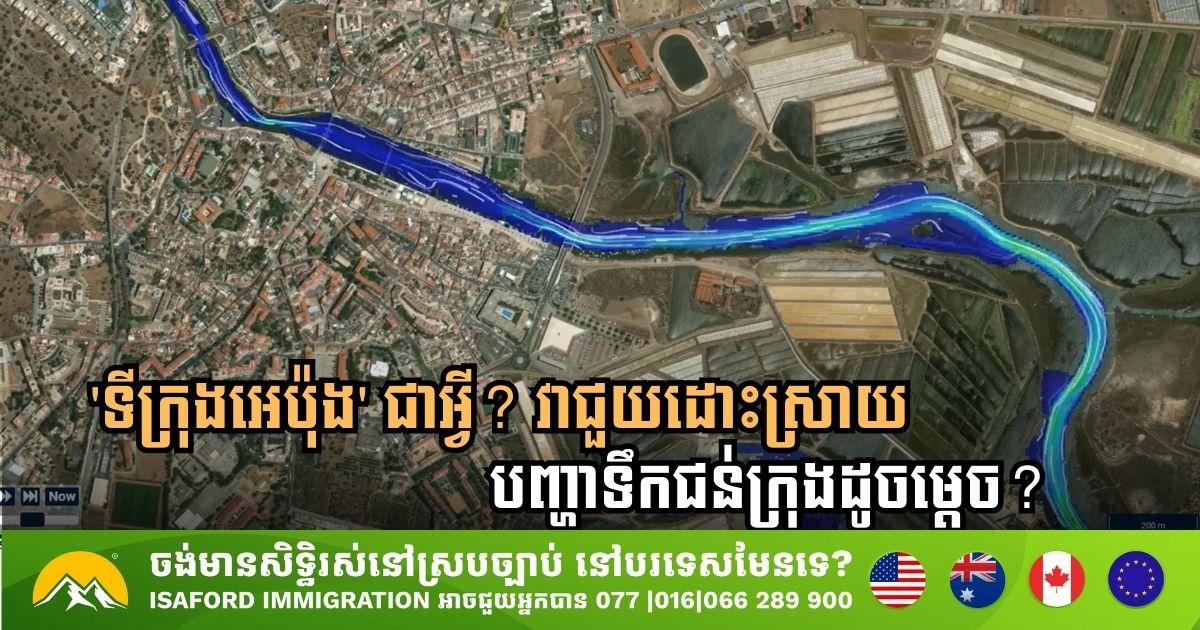


OpenFlows FLOOD Simulation Paves Way for Smarter ‘Sponge City’ Flood Mitigation

A new report is advocating for the widespread adoption of “sponge cities” as a vital, if not singular, solution to the growing threat of surface water flooding.

According to the study co-authored by the Infrastructure Policy Advancement think tank, part of Bentley Systems, and Aqua Consultants, creating sponge cities could reduce the risk of surface water flooding for 4.6 million UK properties, and the same concept can apply to other flood-prone areas around the world.

Mark Coates, vice president of Infrastructure Policy Advancement at Bentley Systems, said a sponge city is defined as an urban area designed with the ability to “absorb, hold and place water in a safe location that then, in time, can drain away.”

Sponge city concepts essentially mean creating dual-purpose infrastructure, often by using green spaces for both environmental and mental well-being benefits, as well as for water absorption.

He added that solutions to flooding require government involvement, including stricter regulations on construction and drainage management, encouragement of advanced planning of large-scale SuDS, and, more importantly, larger budget allocation to flood management.

Besides great planning and regulations, digital tools will also be the key to help countries across the world effectively manage flooding.

Bentley’s tools, such as CAD Modeling and Visualization, Digital Twins, and Hydraulics tools such as OpenFlows FLOOD, OpenFlows Water, OpenFlows Sewer, and OpenFlows Storm, can come in handy.

For example, OpenFlows FLOOD is a powerful software tool designed to analyze and mitigate flood risks across urban, riverine, and coastal environments. It works by employing fully spatially-distributed numerical models to provide a comprehensive simulation of all relevant hydrological and hydraulic processes.

The software simulates all critical processes that lead to flooding, providing a holistic view of water movement within a river basin. This includes rainfall, infiltration, surface runoff, channel flow (river flow), and groundwater flow.

OpenFlows FLOOD is highly versatile, enabling flood risk assessment and mitigation planning in three primary areas: Urban Areas, Riverine Areas, and Coastal Areas.

The software allows users to leverage real-world digital context, such as a 3D reality mesh from ContextCapture. This feature brings simulations to life by generating realistic visualizations of flood events, which is highly beneficial for public communication, stakeholder engagement, and supporting effective emergency planning.

Another key feature for solving flood issues is the scenario management capability. This allows engineers and planners to easily create, compare, and analyze the outcomes of different mitigation alternatives (e.g., building a new flood wall, installing new Suds, or rerouting a channel). This function helps users quickly find the best and most effective solution for flood risk mitigation.

- Video Advertisement -

Related Post

AI-Powered Digital Twin Revolutionizes Tunnel Maintenance in Italy

Italferr S.p.A. has set a new benchmark in railway safety by implementing an AI-powered digital twin for the Serravalle Tunnel, part of the strategic Tezo Valico dei Giovi line connecting Genoa and Milan. By moving away from manual, time-consuming inspections, the project has successfully automated defect detection, dramatically reducing operational risks. The primary challenge for […]

MPTC Hosts Successful Digital Government Forum 2025 and Technology Expo

The Ministry of Post and Telecommunications and the Digital Government Committee organized the Digital Government Forum 2025, Digital Technology Expo, and Related National and International Events—held under the theme “Accelerating Digital Future: Governance, Growth, and Global Partnerships”—were organized over three days, from 5 to 7 December 2025, at the Diamond Island Convention and Exhibition Center. […]

Meeting of Digital Government Committee to Explore Key Initiatives

Phnom Penh, December 24, 2025 – In a significant gathering at the Ministry of Post and Telecommunications, His Excellency Chea Vandeth, Minister of Post and Telecommunications and Chairman of the Digital Government Committee (DGC), presided over the 8th session of the DGC, featuring robust discussions on pivotal digital initiatives aimed at enhancing governance and public […]

Bentley Systems 2025: A Year of Infrastructure Innovation and Global Collaboration

As 2025 draws to a close, Bentley Systems is reflecting on a landmark year defined by global expansion, open-source breakthroughs, and a renewed focus on the next generation of engineers. From the streets of Philadelphia to the tech hubs of Berlin, the company’s event calendar highlighted a strategic shift toward integrated digital twins and geospatial […]
AI Powerhouse: Flux Energy Compresses Five-Year Geothermal Project into 12 Months

Flux Energy Solutions has achieved a remarkable feat in renewable energy development, leveraging artificial intelligence (AI) and GPU-accelerated simulation to compress a 60-month geothermal reservoir modeling project into just 12 months. The successful optimization of a 69.5-megawatt (MW) geothermal field in western Turkey delivered a 500% gain in modeling efficiency and significant cost savings. The […]

What are the key takeaways from  2025 Bentley Civil User Conference?

After a seven-year hiatus, the Bentley Civil User Conference returned as an in-person event, bringing together over 500 Bentley users, experts, and industry leaders to tackle persistent sector challenges like workforce shortages and aging infrastructure. The central theme of the 2025 conference was how digital project delivery, open applications, and Artificial Intelligence (AI) are poised […]