


Aac Lightens Load in Cambodia

Bricks are a standard material on virtually all building sites. But with lighter and longer Autoclaved Aerate Concrete (AAC) blocks, building walls and other sections of buildings where bricks are conventionally applied, becomes easier, faster and cheaper.

Autoclaved aerated concrete (AAC), which is also known as autoclaved cellular concrete (ACC) and autoclaved lightweight concrete (ALC), is a lightweight, precast, concrete building material invented in the mid-1920s that simultaneously provides structure, insulation, and fire- and mold-resistance. AAC products include blocks, wall panels, floor and roof panels, cladding (facade) panels and lintels.

In production for over 70 years with a wide range of products including green technology solutions, P.K. Light Block is now introducing this technology to the Cambodian market to help reduce costs on construction projects as well as reducing environmental impact.

Their factory, staffed by their experienced local and international technical team, is expected to open in December this year. Their main target clients are construction companies as the block can be applied to an entire building.

“As ASEAN integration is coming, the company expects Cambodia’s construction and property sectors to grow rapidly,” said Sok Sothy of P.K. Light Block. “So through our light block, we have a great opportunity to contribute to the development of more skyscrapers in Cambodia by helping save on construction costs and time, and minimise environmental impacts plus many other benefits.”

Besides its insulating capability that reduces heating and cooling load in buildings compared to conventional bricks, other significant advantages it offers are; quick and easy installation, porous structure allowing for superior fire resistance, workability allowing accurate cutting which minimises waste, lower environmental impact in all phases of its life cycle, moisture resistance, energy efficiency, pest resistance, sound-proofing, non-toxic and a long life span.

Because of their light weight, AAC blocks can save cost and energy in transportation, labor expenses, and increases chances of survival during seismic activity. Larger-sized blocks also lead to faster masonry work. The combination of all these factors equates to ultimately reducing the total project cost.

“By using PK Lightweight blocks instead of conventional bricks, contractors and project owners can reduce the total cost by up to 40 percent,” said Sothy.

AAC is well suited for urban areas with high-rise buildings and those with high temperature variations. Due to their lower density, high-rise buildings constructed using AAC blocks require less steel and concrete for structural members. The mortar laying requirements for AAC blocks are also reduced due to fewer joints.

Using AAC in rendering reduces material use thanks to its extra dimensional accuracy. Better thermal efficiency makes AAC suitable for use in areas with extreme temperatures as it eliminates the need for separate materials for construction and insulation which again leads to faster construction and savings.

Since 1980, there has been a worldwide increase in the use of AAC materials among developers, architects, and home builders, and that is why the technology has also now arrived in Cambodia.

- Video Advertisement -

Related Post

Massive Industrial Expansion Set for Kampong Speu as Chinese Firm Proposes New Special Economic Zone

Strategic development project spanning over four hundred hectares aims to bolster Cambodia’s manufacturing capacity and create thousands of local employment opportunities The industrial landscape of Kampong Speu province is poised for a significant transformation following a formal proposal by a Chinese firm to establish a sprawling special economic zone. On January 6, 2026, the Council […]
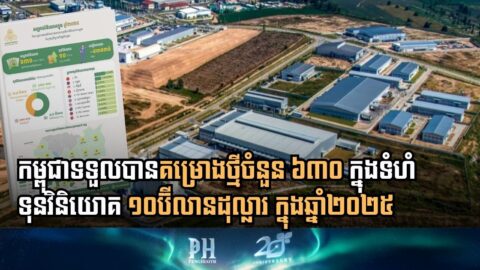
Cambodia Records Surge in Investment with Ten Billion Dollars in New Projects for 2025

Cambodia has reached a major economic milestone in 2025, securing 630 new investment projects with a total capital value of approximately 10 billion dollars. This performance represents a significant 45 percent increase in investment volume compared to the previous year, highlighting the Kingdom’s growing appeal as a strategic hub for international capital. The Council for […]

Cambodia Strengthens Environmental Guardrails as Natural Resource Crimes Decline in 2025

Enhanced ranger patrols and advanced monitoring technologies drive a fifteen percent drop in violations across protected landscapes while boosting legal accountability Cambodia has marked a significant shift in its environmental protection efforts throughout 2025, reporting a notable decrease in natural resource crimes across the Kingdom. According to the latest data from the Ministry of Environment, […]

Kandal Province Launches Official Construction of Prek Thnot Riverbank Park to Enhance Urban Beauty

Provincial authorities and Ministry officials join forces to transform the southern riverbank into a modern recreational space for residents and tourists The landscape of Takhmao city is set for a significant aesthetic upgrade following the official groundbreaking of the Prek Thnoat riverbank park project on January 3, 2026. This ambitious development, situated along the southern […]

Cambodia Surpasses $600 Million Revenue Milestone in Global Rice Exports

Strategic expansion into European and ASEAN markets drives record-breaking year for the Kingdom’s agricultural sector as total exports exceed nine hundred thousand tons Cambodia’s agricultural sector has achieved a significant economic victory in 2025, recording over $602.41 million in revenue from the export of milled rice to international markets. Over the course of the twelve […]

LSU Launches America’s First Industry-Backed Digital Twin Certificate

Louisiana State University (LSU) has announced the launch of the nation’s first Digital Twin Design and Production Certificate, a landmark educational program co-developed with industry leaders, including Bentley Systems. The online initiative aims to bridge the growing skills gap in “digital twin” technology—a field that has become essential to the design, construction, and operation of […]