
Airports Capacity Grows with Traffic

The double-digit growth of air passengers through Cambodia’s airports has led to the launch of a huge airport development master plan which offers a transport infrastructure vision for the next 30-40 years.

The kingdom’s three international airports; Phnom Penh (PNH), Siem Reap (REP), and Sihanoukville are currently undergoing construction, extension, and renovation projects to increase their respective capacities.

Cambodia Airports— a joint venture between France’s VINCI Airports (70%) and Malaysia’s Muhibbah Group (30%) has the concession to develop and operate the three international airports for 45 years starting from 1995. It decided to launch the extension and renovation projects for Phnom Penh and Siem Reap airports after seeing the steep rise in traffic at the airports.

“We at the airports of Phnom Penh and Siem Reap have observed double-digit growth annually of passengers since 2010 from 18% to 20% in Siem Reap and 12% to 15% in Phnom Penh although the increases have been softer in 2014,” said Emmanuel Menanteau, CEO of Cambodia Airports.

While construction projects for both airports are jointly built by Vinci Construction Grands Projets (VCGP) and Muhibbah, Hamiltons International were selected as an architectural consultant for Phnom Penh and Archetype won the bid for Siem Reap.

Since there was already an expansion plan in place during construction in 2004, upgrading Siem Reap airport is relatively straightforward with some new facilities already open between check-in and boarding. As the airport’s brand new international arrival terminal opened on 13 June, work will also start this year to extend the apron to accommodate three more additional aircraft. No aircraft-terminal walkways have yet been installed in Siem Reap to conserve its unique architecture.

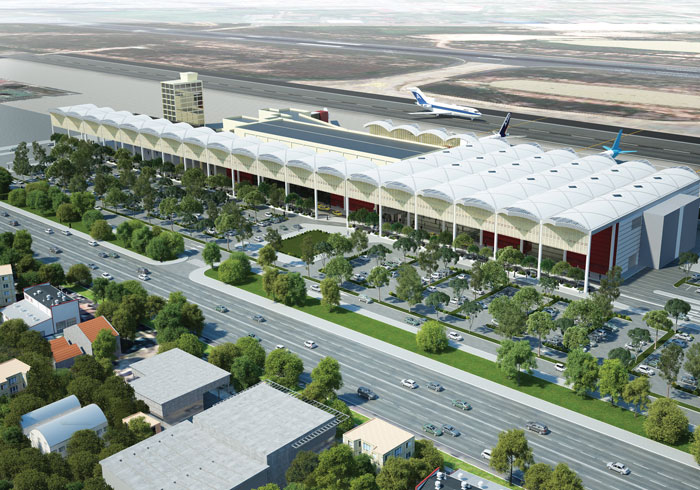
In Phnom Penh, construction is more complicated because the terminal building is quite old, although it was partly planned for an extension. After the new design was approved, construction started in June 2014 with completion expected by March 2016. The design involves an extension wing which increases the current terminal size as well as renovating the existing facilities including car parks, etc. The new wing is expected to be open and connected to the existing terminal by December and fully operational in 2016.

“This is why it is a complicated project because rather than building a brand new terminal, we build a wing that connects to an existing terminal and then we refurbish the old facilities, all of that without stopping operations,” Menanteau explained.

Thanks to these projects, both airports will be equipped with larger spaces for premium lounges and duty-free areas, more food and beverage outlets, check-in counters and boarding gates, and luggage delivery carousels, as well as increased aircraft parking capacity.

Responding to environmental conditions, brand-new wastewater treatment plants have been installed at both airports. Wastewater and garbage from the airports will be composited and transformed into agriculture fertiliser that will be offered to external users.

So far, Cambodia Airports has spent over $100 million on various projects at both airports under its own financing as the airport concessionaire.

Expansion and renovation works have also been launched at Sihanoukville airport this year. Besides extending its facilities to ensure this coastal airport can accommodate medium-sized regional commercial planes, have enough passenger facilities, and also be connected to the EDC electrical grid.

By the end of 2015, PNH and REP are expected to handle combined traffic of around 6.1 million passengers, while the Sihanoukville airport, which handled 40,000 passengers last year, is expected to receive 80,000 passengers this year.

For 2020, PNH and REP are expected to receive around 7.3 million passengers, roughly 3.5 million for each airport with 200,000 passengers through Sihanoukville.

To help ease the burden on the three international airports, the government and Cambodia Airports, via cooperation with the International Air Transport Association (IATA), have been studying the feasibility of reopening some domestic airports.

The study aimed to create a long-term vision of Cambodia’s airport infrastructure that will link to other transport infrastructure developments in the country, and also connect Cambodia to the rest of the world.

IATA recommended Ratanakiri, Kong Kong, and Preah Vihear provinces as prospective areas for either reopening or developing airports’ due to tourism potential.

Cambodia doesn’t need to build another new international airport near the capital according to IATA, asserting that the size of the current Phnom Penh airport will be able to handle traffic until almost 2035 or 2040.

- Video Advertisement -

Related Post

Cambodia Records Surge in Investment with Ten Billion Dollars in New Projects for 2025

Cambodia has reached a major economic milestone in 2025, securing 630 new investment projects with a total capital value of approximately 10 billion dollars. This performance represents a significant 45 percent increase in investment volume compared to the previous year, highlighting the Kingdom’s growing appeal as a strategic hub for international capital. The Council for […]

Kandal Province Launches Official Construction of Prek Thnot Riverbank Park to Enhance Urban Beauty

Provincial authorities and Ministry officials join forces to transform the southern riverbank into a modern recreational space for residents and tourists The landscape of Takhmao city is set for a significant aesthetic upgrade following the official groundbreaking of the Prek Thnoat riverbank park project on January 3, 2026. This ambitious development, situated along the southern […]

Battambang Completes Construction of Massive Water Treatment Facility to Meet Growing Urban Demand

New high-capacity plant set to launch in early 2026 will double the provincial capital’s clean water supply through advanced Chinese engineering The skyline of Battambang’s Kampong Seima area has been permanently transformed with the 100 percent completion of the province’s third and largest water treatment plant. This major infrastructure milestone, announced by H.E. Ut Kloeung, […]

Progress Inspection for Wastewater Treatment System Development in Takhmao City

In a significant step towards enhancing the development progress in Takhmao City, HE Ros Vanna, Secretary of State of the Ministry of Public Works and Transport, led a comprehensive inspection of the wastewater treatment system development project in Takhmao City. This project, pivotal for managing urban wastewater, is funded by the Economic Development Cooperation Fund […]

Mekong River Bridge (Dei Edth-Thma Kor) Construction Reaches 36% Completion

The Mekong River Bridge (Dei Edth-Thma Kor) Construction Project has marked a significant milestone, achieving 36% completion as of late December 2025. His Excellency So Vector, Secretary of State for the Ministry of Public Works and Transport and Managing Director of the project, led a team of officials to the construction site to evaluate advancements […]

Milestone Achievement in Kampong Cham as Mekong River Bank Protection Project Reaches Completion

The Ministry of Water Resources and Meteorology has announced the successful completion of a significant riverbank protection project along the Mekong River in Kampong Cham province. Spanning 700 meters in length, this second phase of construction has reached one hundred percent completion, marking a vital step in safeguarding local infrastructure and livelihoods against the relentless […]