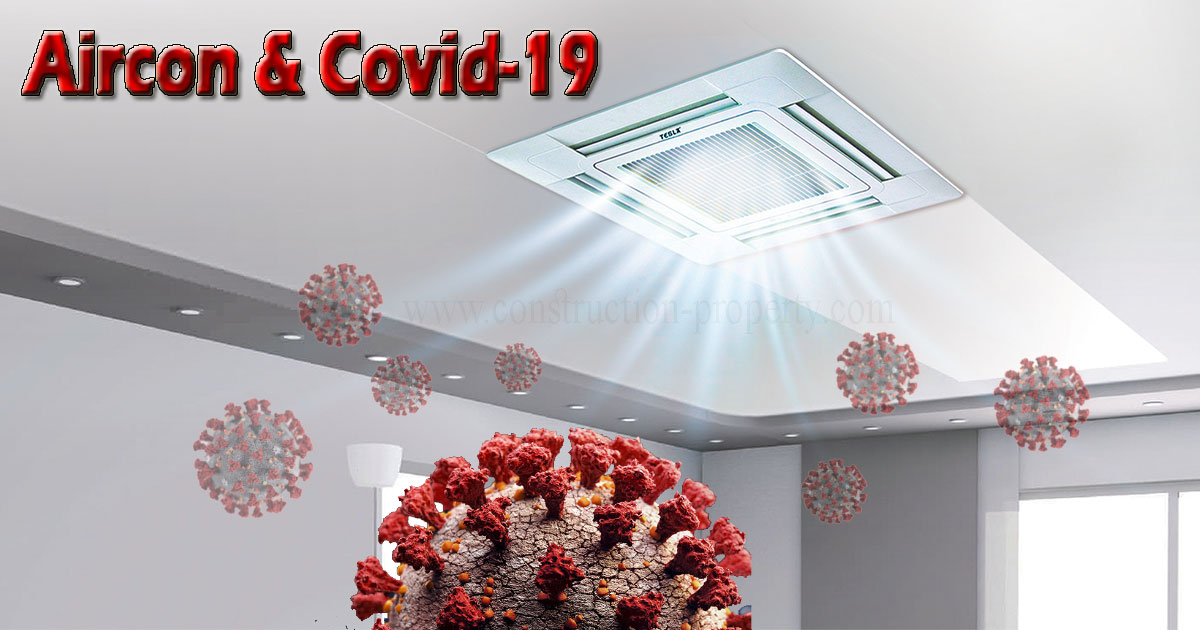
Can coronavirus be transmitted through the air? This question has not yet been fully scientifically proved. However, there is some evidence that scientists believe that COVID-19 can be spread through droplets from AC, depending on the design of the air conditioner.
Evidence that COVID is capable of transmitting through air-conditioning systems
Studies found that workers on the Diamond Princess Cruise ship in Japan quickly spread the virus, which increased from 10 infected persons to more than 600 within just two weeks.
It is the airflow from the AC of that cruise ship, which is most likely responsible for spreading the virus. Experts said, “The air currents on the ship can play a big role in transmitting the infection,” according to an article published by the South China Morning Post (SCMP).
Photo: soundhealthandlastingwealth.com
A group of Singaporean scientists reexamined this case by conducting experiments in three isolation rooms to monitor the transmission of the virus.
The good news from this study is that the recirculating air tests used from inside the room show negative results, which means that the virus does not live in the air like any other highly contagious viruses.
However, the bad news is that lab samples taken from the air-conditioned outlet showed a positive test result. This means that airflow in the air conditioning system can bring down small drops of the virus that contain the COVID-19, which can hang on the inside of the engine compartment, such as on the vent.
“For air-conditioners designed for a cruise ship, it is likely to mix air inside and outside the room or hall to save energy,” Qingyan Chen, a professor of mechanical engineering, told Purdue University Press about two weeks ago.
“… The problem is that these systems cannot filter particles smaller than 5,000 nanometers,” Chen said.
“If the coronavirus is the size of other SARS virus with a diameter of 120 nanometers, then it means that the air conditioning system can help disseminate the virus across rooms.”
As a solution, he recommends, “this cruise ship can mitigate this problem by using air-conditioners that use air from the outside and prevent the air from recycling.”
Notably, Qingyan (Yan) Chen and his team have investigated the spread of air particles in passenger vehicles. In the past, his research team developed a model for how H1N1-A Flu and other pathogens spread through the cockpit.
Air conditioning for buildings may be at risk
If the air-conditioning system for the ship is already suspected to be a crossroads for 700 COVID-19 infected people, and further experiments by Singaporean scientists have confirmed the case, then the humidity in a building’s air conditioning system could also be a factor that researchers are paying extra attention to.
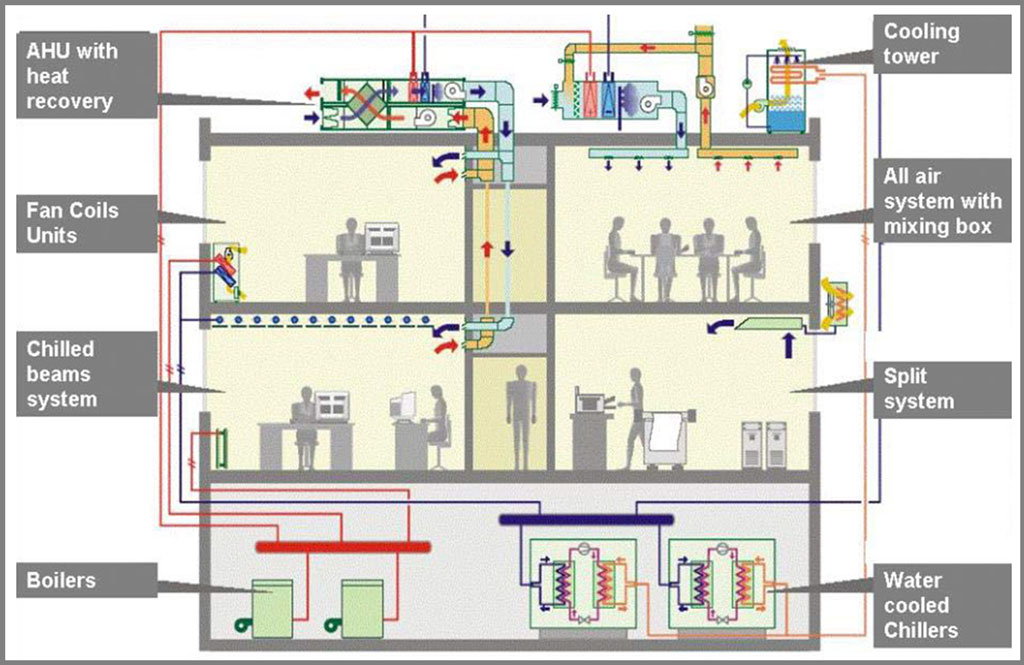
Typical air conditioning system for the office building (Photo: auditAC)
The effect of COVID-19 being able to survive in air-conditioned droplets is a worrying sign, especially for buildings that use large integrated air conditioning systems for hallways or have a single air hub for multiple rooms.
Many of the air conditioners we use today are designed with internal air recycling systems in much the same way as those used on the Diamond Princess cruise ship. This is according to an expert, who was currently interviewed by Newshub.
“If the size of the COVID-19 virus is as small as the SARS virus, that means the air filter in the air conditioning of the cruise ship and air filter systems for buildings could not detect the virus”, according to an article by The Telegraph.
Facing this risk, the design and maintenance of air-conditioning is the key to ensuring the wellbeing of all buildings’ residents.
Studies have shown that reduced humidity in the AC system, as well as increased filtration levels in it, could have a significant effect on reducing the transmission of airborne viruses.
Upgrading AC quality to the standard used to maintain the fresh air quality in hospital operating rooms and industrial cleanrooms should be made.
Air conditioning on a ship may be worse than the air system on an aircraft
According to Purdue University air quality experts, cruise ship air conditioning systems are not designed to filter out small particles such as SARS-2 the official name of coronaviruses. This is the main factor that allows the virus to spread to other cabins in the ship.
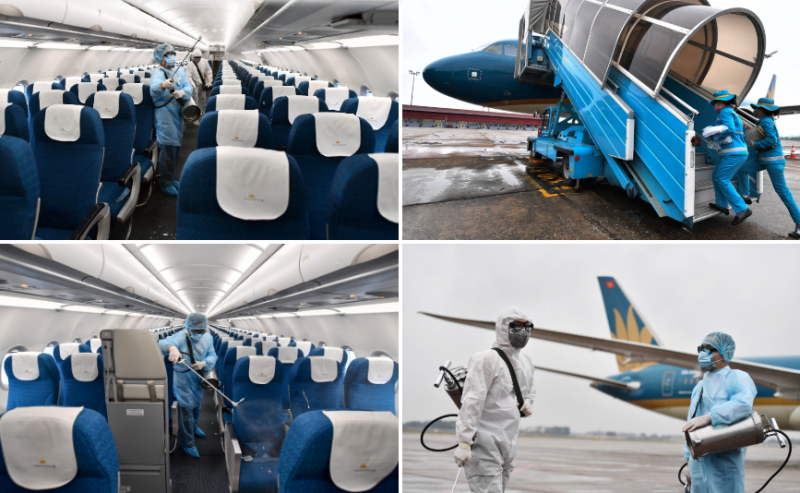
Photo: Vietnam Times
To solve this problem, the design of the air conditioning system in buildings and on cruise ships can be modelled to several types of aircraft or even more advanced than that level. Prof.
Chen and his team’s findings on the airborne nature of the virus (SARS) could provide further insight into the coronavirus transmit-ability through AC.
“For airplanes, coronaviruses are more likely to be spread by direct contact than by airflow through an AC system,” said Chen. “Because the aircraft air-conditioning system is capable of filtering particles like SARS viruses more effectively.”
Can Corona survive in the air?
The possibility of the virus surviving in the air is still controversial among experts. However, “airborne coronavirus infection is plausible,” according to a study, published this week in the New England Journal of Medicine from scientists at Princeton University UCLA and the National Institute of Health (England). The researchers concluded that the virus could survive in the air for up to three hours.
The COVID-19 virus can remain in air humidity for up to three hours and can survive on plastic and other surfaces for up to three days, according to a study that awaits scientific review by. Princeton University, the University of California-Los Angeles, and the US National Institutes of Health (NIH) posted online last Sunday.
In connection with the indirect virus case, on 11 March, Singapore reported 10 new cases of cases involving patients who had no history of traveling to China and had never been to a place where they were related to previously infected cases. This is according to Singapore’s Straits Times Post.
Cambodia Case: Air Conditioning System at The Great Duke Hospital, COVID-19
According to the case study above, the COVID-19 virus is still capable of circulating in an air-conditioning system that does not have a particle filter and that would allow the virus to spread to other cabins or rooms.
If so, this is of great concern for quarantine clinics, such as hospitals and buildings that use air-conditioning systems that convert air from inside the infected room to other rooms.
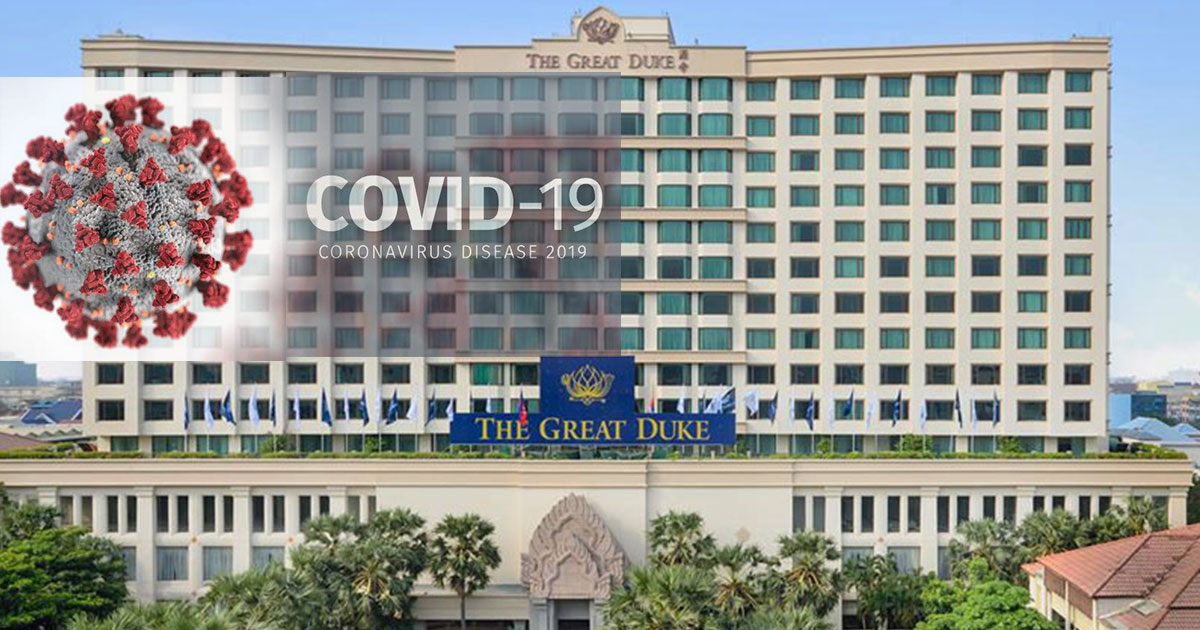
Remarkably, the Royal Government of Cambodia has just approved The Great Duke Hotel (formerly the 5-star Intercontinental Hotel) as a COVID-19 treatment hospital, according to a statement from the Ministry of Health on 17 March.
There is no clear and reliable source of information about the air conditioning system used in the hotel and the potential for such contamination in the building so far. However, this remains a worrying issue. According to the case study above, the government or professional bodies, and especially the Ministry of Health, should be cautious about the possibility of air-conditioning spreading the virus throughout the building. In addition, there should be a technical examination through all the ventilation systems at The Great Duke Hotel to prevent and minimize unforeseen spread of the virus.
However, the possibility of transmission of the virus through air conditioning should be used as a lesson learned, especially for virology scientists and global air conditioning producing companies. They should seriously take this case for higher consideration to learn more about the quality of their products and their coping ability to prevent and eliminate viruses that could be transmitted in the same way in the future.
In a significant step towards bolstering innovation in the automotive sector, Cambodia officially inaugurated the Institute of Automotive Technology and New Energy Industry, led by HE Hem Vandy, Minister of Industry, Science, Technology, and Innovation. During the launch event, Minister Vandy highlighted that the institute aims to equip individuals with essential skills, foster industrial innovation, […]
In a groundbreaking announcement, Professor Sir Konstantin (Kostya) S. Novoselov FRS, an esteemed Nobel Prize winner in physics, has unveiled his ambition to set up a state-of-the-art laboratory in Cambodia. This initiative aims to nurture and expand the skills of Cambodian youth in the fields of science and technology. During a pivotal discussion with Samdech […]
In a significant move to elevate vocational training standards, Cambodia and China have announced the joint establishment of a Vocational Development and Skills Enhancement Center. The initiative was formalized through a Memorandum of Understanding (MoU) signed between the Ministry of Labor and Vocational Training of Cambodia and the Education Development Foundation of Anhui Province, China. […]
Cambodia and China celebrated a significant milestone in skills development with the signing of a Memorandum of Understanding (MoU) between Zhejiang Construction Technician College (ZCTC) and Cambodia’s Polytechnic Institute of Pursat Province (PIPP) in Zhejiang. This agreement aims to bolster Cambodia’s technical and vocational education and training (TVET) system to meet the demands of emerging […]
In a significant move to elevate technical and vocational education in Cambodia, Yalong Intelligent Equipment Group Co., Ltd has officially signed a memorandum of understanding with the Ministry of Labor and Vocational Training. The agreement aims to foster international learning exchanges and collaborative efforts geared towards improving the quality of training in this vital sector. […]
In a significant development for Cambodia’s automotive sector, Toyota Tsusho Manufacturing (Cambodia) Co., Ltd. has unveiled plans to establish a technical training center aimed at enhancing skills within the industry. During a recent meeting between H.E. Chea Wutthy, Secretary General of the Cambodia Investment Committee, and Mr. Kensuke Tsuchiya, President of Toyota Tsusho Manufacturing (Cambodia), […]
This site is registered on wpml.org as a development site. Switch to a production site key to remove this banner.


 English
  ខ្មែរ
ខ្មែរ