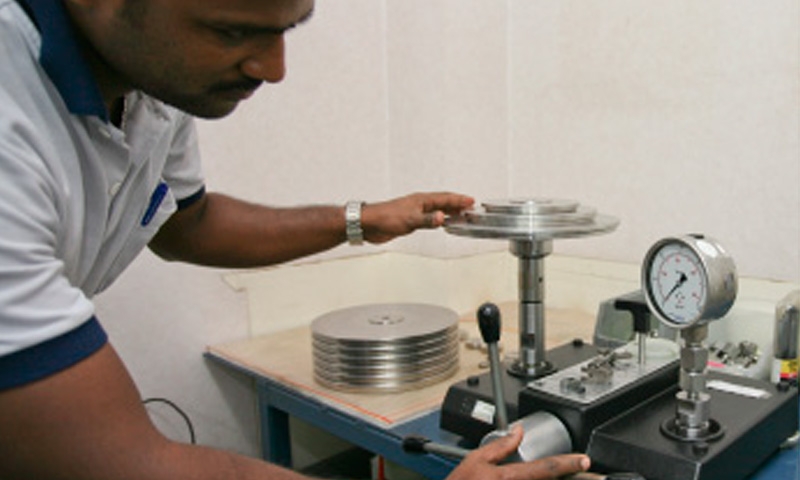


Safety First: Evaluating Concrete in Use

By Mr. Lim Eng Heng (Executive Director and Chief Executive Officer), Branch of CAST Laboratories Pte Ltd

Engineers may need to evaluate the conditions of concrete in structures while in service for a number of reasons, which include investigating signs of distress and quality control checks on new structures, assessment for change of exposure and routine maintenance.

The primary objective of a structural investigation of an existing building is to determine the condition of an existing structure and its structural components in relation to its present and future performance. It further supplements information regarding details to determine the extent and cause of visible defects in reinforced concrete elements. An attempt has been made to include a typical case study on the assessment of an existing old structure which was showing signs of deterioration of concrete and corrosion of reinforcement.

These types of investigations have become an area of increasing significance for many years. As the number of ailing /deteriorating structures increases, there is a need to develop a systematic testing approach for the diagnosis and assessment of existing buildings.

The need for structural investigation may come from one or combination of the following:

  • Statutory requirements or safety checks
  • Change of ownership
  • Change of use
  • Visible defects
  • Periodic inspection as a part of planned maintenance
  • Additions and alterations to the building
  • Fitness for new purpose

Generally, assessment is carried out in different stages in order to be more objective. The main stages derived from the different stages are summarised in table given below:

STAGE 1

Aim

Steps

Visual Survey

Building survey, defect mapping is undertaken efficiently according to gridlines

To understand the behaviour of the structure

To select areas for investigation / field in-situ testing /sampling

Historical data collection

Visual inspection and photo documentation

Tabulation of defects

STAGE 2

Detailed investigation

To get reliable and sufficient data for assessing the structure with high confidence

Non Destructive test

Physical and chemical tests

Field sampling and subsequently lab testing

Interpretation of results

To use the recorded and observed results for assessing the current performance of the structure specific to the clients requirement

Evaluation of areas of distress /deterioration in building

Recommendations

To comment what further actions are necessary either for repair, strengthening or more detailed additional investigations and surveys

Case Study 1: Assessment of 2-storey building which was used a theatre

The investigation was divided into two stages as follows:

Stage 1: focus was made on a global survey of the structure based on visual examination of defects. Location of the structure with respect to surroundings must also be analysed due to environmental effects

Desk top study consisting of review of existing drawings, if any, past and present usage, alterations, renovations or repair works and the client’s present requirement or need e.g. change of loading / utility if any etc.

Once the above is done, selection of test areas can be formulated

Stage 2: This stage provides required information for the assessment of the structure. Many method or techniques varying from non-destructive to semi-destructive are available for testing the various structural elements including footing. These techniques are outlined below:

Cover meter survey

Rebound hammer

Core testing

Windsor probe test

Carbonation test

Ultrasonic pulse velocity test for durability , quality and uniformity of concrete

Water absorption on core sample

Chemical analysis on concrete sample

Physical properties of reinforcement bar

Corrosion probability test on reinforcement bar

Trial pit investigation for type, size of foundation etc.

Plate load test for bearing capacity of soil

A combination of tests is an essential part of the investigation in order to establish the material property. As an example UPV compliments the core tests results. Once field work and lab testing are completed, results obtained from the investigation work are carefully studied for getting an indication of material property.

Where signs of corrosion are visible, it is likely that there is corrosion activity in other parts of the structure, hence when symptoms of reinforcement corrosion exists in a structure, the following tests are usually carried out to diagnose the defect:

Depth of cover

Carbonation depth

Chloride content

Density of concrete

Permeability of concrete

Cement content

Strength of concrete and steel

Half-cell potential mapping for probability of corrosion

Sulphate content in concrete

Conclusion and recommendation will be made based on the test results. Further, reference will be made to what future course of action is necessary e.g. like repair, strengthening or periodic monitoring of crack defects.

Thus, structural investigation of existing structural elements enables engineers to establish structural strength, load carrying capacity of different elements, layout details and conditions of the elements.

- Video Advertisement -

Related Post

Cambodia Launches Institute of Automotive Technology and New Energy Industry

In a significant step towards bolstering innovation in the automotive sector, Cambodia officially inaugurated the Institute of Automotive Technology and New Energy Industry, led by HE Hem Vandy, Minister of Industry, Science, Technology, and Innovation. During the launch event, Minister Vandy highlighted that the institute aims to equip individuals with essential skills, foster industrial innovation, […]

Nobel Prize Winner in Physics Plans to Establish Laboratory in Cambodia to Empower Youth

In a groundbreaking announcement, Professor Sir Konstantin (Kostya) S. Novoselov FRS, an esteemed Nobel Prize winner in physics, has unveiled his ambition to set up a state-of-the-art laboratory in Cambodia. This initiative aims to nurture and expand the skills of Cambodian youth in the fields of science and technology. During a pivotal discussion with Samdech […]

Cambodia and China Join Forces to Enhance Vocational Training Standards

In a significant move to elevate vocational training standards, Cambodia and China have announced the joint establishment of a Vocational Development and Skills Enhancement Center. The initiative was formalized through a Memorandum of Understanding (MoU) signed between the Ministry of Labor and Vocational Training of Cambodia and the Education Development Foundation of Anhui Province, China. […]
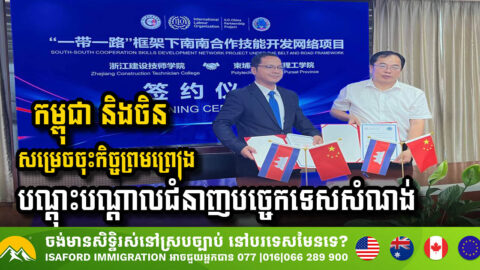
Cambodia and China Sign Skills Training Pact to Enhance Workforce Readiness

Cambodia and China celebrated a significant milestone in skills development with the signing of a Memorandum of Understanding (MoU) between Zhejiang Construction Technician College (ZCTC) and Cambodia’s Polytechnic Institute of Pursat Province (PIPP) in Zhejiang. This agreement aims to bolster Cambodia’s technical and vocational education and training (TVET) system to meet the demands of emerging […]

Yalong Partners with the Cambodian Ministry of Labor to Enhance Technical Education

In a significant move to elevate technical and vocational education in Cambodia, Yalong Intelligent Equipment Group Co., Ltd has officially signed a memorandum of understanding with the Ministry of Labor and Vocational Training. The agreement aims to foster international learning exchanges and collaborative efforts geared towards improving the quality of training in this vital sector. […]

Toyota to Plan Technical Training Center for the Automotive Industry in Cambodia

In a significant development for Cambodia’s automotive sector, Toyota Tsusho Manufacturing (Cambodia) Co., Ltd. has unveiled plans to establish a technical training center aimed at enhancing skills within the industry. During a recent meeting between H.E. Chea Wutthy, Secretary General of the Cambodia Investment Committee, and Mr. Kensuke Tsuchiya, President of Toyota Tsusho Manufacturing (Cambodia), […]