

Understanding Six Types of Property Ownerships in Cambodia

For most people, property ownership might only refer to public or state ownership. However, according to the Land Law and the Civil Code, ownership of immovable property is divided into six categories.

1) Private Ownership

This type is the most common that all legal immovable property owners possess. It shows that the property is privately owned by you. According to Article 138 of the Civil Code, the person with the legal title has the full right to use and possess that immovable property.

2) Undivided ownership

Undivided ownership is a type of ownership on property that has more than one owner. However, the property cannot be subdivided into each unit for each owner, which means all owners hold only one ownership title deed. Simply put, 10 people jointly buy a house. All of them will get only one title deed and they also cannot divide the house into ten pieces.

Given this type of ownership, you must have the consent of every owner if you are willing to sell the property, either just your share or the whole property. Thus, as buyers, one should always check the detail on the ownership title deed before buying.

3) Co-ownership (or Strata-Title)

Co-ownership property is the property that is owned by more than one owner and the property can be divided into small plots for individual owners, which means each owner has their own title deed. Meanwhile, the remaining space is known as a common area shared by every owner, yet cannot be sold. (Article 175 of the Land Law)

For example, a condominium is a co-owned property where each owner own their private units with a specific ownership title deed, while public spaces such as gardens, swimming pools, or elevators are shared between all co-owners.

4. Collective Ownership (or Community Ownership)

This refers to the immovable property owned by the community in which all members of a group share mutual benefits, such as Buddhist temples or indigenous people community lands. According to Articles 20 and 23 of Land Law, this type of property cannot be sold, exchanged, donated or owned by any individual.

5. State Public Ownership

This refers to the immovable property of the state being used for public benefit. Public property includes but is not limited to bridges, roads, parks, public schools, public hospitals, temples, lakes, rivers, seas, forest, and administration buildings, among others. According to Articles 15 and 16 of the Land Law, this type of property cannot be traded.

6. State Private Ownership

This refers to the state land that no longer has public usage. Simply put, this type refers to state land that has been transferred to the private sector. The transfer can be done in form of economic or social land concessions, for example. This type of land can be sold, rented out, or transferred, but under limited conditions (Article 16 of the Land Law).

In sum, understanding the six types of property ownership will help you avoid fraud and illegal purchasing as you can always check on the property title deed for verification.

- Video Advertisement -

Related Post

Authority to Launch Sewerage Service Fee Collection After Policy Review and Approval

In an important move to streamline the collection of sewerage service fees, the Council of Ministers convened a closed meeting on December 26, 2025, to discuss a draft sub-decree outlining the procedures for this process. Chaired by HE Liv Sovanna, Vice President and Chairman of the 4th Working Group of the Council of Lawmakers, and […]
Authority to Launch Sewerage Service Fee Collection After Policy Review and Approval

In an important move to streamline the collection of sewerage service fees, the Council of Ministers convened a closed meeting on December 26, 2025, to discuss a draft sub-decree outlining the procedures for this process. Chaired by HE Liv Sovanna, Vice President and Chairman of the 4th Working Group of the Council of Lawmakers, and […]

National Council for Building Technical Regulations Takes Significant Steps Towards Enhanced Standards in Cambodia

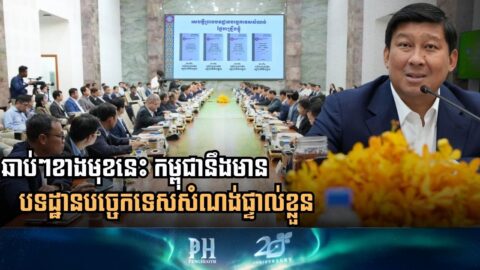
HE Say Samal leads the meeting to approve the draft technical regulations to ensure safety and sustainability in the construction sector The National Council for Building Technical Regulations convened a significant meeting under the auspices of the Ministry of Land Management, Urban Planning, and Construction, according to the meeting held on 18 December 2025. This […]
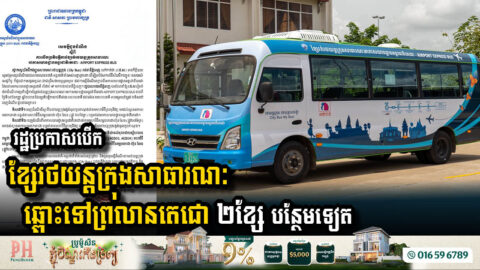
The Gov’t Announces New Public Bus Lines to Techo International Airport to Ease Traffic Congestion

In an effort to alleviate traffic congestion and improve travel convenience, the Phnom Penh City Bus Autonomous Administration (CBA) has announced plans to launch two new public bus lines to Techo International Airport starting September 9, 2025. This initiative aims to provide residents and visitors with an efficient transportation option to one of Southeast Asia’s […]
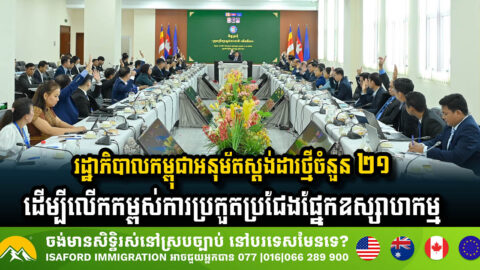
Cambodian Government Approves 21 New Standards to Enhance Industrial Competitiveness

In a significant move to bolster industrial growth, the Cambodian government has approved 21 new international standards aimed at enhancing the country’s competitiveness. This decision was announced during the 31st meeting of the National Standards Council, led by H.E. Hem Vandy, Minister of Industry, Science, Technology, and Innovation, on September 3, 2025. The newly approved […]

Cambodian Parliament Approves Landmark Law for 24 Electricity Investment Projects

In a significant move to bolster the nation’s energy infrastructure, the Cambodian Parliament has officially approved a draft law facilitating payment guarantees to 24 electricity investment companies. This landmark decision was made during the fourth session of the seventh National Assembly held on 22 May 2025. The new law comes in response to the surging […]