



Tax on Unused Land in Cambodia

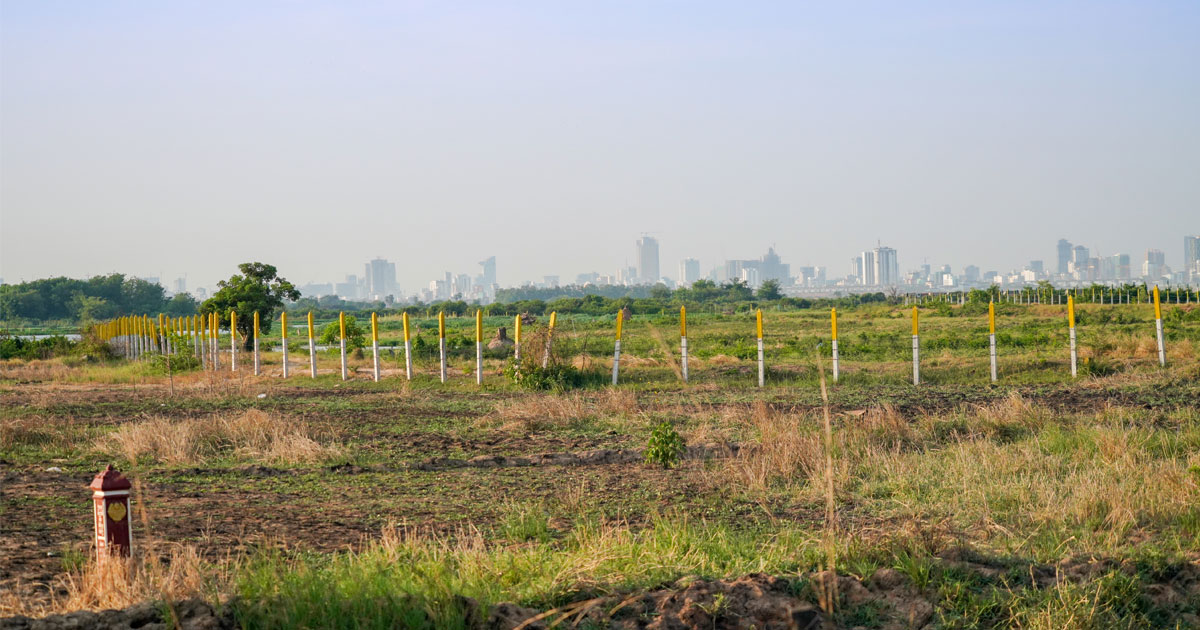
In Cambodia, some properties are taxable, while others are not. Among them, unused land is considered taxable, although tax payments on properties are not, all the same, depending on the type, size, and location of the property. For instance, the tax base of unused land is not the same as the tax base of immovable property, as stated in Article 13 of the Finance Law in 2010, which refers to land, houses, buildings, and other structures built on it. (Read more)

The tax on unused land has been implemented since 1996 by the Finance Act of 1995. Article 27 of this law states that the unused land tax is levied on both non-constructed land and the abandoned constructed land, located in the cities and the areas levied by the Unused Land Appraisal Committee (ULAC). The tax on unused land does not fall under the scope of tax on Immovable Property. This unused land tax is paid by the owner at a rate of 2% of the tax base.

From 1996 to 2006, according to Article 30 of the Finance Act of 1995, this tax was allowed to be deducted from the tax base on an area of 1,200 square metres per plot; but since 2007, the deduction has no longer been permitted.

The unused land tax is intended to prevent the act of buying land and waiting for higher prices to sell for excess profit and stimulate land use in line with the state’s development purposes to boost economic activities, create jobs, and generate more income for sub-national institutions.

The collection of unused land tax is collected nationwide on land both with construction and land without construction abandoned in cities levied by the Unused Land Appraisal Committee (ULAC), as stated in the Decision No 007 SSR.SHV.PD dated 29 December 2005.

However, land with crops is considered land in use. As such, this kind of land is not subject to tax on unused land. Land with crops will be not subject to unused land tax unless the monthly income from the cultivation activities exceeds 80% of one-twelfth of the land value in the tax year multiplied by the coefficients determined by the Prakas No 744 PRK.SHV.PD dated 21 November 1996 on coefficient determination for tax on unused land.

All owners of unused land can pay the tax at the provincial tax branches where the property is located, and if the property is in Phnom Penh, the owner can pay the tax to the General Department of Taxation. The landowner must submit a tax declaration of unused land from 1 January to 30 September of each tax year. For example, if the land is located in Siem Reap, the owner must submit a tax return and pay tax to the Siem Reap Tax Branch.

To calculate tax, the owner has to multiply the tax base by the tax rate (2%). Before calculating the tax, the owner has to first calculate the tax base, which is the total area of the land multiplied by the value of the land per square meter (Value determined by the Unused Land Appraisal Committee). For example, in Siem Reap, an unused land plot in Zone 2 is 2,000 metres long and 700 metres wide. The Unused Land Appraisal Committee determined that the land was worth 50,000 riels per square metre.

In case of negligence, the owner who fails to file a tax return or fails to pay the unused land tax is subject to a penalty of 10% or 25%, and 40% of the amount of the underpaid tax adding interest at 2% of the amount of the underpaid tax for each month or the portion of the month that the underpaid tax has not been paid.

Recently, the General Department of Taxation has urged all immovable property owners in Phnom Penh and all provinces to pay their property taxes, including the tax on unused land for 2020 before the end of 30 September 2020, according to the notification of the General Department of Taxation on 28 May 2020. (Read more)

- Video Advertisement -

Related Post

Cambodia Launches Institute of Automotive Technology and New Energy Industry

In a significant step towards bolstering innovation in the automotive sector, Cambodia officially inaugurated the Institute of Automotive Technology and New Energy Industry, led by HE Hem Vandy, Minister of Industry, Science, Technology, and Innovation. During the launch event, Minister Vandy highlighted that the institute aims to equip individuals with essential skills, foster industrial innovation, […]

Nobel Prize Winner in Physics Plans to Establish Laboratory in Cambodia to Empower Youth

In a groundbreaking announcement, Professor Sir Konstantin (Kostya) S. Novoselov FRS, an esteemed Nobel Prize winner in physics, has unveiled his ambition to set up a state-of-the-art laboratory in Cambodia. This initiative aims to nurture and expand the skills of Cambodian youth in the fields of science and technology. During a pivotal discussion with Samdech […]

Cambodia and China Join Forces to Enhance Vocational Training Standards

In a significant move to elevate vocational training standards, Cambodia and China have announced the joint establishment of a Vocational Development and Skills Enhancement Center. The initiative was formalized through a Memorandum of Understanding (MoU) signed between the Ministry of Labor and Vocational Training of Cambodia and the Education Development Foundation of Anhui Province, China. […]
Cambodia and China Sign Skills Training Pact to Enhance Workforce Readiness

Cambodia and China celebrated a significant milestone in skills development with the signing of a Memorandum of Understanding (MoU) between Zhejiang Construction Technician College (ZCTC) and Cambodia’s Polytechnic Institute of Pursat Province (PIPP) in Zhejiang. This agreement aims to bolster Cambodia’s technical and vocational education and training (TVET) system to meet the demands of emerging […]
Yalong Partners with the Cambodian Ministry of Labor to Enhance Technical Education

In a significant move to elevate technical and vocational education in Cambodia, Yalong Intelligent Equipment Group Co., Ltd has officially signed a memorandum of understanding with the Ministry of Labor and Vocational Training. The agreement aims to foster international learning exchanges and collaborative efforts geared towards improving the quality of training in this vital sector. […]
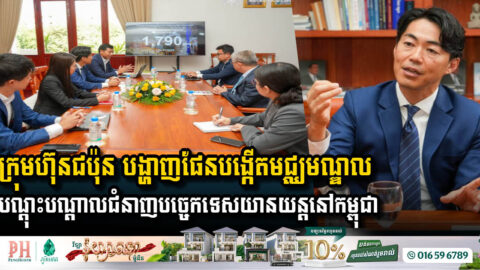
Toyota to Plan Technical Training Center for the Automotive Industry in Cambodia

In a significant development for Cambodia’s automotive sector, Toyota Tsusho Manufacturing (Cambodia) Co., Ltd. has unveiled plans to establish a technical training center aimed at enhancing skills within the industry. During a recent meeting between H.E. Chea Wutthy, Secretary General of the Cambodia Investment Committee, and Mr. Kensuke Tsuchiya, President of Toyota Tsusho Manufacturing (Cambodia), […]