Asean Integration and Membership Top Agenda at Construction Summit

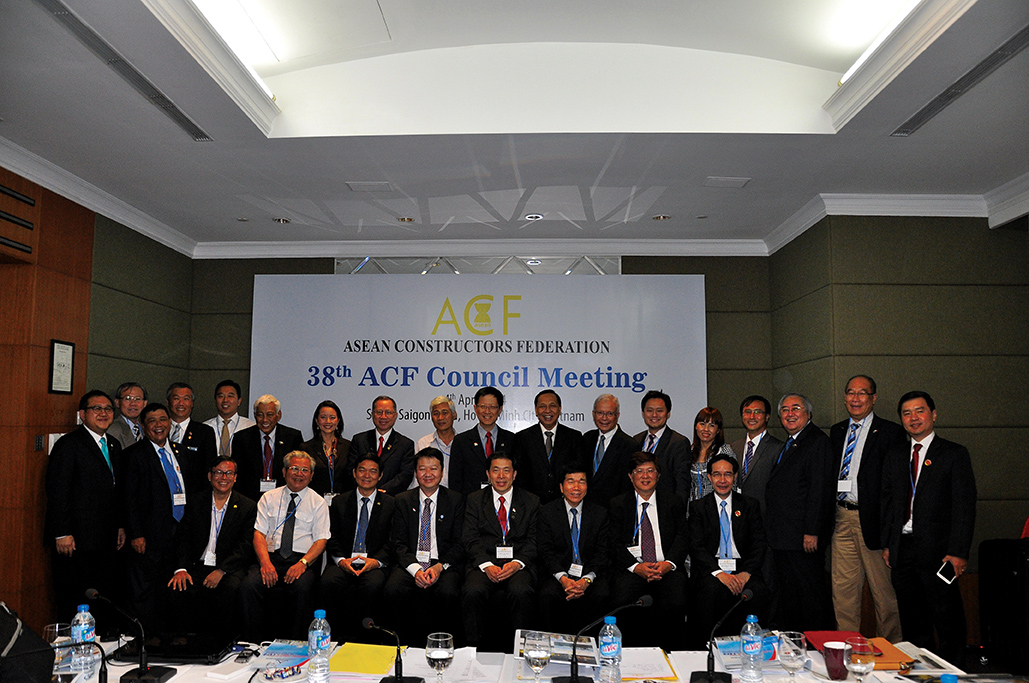
ASEAN’s upcoming economic integration has stepped up the pressure on the ASEAN Constructors Federation (ACF) to speed up work on harmonizing the construction industry across the bloc. At its April meeting, the ACF also discussed bringing new members on board.

On the April 4 council meeting of the ACF in Ho Chi Minh City, economic integration and cross-border harmonization were near the top of the agenda. The association would like to harmonize the skills of construction workers across the region via the ACSTSTprogram, which would train workers and promote construction-related standards in the region. This is no small feat.

But outcomes have been slow due to the program’s complicated procedures and need for multiple parties to get on board. One requirement is the participation and assistance of the ASEAN secretariat, the International Labor Organization (ILO) and various private associations willing to promote the building industry like the Singapore-based Temasek Foundation.

The ACF would also like to have a directory that will have information on all construction-related businesses in ASEAN countries in one place. ACF members all offered their support to this endeavor. The secretariat began seeking a qualified party to manage the publication last year.

But at this 38th council meeting, hosted by the Vietnam Association of Construction Contractors (VACC), there were a wide ranges of issues discussed, including membership and bringing three ASEAN members on board.

The ACF secretariat has been trying over the last two years to convince the flagship building associations in Myanmar, Laos and Brunei to join the federation.

Myanmar, represented by the Myanmar Construction Entrepreneurs Association (MCEA), has confirmed it is interested in joining and has submitted the required documents and registration materials. The hope is that it will be granted official membership at the next ACF meeting.

Despite expressions of interest from Laos about membership, progress has been slow. An initiative to bring Laos on board began at the 36th meeting, but the country is still setting up its main construction association. It is unlikely that Laos will be part of the ACF at the next meeting.

Brunei has said it isn’t ready to join at the current time due to limited resources and that it needs more time for preparation.

The secretariat has now been following up with Myanmar to ensure it can join the team on time for the next meeting while the Thai Constructors Association (TCA) has been assigned to follow-up with Laos on its progress toward membership.

Talks at the council meeting also focused on the ACF website update. SingaporeContractorsAssociation Limited (SCAL) has taken the lead in this area, updating thewebsiteand encouraging memberstosupplydataandnewsfor it. The site is meant to be an information-sharing platform as well as a tool to let others know more about ACF and its activities.

Financials were also discussed and it was announced that at the end of 2013, the ACF has seen US$100,302 in revenue since its inception. Annual membership fees for each member are US$1,000 and the federation’s net balance keeps growing since the host association usually handle most of the expenses of the meetings.

The 39th council meeting in October will be held in Malaysia and chaired by the Master Builders Association of Malaysia (MBAM).

ACF councils meet twice annually, usually in April and October. Venues are elected among the seven nations.

The ASEAN Constructors Federation was established on May 30, 1985 and held its inaugural meeting in Jakarta, Indonesia. The seven constructors associations representing the private construction-related companies in ASEAN are: the Cambodia Constructors Association (CCA), the Indonesian Constructors Association (ICA), the Master Builders Association Malaysia (MBAM), the Philippine Constructors Association (PCA), Singapore Contractors Association Limited (SCAL), the Thai Contractors Association (TCA), and the Vietnam Association of Construction Contractors (VACC).

- Video Advertisement -

Related Post

Ferrovial Uses Digital Technology and AI to Power Long-Term Infrastructure Growth

Ferrovial, one of the world’s largest infrastructure companies, is transforming how major transportation projects are designed, built, and operated through digital engineering, centralized data management, and artificial intelligence. The strategy has helped the company reduce project risks, improve efficiency, and strengthen its long-term concession business, which now accounts for the majority of its value. The […]

Kampong Speu Breaks Ground on 8.5-Kilometer Road 130A Rehabilitation in Kong Pisei District

Presided over by Governor Cheam Chansophorn, the DBST asphalt paving project restores a damaged provincial corridor to support expanding agricultural, industrial, and tourism sectors Kampong Speu province has officially launched the reconstruction of Road No. 130A, a key local transport link spanning 8.5 kilometers in length and 7 meters in width. Presided over by Kampong […]

Bentley SYNCHRO 4D Helps Deliver West Coast’s Largest Hotel Six Weeks Ahead of Schedule

A joint venture between Mortenson and McCarthy has completed the Gaylord Pacific Resort & Convention Center in Chula Vista, California, six weeks ahead of schedule by leveraging Bentley Systems’ SYNCHRO 4D construction planning software. The USD 1.3 billion development is now the largest hotel construction project ever completed on the U.S. West Coast, demonstrating how […]

Cambodia and Singapore vow to boost parliamentary cooperation, green energy, tourism, and combating cybercrime

High-level legislative talks between First Vice President Cheam Yeap and Singapore’s Ambassador highlight joint actions on AI integration, renewable energy trade, multi-destination tourism, and global online scam suppression Phnom Penh: The historic diplomatic relationship spanning over six decades between the Kingdom of Cambodia and the Republic of Singapore has achieved another milestone in parliamentary and […]

Cambodia, Laos, and Vietnam Strengthen Cross-Border Land Transport Networks to Drive Regional Economic Integration

High-level trilateral and bilateral meetings in Siem Reap resolve cross-border logistics bottlenecks and revive decade-dormant bilateral talks between Cambodia and Laos Siem Reap: As economic integration across Southeast Asia increasingly relies on seamless logistics networks, neighboring Indochinese nations are reinforcing their commitment to cross-border transport efficiency. From August 18 to 20, 2026, the historic province […]

Cambodia Advances Strategic Infrastructure Plan with Upgraded National Road 1 and New Mekong River Bridge

Discussions on JICA’s draft final report highlight a 53-kilometer road widening project and an Extradosed Bridge connecting Phnom Penh to Areyksat along the Southern Economic Corridor As Southeast Asian nations continuously upgrade their transport networks to drive economic integration and regional competitiveness, Cambodia is taking significant strides to modernize its core transit corridors. On Wednesday, […]