Bentley’s PLAXIS Ends the Guesswork Beneath Megaprojects

From earthquake-stricken factories in Japan to tight-squeeze tunnels under Madrid, the risks inherent in massive construction projects have traditionally been a game of costly conjecture. However, Bentley Systems’ PLAXIS is changing all that, allowing geotechnical engineers to peer beneath the earth and predict ground behavior with unprecedented accuracy.

Bentley Systems’ advanced finite element analysis software, PLAXIS 3D, is enabling engineers to conduct sophisticated three-dimensional simulations for projects spanning civil infrastructure, mining, energy, and environmental sectors. It takes the guesswork out of what lies beneath our feet, allowing teams to build smarter, faster, and safer.

Here are some real-world examples of PLAXIS applications.

Triple Earthquake Simulation, Fukushima, Japan

After the 2011 Great East Japan Earthquake and tsunami in Fukushima, one of the region’s rebuilding efforts involved a one-story factory constructed on silty ground. Engineers typically had difficulty simulating the behavior of silty ground, but using a PLAXIS 3D soil model and seismic records from nearby sensors, engineers simulated the TNF’s performance across all three earthquakes. The model not only matched the observed post-quake settlements, but it also confirmed something crucial: liquefaction had occurred in the silty ground, challenging long-held assumptions that there was a low risk of this happening.

Madrid Metro Line 5, Spain

The most formidable challenge is an underground crossing that threads a new tunnel between the existing Metro Line 8 tunnel and the M-11 motorway’s embankment. Clearance is just 3 meters at its tightest point, posing a risk to the stability of existing infrastructure.

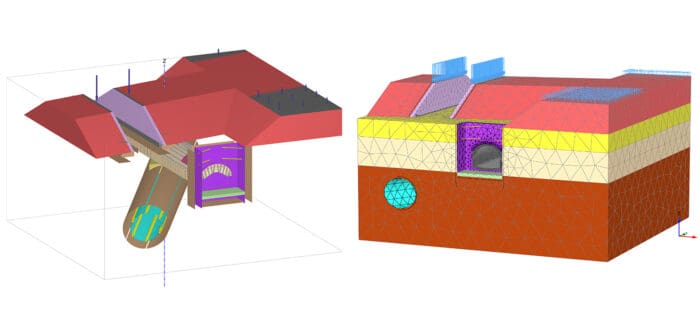
However, PLAXIS 3D helps develop a sophisticated soil-structure interaction model. This complex simulation encompasses over 400 construction phases and all structures within the critical crossing zone. The model demonstrated that the tunnel could be safely built by excavating the tunnel face in shorter segments (1.25 meters) to minimize ground movement and protect nearby infrastructure.

Engineers used Plaxis 3D for the ground modeling and structural planning for Madrid’s Metro Line 5 project.

Hong Kong’s Deepest Subsea Connection

Costing US$2.33 billion, the Tuen Mun-Chek Lap Kok Link Tunnel, Southern Landfall, is a strategic 5-kilometer, dual two-lane subsea tunnel in Hong Kong. It’s designed to be the city’s deepest and longest. Golder Associates faced complex geotechnical conditions, including alluvium, marine deposits, thick sand fill, and high water pressure.

Golder Associates employed Bentley’s geotechnical applications, including PLAXIS 3D, to optimize the tunnels. This helps reduce the number of required barrettes by 52, while shortening 46 others by an average of 2.8 meters. These efficiencies saved US$16 million, cut construction time by two months, and reduced carbon dioxide emissions by an estimated 1,500 tons.

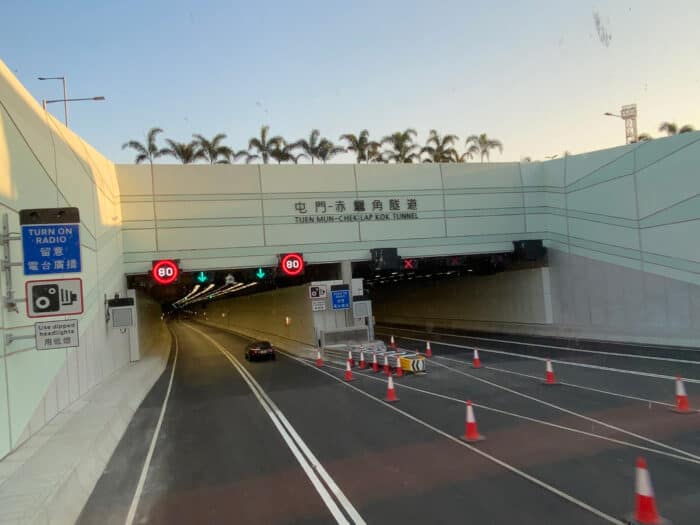
Entrance to the Tuen Mun-Chek Lap Kok Tunnel. Image credit: Wikimedia Commons

Marina Bay Sands, Singapore

Singapore’s iconic Marina Bay Sands development required one of the country’s largest and deepest urban excavations – a sprawling basement up to 18 meters deep in soft marine clay. A particularly sensitive area was the Benjamin Sheares Bridge, Singapore’s longest bridge, whose foundations lay close to the edge of the development. The excavation posed a serious risk of ground movement, with the potential to overstress the bridge’s existing connections.

Marina Bay Sands in Singapore.

Arup engineers used PLAXIS 2D to assess and manage this risk, simulating the soil-structure interaction between the excavation support system and the surrounding ground, with a focus on the bridge abutments. The analysis revealed that lateral ground movement from the deep excavation would indeed exceed safe limits for the bridge’s fixed structural connections.

Instead of attempting to eliminate all movement, an impractical and costly task, the team modified the bridge itself, replacing three fixed connections with adjustable pins so that the deck could sufficiently articulate to tolerate the predicted ground movement.

These examples underscore a profound shift in engineering. By replacing assumptions with simulation, PLAXIS not only validates designs—it actively optimizes them, unlocks enormous savings, and ensures the stability of our most ambitious global infrastructure.

- Video Advertisement -

Related Post

Bentley Systems Unveils Ai-Powered Software To Accelerate Substation Design

Bentley Systems has launched OpenUtilities Substation+, a new model-based design platform featuring built-in “agentic” AI to safely automate complex engineering workflows​ in the utilities infrastructure sector. The + version was launched following the surge in global electricity demand from widespread electrification and new data centers. The utilities sector faces immense pressure to design power substations […]

Bentley Systems Launches First Applied AI Tech Hub in Québec City

Infrastructure software giant Bentley Systems has officially opened a multimillion-dollar applied AI tech hub in Québec City, marking its first major facility dedicated to bringing artificial intelligence to global infrastructure engineering. The new technology hub serves as a critical laboratory where software and AI teams collaborate directly with regional engineering partners. Bentley Systems develops advanced […]

New Orleans Faces Rising Seas; Engineers Turn To Bentley Digital Tech To Fortify Defenses

US engineers are leveraging Bentley Systems’ advanced technology to secure that the city will not sink into the water, transforming Louisiana into a potential global model for climate adaptation. A new Tulane University study has recently warned that rising sea levels could eventually push the Gulf of Mexico shoreline 62 miles inland, placing New Orleans […]

How Bentley Software is Saving Millions on Brazil’s New Bridge

Sener Mobility has successfully leveraged advanced digital engineering software to optimize the foundation design for the BRL 10.42 billion Salvador-Itaparica Bridge project in Brazil. Tasked with managing complex soil and rock conditions for the 12.5-kilometer bridge, the engineering team transitioned from traditional 2D workflows to an integrated 3D approach using Bentley Systems’ subsurface software, Leapfrog […]

How Bentley Digital Twins is Reshaping Maritime Inspections

Major engineering firm Haskoning has revolutionized maritime infrastructure inspection by successfully completing a digital-first assessment of the Holyhead Deepwater Jetty in North Wales using Bentley Systems software. A critical asset supporting cruise vessels and contributing over GBP 4.75 million annually to the regional economy, the aging jetty required a comprehensive inspection of its 400 piles […]

Bentley, NXT BLD Launch $3M ‘NXT Activate’ Accelerator to Fund Next-Gen AEC Software Innovators

Bentley Systems and NXT BLD have partnered to launch NXT Activate, a new $3 million developer-focused accelerator aimed at backing early-stage startups that are building next-generation architecture, engineering, and construction (AEC) software. The three-year program is designed to support early-stage startups building software that breaks down data silos and improves workflows across the construction and […]