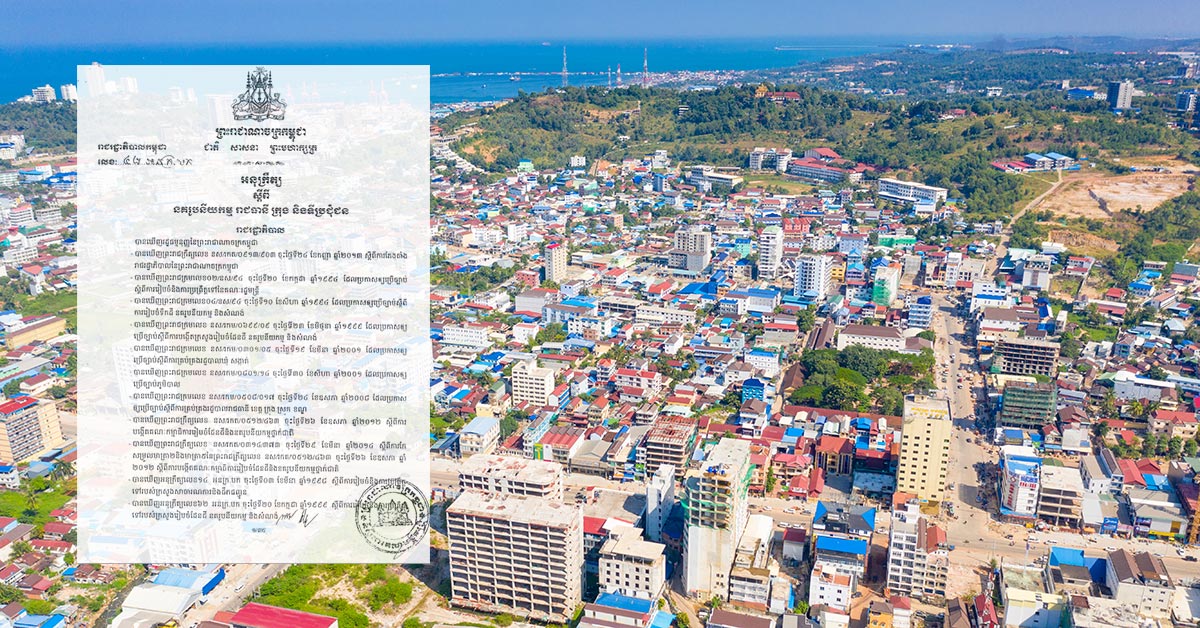
Buildable Land Vs Restricted Buildable Land

To ease urban planning, the Cambodian Government has divided the types of land for different usage.

In the previous article, Construction & Property Magazine has explained the definition of land development and the 12 forms of land development that require a land development permit from the competent authorities (Read more). This article will focus on the different types of lands base on their usages.

According to Sub-Decree No 42 Dated 03 April 2015 on Urbanization of Capital City, Towns and Urban Areas, there are two main types of land: the buildable land, and the restricted buildable land. What is the difference between these two types?

A. The buildable land: refers to land that promotes development and construction in all sector. Buildable land is divided into 10 areas including:

1. Residential zone:
– Detached, low-rise residential zone refers to a zone for building residential houses with a building coverage ratio smaller or equal to 50% of the land plot and has the height from the ground floor to the second floor.
– Linked Low-rise residential zone refers to a zone for constructing residential buildings or apartments with a maximum height of 12 meters.
– Medium-rise residential zone refers to a zone for constructing residential buildings, or apartments, or linked houses, or collectively owned buildings with a maximum height lower than an 11th floor.
– High-rise residential zone refers to a zone for constructing residential buildings with a height higher than the 11th floor.
– Mixed residential zone refers to a zone for constructing many kinds of residential buildings such as linked houses, semi-linked houses, detached houses, apartments and co-owned buildings.

2. Commercial zone:
– Commercial zone refers to buildings that serve the business sector, and services such as office buildings, banks, cinemas, theatres, restaurants, hotels, shops, markets, distribution depots, etc.
– Mixed commercial zone refers to areas with commercial functions for housing and accommodation including shops and small markets that sell goods and services to supply and support the daily lives of local people.

3. Industrial zone:
– Industrial zone refers to a zone for buildings that serve large-scale industries with high toxicity such as factories, large-scale handicraft factories, warehouses, garages, etc. Housing is not allowed in this area.
– Light industrial zone refers to a zone for buildings that serve for small-scale factories with little or medium toxicity such as factories, small-scale handicrafts, warehouses, garages, etc. Housing is allowed in this area.
– Mixed industrial zone refers to a zone of buildings that serve the industry and services that do not affect the environment. Residential and commercial buildings are allowed in this zone such as schools, hospitals, universities, restaurants, cinemas, warehouses, garages.

4. Mixed zone refers to a multi-purpose zone for housing, commerce and service.

5. Transportation zone refers to a zone for the construction of buildings, infrastructure and services for the transport and telecommunication sectors, such as railway stations, airports, bus stations, ferry ports, ports, warehouses, distribution centres, logistics and telecommunication centres.

6. Tourism zone refers to a zone of construction of building to serve tourism and leisure including hotels, guesthouses, restaurants, clubs, etc.

7. Public administration and service zone refers to a zone for serving public affairs and services such as offices of ministries, institutions, departments, government units, schools, hospitals, libraries, health centres, post offices, etc.

8. Public space and green space zone refers to a zone for relaxation, recreation, entertainment, and public events such as parks, gardens, zoos, playgrounds, playgrounds, youth parks, old people’s parks, etc.

9. Cultural and religious areas refers to a zone for the construction of buildings that serve the fields of history, art, culture and religion, such as temples, pagodas, religious churches, schools, museums, sports, sculpture handicraft, Buddhist universities, etc.

10. Some other areas are in line with the actual geography.

B. Restricted buildable land is a kind of land to be restricted for construction. This kind is divided into:

1. Agricultural zone refers to a zone for agriculture such as rice fields, plantations, vegetable gardens, animal farms, nurseries, fish farms, shrimp, crabs, handicrafts for agriculture, etc. This area is allowed to build farmers’ houses.

2. Forest zone refers to forest area which requires protection such as dense forest, swamp forest, protected forest, conservation forest, flooded forest, etc.

3. Water resource zone refers to water surface areas and water sources that which requires protection such as seas, rivers, streams, canals, lakes, irrigation structures, etc.

4. Protection zone refers to natural areas and spectacles which requires protection. These areas will be used for the sake of environment, economy, society, science, education and recreation such as beaches, forage, rivers, mountains, national parks, wetlands, biological areas, etc.

5. Some other areas that are in line with the actual geography.

Development and construction projects in restricted land must comply with legal procedures and require a permit converting that land to buildable land. Only agricultural areas do not need to be converted into buildable land, except the specific areas protected by the authorities.

Thus, people especially investors shall study carefully on their land information before developing into something else to avoid unexpected issues.

- Video Advertisement -

Related Post

Julien Moutte: The Tech Leader Breaking Down Barriers to Build a Better World

Julien Moutte, the Chief Technology Officer of Bentley Systems, lives by a simple philosophy: removing barriers is the best way to move forward. Unlike many top executives, you won’t find him in a private corner office. Instead, he sits at a plain wooden desk in the middle of an open-plan floor, surrounded by his team […]
Cambodia Launches Institute of Automotive Technology and New Energy Industry

In a significant step towards bolstering innovation in the automotive sector, Cambodia officially inaugurated the Institute of Automotive Technology and New Energy Industry, led by HE Hem Vandy, Minister of Industry, Science, Technology, and Innovation. During the launch event, Minister Vandy highlighted that the institute aims to equip individuals with essential skills, foster industrial innovation, […]

Nobel Prize Winner in Physics Plans to Establish Laboratory in Cambodia to Empower Youth

In a groundbreaking announcement, Professor Sir Konstantin (Kostya) S. Novoselov FRS, an esteemed Nobel Prize winner in physics, has unveiled his ambition to set up a state-of-the-art laboratory in Cambodia. This initiative aims to nurture and expand the skills of Cambodian youth in the fields of science and technology. During a pivotal discussion with Samdech […]

Cambodia and China Join Forces to Enhance Vocational Training Standards

In a significant move to elevate vocational training standards, Cambodia and China have announced the joint establishment of a Vocational Development and Skills Enhancement Center. The initiative was formalized through a Memorandum of Understanding (MoU) signed between the Ministry of Labor and Vocational Training of Cambodia and the Education Development Foundation of Anhui Province, China. […]
Cambodia and China Sign Skills Training Pact to Enhance Workforce Readiness

Cambodia and China celebrated a significant milestone in skills development with the signing of a Memorandum of Understanding (MoU) between Zhejiang Construction Technician College (ZCTC) and Cambodia’s Polytechnic Institute of Pursat Province (PIPP) in Zhejiang. This agreement aims to bolster Cambodia’s technical and vocational education and training (TVET) system to meet the demands of emerging […]
Yalong Partners with the Cambodian Ministry of Labor to Enhance Technical Education

In a significant move to elevate technical and vocational education in Cambodia, Yalong Intelligent Equipment Group Co., Ltd has officially signed a memorandum of understanding with the Ministry of Labor and Vocational Training. The agreement aims to foster international learning exchanges and collaborative efforts geared towards improving the quality of training in this vital sector. […]