





Cambodia Sees Surge in Foreign Investment Assets Reaching Over 176 Trillion Riel in First Nine Months of 2025

National Bank of Cambodia reports a seven percent increase in foreign assets as direct investment inflows climb significantly during the third quarter

Cambodia’s investment landscape has demonstrated remarkable resilience and growth through the first three quarters of 2025, with total foreign assets climbing to more than 176 trillion riel. This performance represents a robust increase of over 7 percent compared to the previous quarter, according to the Balance of Payments Statistics Bulletin for the fourth quarter of 2025 released by the National Bank of Cambodia on January 2, 2026. While foreign assets saw a significant upward trajectory, foreign liabilities also experienced a modest rise, reaching more than 303 trillion riel, which marks a growth of over 1 percent compared to the second quarter of the year.

The third quarter of 2025 was particularly notable for the surge in foreign direct investment (FDI) into Cambodia. Data from the central bank indicates that direct investment reached approximately 6.479 trillion riel during this three-month period alone. This figure represents an impressive increase of 1.546 trillion riel, or more than 31 percent, compared to the investment levels recorded in the second quarter. The steady flow of capital suggests that international investors maintain a high level of confidence in Cambodia’s economic stability and its long-term potential within the regional market.

A deeper analysis of the investment sources reveals that China remains the dominant player in Cambodia’s economic development. Investment from China, including Hong Kong and Taiwan, accounted for approximately 43 percent of the total FDI stock. Other major contributors included South Korea at 11 percent, Vietnam at 7 percent, Singapore at 6 percent, and Japan at 6 percent. The remaining 21 percent of investment originated from a diverse range of other international partners. These investments have been strategically funneled into vital sectors of the economy, with the financial sector receiving 32 percent of the capital, followed by manufacturing at 30 percent, real estate at 11 percent, and hotels and restaurants at 8 percent. The agricultural sector and other industries collectively absorbed the remaining 19 percent of the funds.

The continued growth in manufacturing and financial services highlights Cambodia’s successful transition toward a more diversified and industrialized economy. Government officials and economic analysts view these statistics as a testament to the effectiveness of the country’s open investment policies and improved infrastructure. By attracting significant capital into both the service and production sectors, Cambodia is positioning itself as a competitive hub for trade and finance in Southeast Asia. As the nation moves into the final stages of the fiscal year, the central bank expects these positive trends to provide a solid foundation for continued macroeconomic growth and currency stability.

- Video Advertisement -

Related Post

Cultivating Prosperity: Cambodia and Private Partners Launch Strategic Alliance for Modern Agricultural Communities

Landmark agreement between the Ministry of Agriculture and leading financial institutions introduces low-interest capital and carbon credit initiatives to transform small-scale farming into high-value commercial enterprise The Royal Government of Cambodia has taken a significant leap toward agricultural modernization through a strategic collaboration with the private sector. On January 20, 2026, the Ministry of Agriculture, […]

ADB Provides $50 Million to Cambodia to Strengthen Financial Stability and Digital Infrastructure

PHNOM PENH, Cambodia – The Asian Development Bank (ADB) has approved a program approach and a policy-based loan of $50 million to strengthen Cambodia’s financial sector. This financing focuses on both banking and non-banking institutions, as well as enhancing the sustainability of the country’s digital financial infrastructure. According to an ADB announcement on November 24, 2025, […]

Japan Aims to Strengthen Financial Technology Ties with Cambodia

In a significant move to enhance bilateral cooperation, Japan’s regulatory sandbox committee convened with the National Bank of Cambodia on October 17, 2025. The meeting aimed to explore new avenues for collaboration in the burgeoning field of financial technology (fintech). The discussions took place between Dr. Chea Serey, Governor of the National Bank of Cambodia, […]
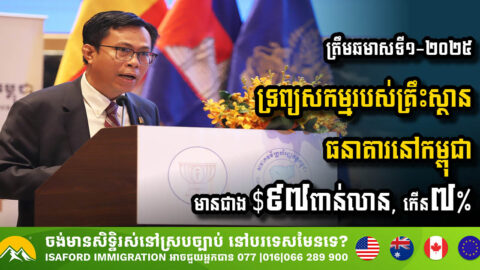
Cambodia’s Banking and Financial Sector Sees Significant Growth by Mid-2025

As of mid-2025, Cambodia’s banking and financial sector has reached a remarkable milestone, with total assets soaring to approximately USD 97 billion. This reflects a healthy growth of 7% over the same period last year. The news was revealed during a recent training program for journalists and content creators conducted by the Cambodian Banking Association […]

NBC Implements Loan Cancellation and Relief Measures for Soldiers Affected by the Cambodia-Thailand War

In a significant move to support the soldiers impacted by the recent Cambodia-Thailand conflict, the National Bank of Cambodia has announced a series of financial relief measures aimed at easing the burden on veterans and their families. Under the new directive, banking and financial institutions are instructed to cancel loans of up to 80 million […]

Thailand Eases Loan-to-Value Rules to 100%, to  Jumpstart USD 486 Billion Debt-Laden Property Sector

Thailand’s central bank has announced a major relaxation of mortgage lending rules, raising the loan-to-value (LTV) ratio to 100% for all housing contracts beginning May 2025 through June 2026—an aggressive intervention aimed at reviving the nation’s sluggish real estate sector, which continues to reel from oversupply, weak demand, and soaring household debt, according to World. […]