City Hall Proposes New Solutions Against Traffic Jams
Having acknowledged that Phnom Penh’s traffic congestion continues to worsen despite the 3-line public bus service recently going on-line, City Hall has proposed new solutions to battle traffic jams as one of seven agendas for its second mandate.
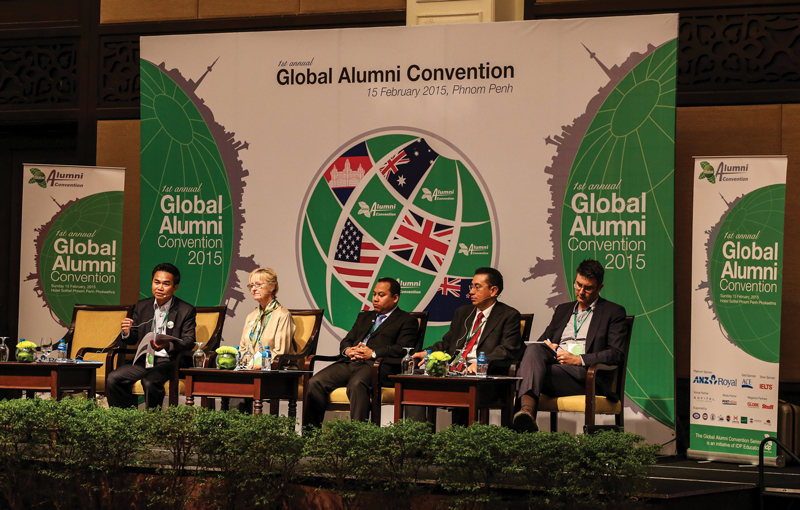
According to City Hall spokesman Long Dimanche, five new solutions have been put forward for government approval. Mr Dimanche made his comments in his presentation at the ‘Urban Planning and Transport: The Future of Phnom Penh’ panel discussion at the 1st Annual Global Alumni Convention (GAC) in Phnom Penh on 15 February hosted at Sofitel Phnom Penh Phokeethra. With keynote speakers which included HE Sun Chantol, Minister of Commerce, HE Say Samal, Minister of Environment, and HE Hun Many together with the Australian, UK, and New Zealand Ambassadors, this unique networking event brought together the best minds in business, government, and academia in a series of discussions on hot topics in Cambodia.
The first part of City Hall’s congestion solution is the management of roadside pavements which have been long been violated by house owners and micro-businesses living along the streets. After a study is completed, City Hall will issue a directive that will permit house owners to only be able to use one third of the pavement and reserve another two thirds for public uses such as for pedestrians.
“This is also a main reason that contributes to the traffic jams and accidents, because the pavement is already filled with stuff, materials, and micro-businesses that leave no space for walkers to go through, and pedestrians resort to walking on the street,” he said. “Even if home owners and businesses use one third of the pavement, they will still need to pay a fee to City Hall.”
The second idea is to rotate the working hours of some public institutions from 8am-3pm, while students and other private employees would keep their studying and working hours from 7am-5pm and 8am-5pm respectively.
As part of the third pillar of change, the Municipality is to set up one-way road system in the city that can speed up traffic flow and reduce blockages at turning points which will also enhance the flow for public buses. The first one-way system to be implemented is the Sothearos Street segment starting from the Russian Embassy to Chomkar Mon traffic lights so that the traffic would now only be allowed to run southward, with no lane for traffic turning back from Chom karmon traffic lights running eastward.
Mr Dimanche also noted that upgrading the current 97 traffic light stops is also a priority as the number will soon exceed 100. Reducing errors with the current lights by moving to an automatic operation system will also work to reduce the jams.
Finally, relocating warehouses, factories, and other large-scale businesses to the outskirts of the city will limit larger vehicles entering the capital and reduce congestion.
Ongoing solutions include the construction and rehabilitation of the drainage system, ring roads, and road enlargements. Almost 50 engineering projects are currently active across the capital that, upon completion, will contribute a lot to reducing traffic congestion.
With concern rising on the amount of vehicles in Phnom Penh, plus those commuting in the city using provincial plate numbers, Mr Dimanche also announced that City Hall is considering limiting the import of used autos. By early 2015, the Ministry of Public Works and Transport had registered over 430,000 autos and 2.3 million motorcycles nationwide.
Existing mechanisms in place will also be extended including the prohibition of heavy trucks entering the capital during the daytime. Mr Dimanche clarified that the ban applies to only four of the city’s districts at specific hours i.e. Daun Pinh, 7 Makara, Chamkarmon and Toul Kork and not the whole city,
City Hall admitted the ineffectiveness of any public transport service so far to serve a capital with a population of over 2 million, but said the non-profit public service is now being applied with the aim of changing citizens’ mindsets to depend on public buses rather than using individual vehicles. Right now, 7,000 passengers daily are commuting via public bus, despite the buses often being late.
According to Mr Dimanche, City Hall is studying how to enhance the bus service, and he mentioned interest in seeking investors to make this public service successful. In terms of the long term vision, City Hall, with assistance from the Japan International Cooperation Agency (JICA), is developing the capital’s transport master plan extending up to 2035 in order to ensure better transportation system management for the rapidly expanding capital.
Another GAC panel member, Dr. Meng Bunnarith, Deputy Director General, Ministry of Land Management, Urban Planning and Construction, said during the session that after trying the bus services a few times he realized the ineffectiveness of the system. He believed that an effective urban planning master plan that the Ministry is currently working on will help contribute to its success.
Also sitting on the GAC Urban Planning panel and agreeing with City Hall’s new resolutions, was Ruben Castillero, a prominent urban planning and transport advocate architect who has developed a number of architectural projects which he would like City Hall to consider. His Phnom Penh Bus Rapid Transport (BRT) concept integrates underground tunnels that allow buses to use exclusive lanes that are integrated in a series of lines making it easy to commute to different areas of the city through the network of sub-way stations because cars and motorcycles are not allowed to use these lanes.
“BRT is a better alternative to a normal system of bus lines with the stops on the side of the road. This is because users go to designated stations like in a subway or metro system to wait for their bus that is not in contact with the rest of cars,” he said.
Also present on the GAC Urban Planning and Transport: The Future of Phnom Penh panel were Dr Ly Rasmey, CEO IAB Architecture and Construction and Associate Professor Christopher Ziguras, Deputy Dean, School of Global, Urban and Social Studies at RMIT, Australia.
Reflecting on the proposed City Hall solutions, Ear Chakriya, a road safety specialist recommended the authority to educate the people about the road-related laws. Pily Wong, Vice-President of Cambodia Automotive Industry Federation also agreed with the idea of curbing used-auto imports, saying that it can reduce congestion and mitigate the environmental impact through the lower emissions.
The 2nd Global Alumni Convention will be hosted in early 2016 and will continue to invite prominent minds from the urban planning, transport, construction and property sectors to discuss key issues facing the nation.
- Video Advertisement -
 English
  ខ្មែរ
ខ្មែរ