Nestled on the right bank of the Ganges River amidst the foothills of the Himalayas, Rishikesh in India stands as a revered pilgrimage site for Hindus and is globally acknowledged as the epicenter of yoga. Annually, it beckons yogis from around the world to partake in the esteemed International Yoga Festival.
In addition to its spiritual significance, Rishikesh has emerged as a magnet for thrill-seekers, drawing a growing number of tourists in search of heart-pounding adventures. Boasting the title of India’s adventure capital, the city offers a plethora of opportunities for whitewater rafting, ziplining, and bungee jumping.
The engineers at Skeleton Consultants, headquartered in Noida, India, embarked on a mission to leave an indelible mark on the adventure capital by conceptualizing India’s tallest bungee-jumping tower. To surpass the previous record-holder, Jumpin’ Heights, also situated in Rishikesh, the new tower necessitated a staggering drop of at least 83 meters.
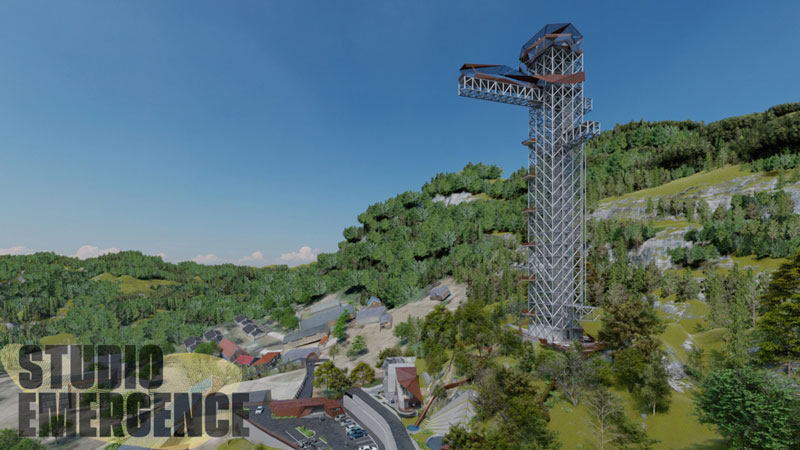
Himalayan Bungy, situated within Hikers Adventure Park, exceeded this benchmark with flying colors. Unveiled to the public in April, the tower perches atop a steep hill, offering sweeping vistas of the Ganges River. It showcases a 27-meter-long boom arm that extends over the sloping terrain below, imparting an illusion of additional height and resulting in a 107-meter drop.
However, erecting a stable structure on this terrain posed a formidable challenge. Abhay Gupta, the director at Skeleton Consultants, emphasized the intricacies involved in ensuring both architectural functionality and design safety. He remarked, “The biggest challenge was with the site conditions.”
The park’s location on rocky terrain in a seismic zone necessitated the creation of a structure capable of withstanding potent seismic forces. Furthermore, the site is prone to gusts of wind reaching speeds of up to 180 kilometers per hour.
Leveraging Bentley’s structural analysis software, Gupta’s team crafted a 3D model to assess the impact of these forces on a tower of such height. Subsequently, they opted for a lattice structure with strategic cross-bracings to optimize the design for windy conditions. Wire ropes were selected to brace the tower’s boom arm, mitigating the risk of torsion in the wind. To enhance stability and avert landslides on the hill where the tower stands, plans were devised for a retaining wall at the hill’s base and two stone masonry walls along the slope.
The software analysis underscored the necessity for a lighter structure to minimize drag, prompting a reduction in the tower’s overall weight by nearly 25%, thereby conserving five tons of steel in the process.
Battling the Elements
Gupta also navigated logistical challenges to transport large components to the park’s relatively remote location for assembly. Pieces constituting the tower were fabricated at a workshop approximately 40 kilometers away and had to be transported along narrow roads leading to the park. Consequently, Gupta tailored his design to accommodate smaller pieces, a decision lauded by Khushbu Davda, the founder of M/s Studio Emergence Mumbai. Davda commended Gupta’s adaptability, deeming it a creative and essential adjustment given the environmental constraints.
She remarked, “It was a matter of how it would be possible to build in an environment like that. And it was also time-sensitive—because when it rains, it pours in Rishikesh.”
Commencing in early 2022, construction of the tower faced a race against time to establish a secure foundation before the onset of the monsoon season in June, which posed the threat of landslides. Even prior to the rainy season, the project encountered arduous conditions. As the tower ascended in height, wind emerged as a growing impediment, heightening risks for the crew tasked with manually tightening each nut and bolt. To streamline the process and enhance safety, the team meticulously orchestrated the sequence for raising and assembling each component.
Despite a two-month delay in construction due to inclement weather, Gupta’s team offset the setback by leveraging innovative digital solutions during the design phase. By utilizing 3D visualization software to optimize the tower’s design before commencing construction, they saved approximately 200 hours of labor.
The Bungee Experience
While prioritizing structural integrity, the design also catered to ensuring a comfortable experience for jumpers, fostering a sense of security. Visitors access a ground-floor lobby and have the choice of ascending via stairs or an elevator to the tower’s primary platform, where bungee masters stand ready to assist jumpers. For spectators accompanying friends and family or for those who opt out of the 107-meter plunge, a viewing lounge is available.
Videos shared on Himalayan Bungy’s social media platforms capture the exhilaration of thrill-seekers who have checked off “India’s Tallest Bungy” from their bucket lists since the tower’s public debut in April. Whether confidently somersaulting off the platform, leaning backwards into the void, or hurtling with outstretched arms akin to flying squirrels, these adrenaline enthusiasts might be surprised to learn that the design and construction of the tower were deemed as audacious a feat as leaping from the platform itself.
Reflecting on the project, Gupta expressed, “Right from day one to the finishing day, it was an exciting experience.”
Image caption/courtesy: Skeleton Consultants saved about 200 hours of work by using 3D visualization software to optimize the tower’s design before beginning construction. Image courtesy of Skeleton Consultants.
Author: Jana Miller serves as the senior manager of product marketing for structural analysis at Bentley Systems. She is responsible for creating consistent messaging, content, and programs promoting software for Bentley’s structural analysis and design, pipe and vessel design and analysis, and offshore wind structural analysis and design offerings. She can be reached at jana.miller@bentley.com.
Bentley Systems has officially launched OpenRail Designer 2025, a major update designed to eliminate the manual bottlenecks that have long challenged rail engineers. By focusing on advanced automation, data integrity, and high-fidelity geospatial integration, this release transforms how complex rail networks—from routine maintenance to high-speed megaprojects—are designed and managed. As global demand for resilient infrastructure […]
As summer temperatures in northern Portugal consistently climb past 38°C, regional water utility Águas do Norte has successfully pivoted from reactive repairs to proactive management by leveraging Bentley Systems’ OpenFlows Water solution. Serving nearly 2 million residents across 63 municipalities, the utility faced recurring crises where extreme heat caused water tanks to hit critical lows, […]
Alabama Utilizes Bentley Tech to strengthen data-driven maintenance planning The Alabama Department of Transportation (ALDOT) is enhancing its long-standing performance-based budgeting model by integrating Blyncsy, an AI-powered solution from Bentley Systems. For more than 15 years, ALDOT has led the way in using data to drive financial decisions, but the manual collection of condition data […]
As extreme weather events continue to expose the vulnerabilities of an aging electrical grid, Bentley Systems is deploying advanced “digital twin” technology to transform how utilities prepare for disasters. By utilizing its Power Line Systems (PLS) software, Bentley can now predict exactly which poles and wires will fail under specific weather conditions, allowing for surgical, […]
Think a “variable speed” pump is a guaranteed money-saver? Think again. A recent analysis has revealed that a common engineering “shortcut” could actually be draining thousands of dollars from utility budgets every year. Junior engineers often fall for the “Pump Affinity Law”—a simple formula suggesting that if you slow a pump down by 20%, you […]
As Germany prepares for a historic US$500 billion investment in its national infrastructure, Bentley Systems has convened its second annual Tech Summit in the heart of Berlin. The event marks a strategic shift for the software giant, moving beyond simple product training toward a “community of technologists” dedicated to solving global infrastructure challenges. In a […]