Poor Building Safety Can Hamper Economic Growth
The deadly Rana Plaza factory collapse in Bangladesh in April last year that took over 1,100 lives has had an impact on Bangladesh’s economy. Buyers like Walt Disney have stopped production in the South Asian country over safety concerns and possible damage to their brands. Poor safety standards in several developing countries have many international companies looking anew at where they produce.
Cambodia is one of the developing world’s major apparel production centers and also has a poor track record on building safety. Should there be an accident on the scale of Rana Plaza, Cambodia could lose large amounts of foreign investment, a nightmare for the country as the textile industry is its major economic engine.
Following a ceiling collapse in a shoe factory in Cambodia in May 2013 plus several other factory building accidents that resulted in deaths and injuries, new concerns were raised about the adequacy of building and fire safety standards in Cambodia, particularly at the 800 garment factories employing over 600,000 workers nationwide.
David Myers, economic officer at the US Embassy in Cambodia, has warned that the poor safety standards of many buildings in the Kingdom can discourage foreign investment.
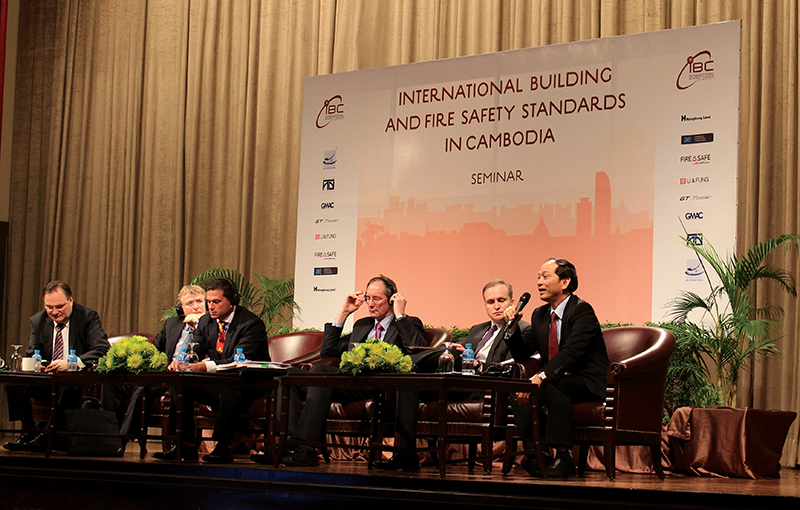
“Following the Rana Plaza tragedy, I have frequently been asked about Cambodian safety standards and the adequacy of enforcement,” he said at the International Building and Fire Safety Standards in Cambodia talk organized in March in Phnom Penh. “Potential investors want the security and stability that comes with adherence to these standards.”
He has asked the Cambodian government to consider building and fire safety standards and their enforcement not as a drag on the business sector, but as a net positive that will encourage and increase investment in Cambodia.
However, Myers also admits that the poor international building and fire safety standards in developing countries are also caused by the reluctance of larger clothing retailers, including some that source from Cambodia, to ensure a safe environment for workers, although they may spend US$1 billion annually on advertising.
Despite the amount of money these companies spend on developing and maintaining their brands, they are very fragile things, and Myers believes their reputations can be destroyed overnight when an incident occurs and news of it is spread via social media.
But after the catastrophe, companies are now very willing to pay a little more to protect their brands rather than risk the millions and possibly billions they invested in their reputations. Perhaps the most recent example was the letter signed by a number of major clothing brands expressing concerns about the labor situation in Cambodia.
Building standards in the Kingdom
There are no proper building safety standards in Cambodia at present. However, the government has enacted some safety regulations. Since building construction involves many sectors, the Ministry of Land Management, Urban Planning and Construction has taken care of general safety standards including the structural and electrical systems, while fire protection falls under Ministry of Interior’s National Police Commissariat. The construction environment is overseen by the Environment Ministry, and working condition regulation falls to the Ministry of Labor and Vocational Training.
All these regulations have formed a set of criteria that are taken into consideration when a project owner applies for a construction permit. But despite the regulations in place, there is still no clear enforcement mechanism.
Due to the absence of a building code, the government has allowed the use of foreign standards. But that concerns Martin Russell Croucher, director of sustainability and special projects for the Royal Institute of Chartered Surveyors (RICS), a UK professional body. He said during a visit to the Kingdom that some codes used here might not be appropriate for the local climate, geography and even building materials.
“It is compulsory that Cambodia have its own standard because those foreign standards may not fit well with Cambodian conditions,” he said.
It other developed countries there are checklists that ensure buildings are built conforming to safety standards. Croucher said that can be a good example for Cambodia.
He recommended having a reliable building inspection regime approved by the government to ensure investor confidence in the construction industry. “Soon Cambodia will have a construction law and building standards, but we need somebody that will check whether the projects have followed the standard or not,” he said.
Pen Sophal, secretary of state in the Ministry of Land Management, Urban Planning and Construction, admits there is poor enforcement of building standards . But he argues that the ministry is trying to promote building safety by strictly controlling the issuance of construction permits, especially with requests for a change of building function.
“Whenever there is a request to change a building’s function or to build extensions, there is a change in building load, and we are strict about that,” he said. “The factory ceiling collapse we saw was caused by a change of the building’s role.”
At present, applicants must respect various technical criteria in order to get a construction permit. In addition, the ministry has strengthened inspections during construction directly at the site. However, he admits implementation hasn’t been effective due to limited recourses and manpower. To fill the gap, the ministry has allowed private inspection services to get involved.
A public committee has also been established to monitor factory building safety standards by using existing technical regulations and certify qualified ones, responding a request by the Garment Manufacturers Association of Cambodia (GMAC).
The 600-member group was under pressure from buyers to increase monitoring.
Despite the pressure from buyers, Vann Sue Ieng, GMAC chairman, said he doesn’t worry too much about a factory’s structural safety since most factories in Cambodia are built on one floor, unlike in Bangladesh where factories are erected on multiple stories. “Factories in Cambodia have less risk regarding structural safety,” he said. “But this country has to focus on the fire safety in factories since there is no standard now.”
After the accident in Bangladesh, GMAC encouraged its members to engage with professional technicians to conduct thorough inspections of their buildings and provided a list of technical service providers to its members.
For fire safety prevention, the ILO’s Better Factories Cambodia project has been working to improve fire prevention in factories since 2008 by giving guidelines to employers, managers and workers with key information on the risks that fires pose in the workplace as well as information on fire prevention and control.
While there are efforts in place, large improvement won’t happen immediately. David Myers of the US embassy admits that raising building safety and fire standards in one country isn’t an overnight mission. The United States struggled for decades before its workers were able to enjoy the protections they have today.
The Rana Plaza disaster in Bangladesh has raised concerns about building safety in Cambodia
- Video Advertisement -
 English
  ខ្មែរ
ខ្មែរ