Solutions for Land and Housing Shortages

According to CBRE Cambodia, the supply of condominiums reached over 25,000 units in the market by the end of 2020 and is expected to jump to 38,000 units by 2021. Data from Knight Frank Cambodia also shows that by the end of 2019, a total of more than 55,000 housing units are available on the market, and another 22,000 are expected by 2022.

On the other side of the same coin, according to The Borgen Project, 10 million Cambodians do not have decent housing. Moreover, around 21.2% of Cambodians live in cities, and one in five of them live in the slums with a lack of access to basic services, according to Habitat for Humanity.

Why Cambodia is still facing a housing shortage issue though the housing supply keeps increasing? And how to mitigate that?

Like other major cities around the world, Phnom Penh is getting bigger in terms of population and land size. Phnom Penh has the highest population density among cities and towns within Cambodia, with approximately 2 million people residing in the city and this already crowded population is expected to increase to 3.5 million by 2030.

Unfortunately, the government to date has not attempted to tackle the rising concerns of the housing problem. On the other hand, due to lower profit margins amid high land prices, many developers have failed to embark on affordable housing developments.

There is an urgent need for the local authorities to launch urban renewal projects – aimed at redeveloping run-down areas of the inner city which exist in many different pockets of Phnom Penh, and thus increasing residents’ quality of life. As land is very limited, especially in the inner-city areas, building high-rise condominiums is the only solution to solve housing supply shortages.

Not all families and residents can afford a modern, luxury condominium unit in the city. For the majority of average or below-average income earners who require inexpensive but convenient housing, they also have the option to live in public housing that is transit accessible and provided by the government or the housing authority.

One of the challenges in providing affordable housing is the availability of land, if there are subsidies for land from the authorities, available land can be utilized to build affordable housing. This would make it more affordable for either private developers or the housing authority to construct low-cost housing.

Second, to subsidize the prices of building materials and manpower, and also embrace innovation in building materials and constructions, can help builders to develop better houses on limited budgets.

In addition, tax incentives from the government and supporting finance would be advantageous for the residents either renting or purchasing the units.

In the end, affordable housing is an issue of basic human dignity. As Phnom Penh continues to grow, the city must allocate land for affordable housing as part of the overall municipal development plans.

In addition, Phnom Penh must provide an adequate transit system from the existing city center to these newly-developed areas, or urban renewal spots. As soon as the authorities in Phnom Penh can reserve land to build affordable housing, the city population can keep growing without informal settlements or slums.

Therefore, the key is for city administrations to be proactive, and always plan ahead to make sure that land for affordable housing is sufficiently built.

- Video Advertisement -

Related Post

Julien Moutte: The Tech Leader Breaking Down Barriers to Build a Better World

Julien Moutte, the Chief Technology Officer of Bentley Systems, lives by a simple philosophy: removing barriers is the best way to move forward. Unlike many top executives, you won’t find him in a private corner office. Instead, he sits at a plain wooden desk in the middle of an open-plan floor, surrounded by his team […]

Cambodia Launches Institute of Automotive Technology and New Energy Industry

In a significant step towards bolstering innovation in the automotive sector, Cambodia officially inaugurated the Institute of Automotive Technology and New Energy Industry, led by HE Hem Vandy, Minister of Industry, Science, Technology, and Innovation. During the launch event, Minister Vandy highlighted that the institute aims to equip individuals with essential skills, foster industrial innovation, […]

Nobel Prize Winner in Physics Plans to Establish Laboratory in Cambodia to Empower Youth

In a groundbreaking announcement, Professor Sir Konstantin (Kostya) S. Novoselov FRS, an esteemed Nobel Prize winner in physics, has unveiled his ambition to set up a state-of-the-art laboratory in Cambodia. This initiative aims to nurture and expand the skills of Cambodian youth in the fields of science and technology. During a pivotal discussion with Samdech […]

Cambodia and China Join Forces to Enhance Vocational Training Standards

In a significant move to elevate vocational training standards, Cambodia and China have announced the joint establishment of a Vocational Development and Skills Enhancement Center. The initiative was formalized through a Memorandum of Understanding (MoU) signed between the Ministry of Labor and Vocational Training of Cambodia and the Education Development Foundation of Anhui Province, China. […]
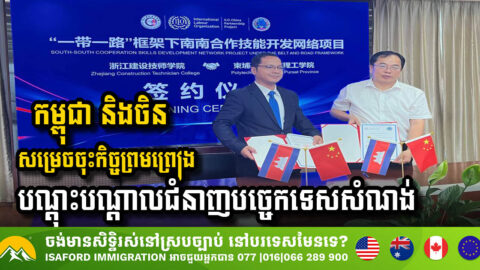
Cambodia and China Sign Skills Training Pact to Enhance Workforce Readiness

Cambodia and China celebrated a significant milestone in skills development with the signing of a Memorandum of Understanding (MoU) between Zhejiang Construction Technician College (ZCTC) and Cambodia’s Polytechnic Institute of Pursat Province (PIPP) in Zhejiang. This agreement aims to bolster Cambodia’s technical and vocational education and training (TVET) system to meet the demands of emerging […]

Yalong Partners with the Cambodian Ministry of Labor to Enhance Technical Education

In a significant move to elevate technical and vocational education in Cambodia, Yalong Intelligent Equipment Group Co., Ltd has officially signed a memorandum of understanding with the Ministry of Labor and Vocational Training. The agreement aims to foster international learning exchanges and collaborative efforts geared towards improving the quality of training in this vital sector. […]