DOUBLING UP: UPGRADES INCREASE AIRPORT CAPACITY
The double-digit growth in air passenger traffic in Cambodia has led to an upgrading of the nation’s current international airports.
To absorb ever-increasing passenger numbers, new and enhanced facilities at Phnom Penh International Airport (PPIA) and Siem Reap International Airport (REP) were inaugurated in mid-March after plans were first initiated in 2011.
With an expansion plan already in place since construction in 2004, upgrading Siem Reap airport has been relatively straightforward with some new facilities already open between check-in and boarding. With the airport’s new international arrivals terminal opening in June 2014, work on the apron extension started in 2015 and opened for use this year and is now able to accommodate three additional aircraft. However, no aircraft-terminal walkways have yet been installed in Siem Reap to conserve its unique architecture.
At Phnom Penh International Airport, construction was more complicated because the terminal building is quite old, even though extending it was part of the initial design. Following the approval of the new design, construction started in June 2014 and was completed in February 2016.
The new developments at Phnom Penh involve an extension wing which increases the terminal size, new registering systems, an additional 32 immigration booths as well as renovating existing facilities including car parks. Other new equipment includes the latest luggage transferring system, scanning machines for luggage, wi-fi coverage, new restaurants, shops, duty-free space and a business lounge.
Brand-new waste water treatment plants have also been installed at both airports. With these new facilities, the two airports have a combined capacity of 10 million passengers annually, up from 4 million.
Cambodia Airports, the concessionaire which develops and operates the Kingdom’s airports, invested around $100 million on the terminal extension projects. Cambodia Airports is a joint venture between France’s VINCI Airports (70%) and Malaysia’s Muhibbah Group (30%) and has held the 45 year concession for Phnom Penh since 1995; Siem Reap since 2001, and Sihanoukville since 2006.
Both expansion projects were jointly built by Vinci Construction Grands Projets (VCGP) and Muhibbah. Hamiltons International was the architectural consultant for Phnom Penh and Archetype won the bid for Siem Reap. The projects also used Building Information Modelling (BIM) technology to improve safety performance and construction schedule compliance.
The architecture of the Phnom Penh airport is a fairly classical example of modern capital city design, but Siem Reap airport, near the UNESCO World Heritage site of the Angkor temples, takes direct inspiration from Cambodian tradition.
Mr. Xavier Huillard, VINCI chairman said the expanded terminals at Phnom Penh and Siem Reap were the result of good cooperation between the public and private sectors and would benefit the government and the country economically.
“The number of travellers through both airports has drastically increased since 2009, especially between 2010 and 2013, with a surge of more than 15 percent. Both airports have welcomed more than 3 million foreign tourists,” he said, adding that, “With the expanded terminals we will welcome 5 million travellers annually.”
If there is proper management, Mr. Huillard predicts Phnom Penh airport could handle between 8-10 million passengers and Siem Reap 6 million, while Sihanoukville airport could receive more than 12 million per year.
The number of air passengers crossing Cambodia’s airport increased 10-fold from 1995 to 2015 from 600,000 to 6.5 million passengers. Phnom Penh alone handled 4.7 million.
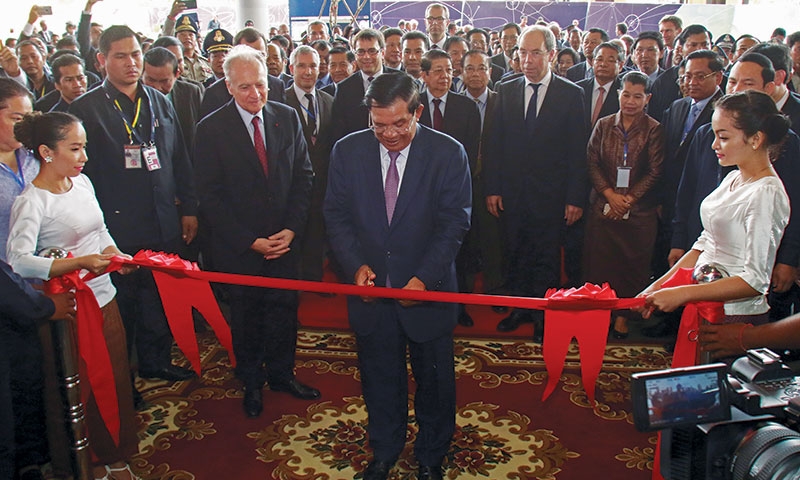
39 airlines, including charter flights, arrive at the three international airports daily, the State Secretariat for Civil Aviation (SSCA) spokesman Sin Chanserey Vutha, told the Khmer Times in March. “Passengers travelling to Cambodia have increased by about 6 to 7 percent per year and this new terminal extension will help reduce congestion,” he said. Speaking at the terminal inauguration in Phnom Penh on 16 March 2016, Prime Minister Hun Sen expressed pride that PPIA can handle heavy flights such as U.S. President Barack Obama’s Air Force One when Cambodia chaired ASEAN in 2012 and the recent big flight that brought in the U.S. Secretary of State John Kerry. “Were there safety concerns, no leader of any country would use a big airplane and land at PPIA,” the prime minister said.
Despite conceding that he had made a mistake by not setting aside more land around the Phnom Penh airport for more runway extensions, the prime minister announced no plans to expand it further, due to the impact on surrounding communities.
“At that time, this area had less people living there, but we have let people live there until now. But now, if we dare to expand it, there will be demonstrations,” he said. “Therefore, let’s keep the status quo.”
New aviation developments
The upgrades to the nation’s aviation infrastructure have been guided by a long-term master plan which maps a transport infrastructure vision for the next 30-40 years. These plans include increasing the capacity of the Sihanoukville coastal airport. Expansion and renovation works began at Sihanoukville airport in 2015 to ensure it can accommodate medium-sized regional commercial planes, provide enough passenger facilities, and also be connected to the EdC national electricity grid.
By 2020, PNH and REP are expected to receive around 7.3 million passengers, roughly 3.5 million for each airport, with 200,000 passengers predicted through Sihanoukville.
To help ease the burden on the three international airports, the government and Cambodia Airports, with help from the International Air Transport Association (IATA), have been studying the feasibility of reopening some domestic airports.
The study aims to create a long-term vision of Cambodia’s airport infrastructure that will link to other transport infrastructure developments in the country and also connect Cambodia to the rest of the world.
IATA recommended Ratanakiri, Kong Kong and Preah Vihear provinces as prospective areas for either reopening or developing airports’ due to tourism potential.
Cambodia doesn’t need to build another new international airport near the capital according to IATA, asserting that the size of the current Phnom Penh airport will be able to handle traffic until almost 2035 or 2040.
ASEAN aviation integration
In parallel with other integration policies, the ASEAN Single Aviation Market (ASEAN-SAM) has aimed to develop a unified and single aviation market in Southeast Asia by 2015, allowing air carriers registered in any ASEAN country to freely fly without limitation within the region of 600 million residents.
ASAM is a complex process comprising seven ‘air freedoms’ for airlines travelling across the region. The most important aspect of liberalising aviation markets is the guarantee of the third, fourth, fifth, and seventh freedoms of the air.
Fifth freedom rights, which were discussed and agreed on by most member states in the 2015 round of negotiations, is the right to fly beyond the second country to a third country with the right to sell tickets in the second country. Seventh freedom rights, i.e. the right to fly between two foreign countries while not offering flights to an airline’s home country is still in the process of negotiation with implementation likely still distant.
ASAM represents an opportunity for Cambodia, rather than a thread, Sin Chansereyvutha, spokesman for Cambodia’s State Secretariat for Civil Aviation (SSCA) told the Cambodian Business Review Magazine after attending the ASAM conference.
“The integration of Cambodia’s aviation industry into the region is profitable because we can expand our market and increase competition that will benefit customers and the nation’s long-term economic growth,” he said.
- Video Advertisement -


 English
  ខ្មែរ
ខ្មែរ