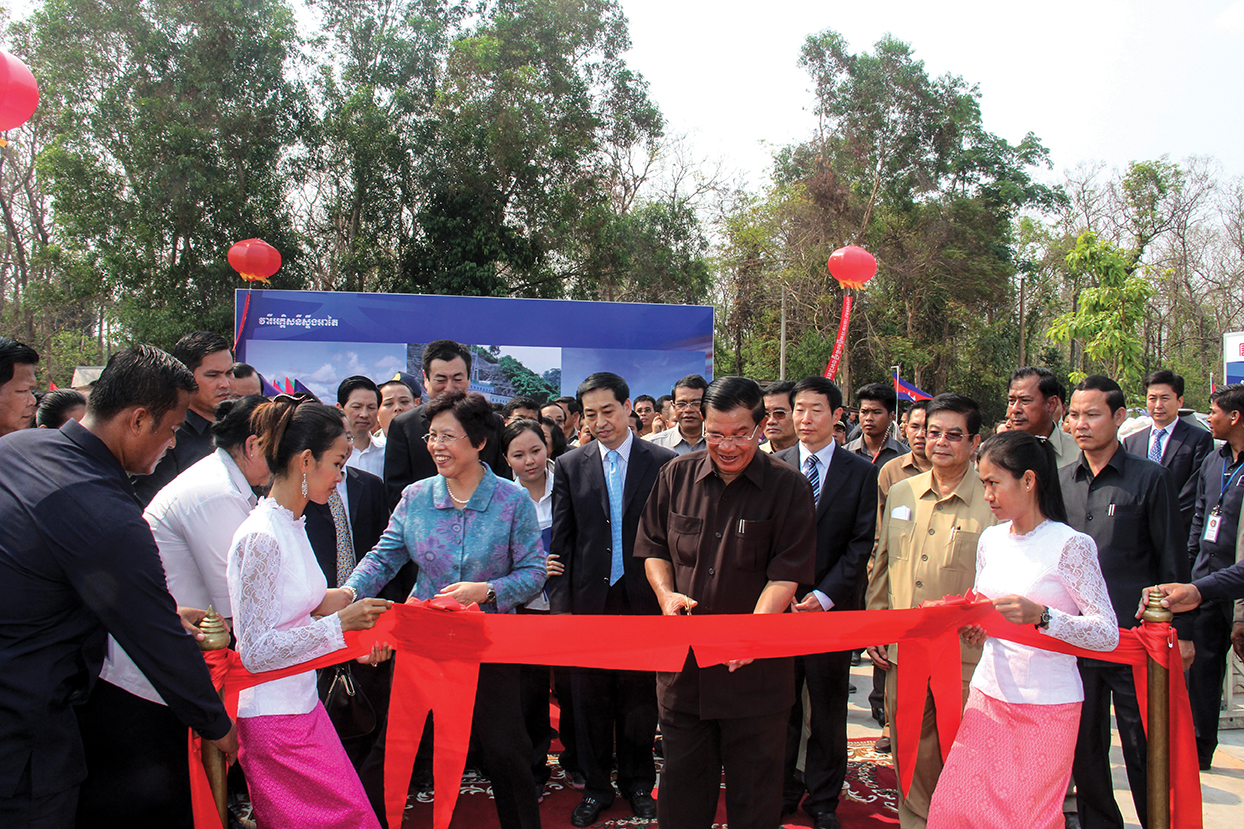
Atai Dam Begins Operation

After five years of construction, the Atai hydroelectric dam went fully online in April. Able to generate 120-megawatts of electricity, officials say they hope it will aid in boosting the local economy.

Built on the Atai River in a remote region of Pursat province, some 340 kilometers west of Phnom Penh, the hydropower dam cost a total of almost US$370 million. Of that, US$255 million was spent on the power plant itself and another US$113 million went to the construction of transmission lines and substations connecting Pursat to Phnom Penh across Kampong Chhnang and Battambang provinces.

While the power generator has been operating since June last year, the transmission facilities were only recently completed.

The project was developed by Cambodia Hydropower Development Co. Ltd., a subsidiary of China Datang Corporation – a Chinese state-owned enterprise and one of the world’s 500 biggest companies. Financing came from the China Development Bank.

Construction began in 2008 and was completed last year under a 34-year concessional build-operate-transfer (BOT) contract with the Cambodian government.

Prime Minister Hun Sen has said the Atai hydropower dam will contribute to the country’s economic growth, particularly aiding competitiveness and the planned ASEAN economic integration set for 2015.

“The investment in such a megaproject illustrates the confidence investors have in Cambodia’s political stability,” he said at the inauguration event on March 27.

Wang Yeping, China Datang’s vice-chairman, said the hydropower plant can generate around 464 million kilowatt hours of electricity a year and will contribute to reducing power shortages in Cambodia, still a serious problem.

“The Atai dam will increase the capacity of the power supply and reduce the country’s reliance on electricity generated by diesel fuel,” he said. “It will significantly contribute to developing the local economy and reducing poverty.”

The project will reduce electricity costs for the people of Pursat province. Electricity rates there will drop from US$0.3 per kilowatt hour to US$0.29 per kilowatt hour starting in June.

China is the largest investor in hydropower development in Cambodia. According to the Ministry of Industry, Mines and Energy, Chinese companies have invested over US$1.6 billion in six dam projects in Cambodia with a total capacity of 928 megawatts.

So far, five Chinese-backed dams have begun operation, and the 246-megawatt Tatai hydropower dam is set for completion next year.

In addition, a series of new plants is planned, mostly backed by Vietnamese in addition to Chinese companies.

The potential for hydropower development in Cambodia is significant, and is only beginning to be explored, advocates say. Twenty-nine locations have been identified that have a generating potential of over 10 megawatts. They are at different stages of development.

However, they are not without controversy. A big issue is the mitigation of the social and environmental impacts of large dams, especially on the Mekong and its tributaries. Environmentalists are concerned about the dams’ effects on fish migration patterns and there are fears that they could negatively affect the livelihoods and traditional ways of life of downstream communities.

In addition, for hydropower to benefit the entire country, the nation’s electricity grid will have to be expanded. Right now, no national energy grid exists. The Kingdom has ambitious plans to build a 2,100 km electricity grid (made up of 230kV and 115kV transfer lines) with connections between existing grid systems in Phnom Penh and the surroundings and further connections to planned power plants as well as cross-border lines to Laos by 2027.

CPP lawmaker Cheam Yeap said in April that the government has signed 13 payment guarantees to companies constructing coal-fired power plants and hydropower dams in the country. However, an Asian Development Bank (ADB) official has called it a risky strategy for the country’s fiscal future.

Oliver Hensengerth, a lecturer at Northumbria University in the UK and an expert in Chinese hydropower investments in Southeast Asia, told the Phnom Penh Post that Cambodia’s blanket guarantees to private firms contracted to build dams could be a danger to the country’s debt sustainability.

“There seems to be a sense of catering to the needs of companies first, then paying attention to the potential implications of the investment,” Hensengerth said.

The Cambodia Power Report 2011 said the country’s power consumption is forecast to rise from 1.4 terawatt hours in 2010 to 3.4 terawatt hours by the end of 2020, an average annual growth rate of 9.4 percent.

According to the available electricity demand forecast in Cambodia prepared by the Ministry of Industry, Mines and Energy in 2007, which was based on demand forecasts by the World Bank and KEPCO, the electricity demand projection in Cambodia for 2024 is 3,045.33 megawatts and 16,244.61 gigawatt hours for capacity and electricity respectively.

- Video Advertisement -

Related Post

Bentley Systems Highlights AI-Powered Digital Twins to Improve Infrastructure Data Management

At the Cesium Developer Conference, Bentley Systems showcased how its Cesium platform, iTwin technology, and new AI tools can help solve a major infrastructure challenge: keeping project data connected throughout an asset’s entire lifecycle. Industry experts noted that valuable information created during design is often lost when projects move from planning to construction and maintenance. […]

Japanese Family Donates Three Hectares to Create Phnom Penh’s Newest Public Park

In an inspiring gesture of international goodwill and community spirit, a Japanese family has gifted more than three hectares of valuable urban land to the Phnom Penh Capital Administration to establish a vibrant new public park. Situated in Prey Lvea village within the Choam Chao II commune of Por Sen Chey district, the prime parcel […]

Cambodia and the United States Unite to Pioneer Green Transportation Systems

Cambodia’s transition toward a green and eco-friendly economy has taken a significant leap forward through a dynamic international partnership designed to revolutionize the national transportation sector. On July 12, 2026, Cambodian enterprise GenRich Investment and United States firm Graphion Energy Solutions officially signed a historic Memorandum of Understanding. This strategic agreement aims to jointly drive […]

Sabesp Transforms Water Infrastructure Through Digital Twin Technology

Sabesp, one of the world’s largest water and waste management companies, is revolutionizing how it serves 30 million residents in São Paulo, Brazil, by shifting from reactive, manual processes to a proactive, data-driven framework called INTEGRA 4.0. To achieve universal water and sanitation access, the utility partnered with Bentley Systems to break down data silos […]

Two Key Ministries Partner for a Five Million Dollar Solar Street Lighting Initiative

A landmark collaboration between the Ministry of Public Works and Transport and the Ministry of Mines and Energy is set to bring modern, eco-friendly solar illumination to roads across thirteen provinces within two years Cambodia is taking a major step toward a safer, greener, and more sustainable future through a progressive national infrastructure initiative. On […]

CHINALCO Explores Steel Production and Mineral Extraction Opportunities in Cambodia

Cambodia is continuing to position itself as a prime destination for heavy industrial transformation and resource development across Southeast Asia. On July 15, 2026, state-owned Chinese industrial giant Aluminum Corporation of China, widely known as CHINALCO, officially announced that it has been conducting comprehensive feasibility studies on steel manufacturing and mineral resources in Cambodia to […]