Bentley’s New AI-Enabled Open Applications Deliver 10x Faster Project Completion

New OpenSite+, Substation+ use AI, automation, and collaboration to speed work as demand strains engineering capacity.

Demand for new infrastructures is growing faster than engineers can design and build them. By 2030, nearly 60% of the world’s population will live in urban areas, placing immense pressure on already-strained resources.

Bentley Systems has introduced a couple of Open Applications that are purpose-built to address this engineering capacity gap.

Tools like OpenSite+ and OpenUtilities Substation+ are now equipped with intelligence (AI) to help with engineering workflows from the start.

Traditional CAD-based workflows rely on manual, time-consuming processes, particularly in drawing production. This is where AI is transformative, according to Ian Rosam, product management director for Bentley’s civil engineering applications.

Rather than treating artificial intelligence as an add-on, Bentley has embedded large language models (LLMs) trained on engineering-specific knowledge, like building codes and environmental rules. The result is a fundamental mindset shift in how engineers work.

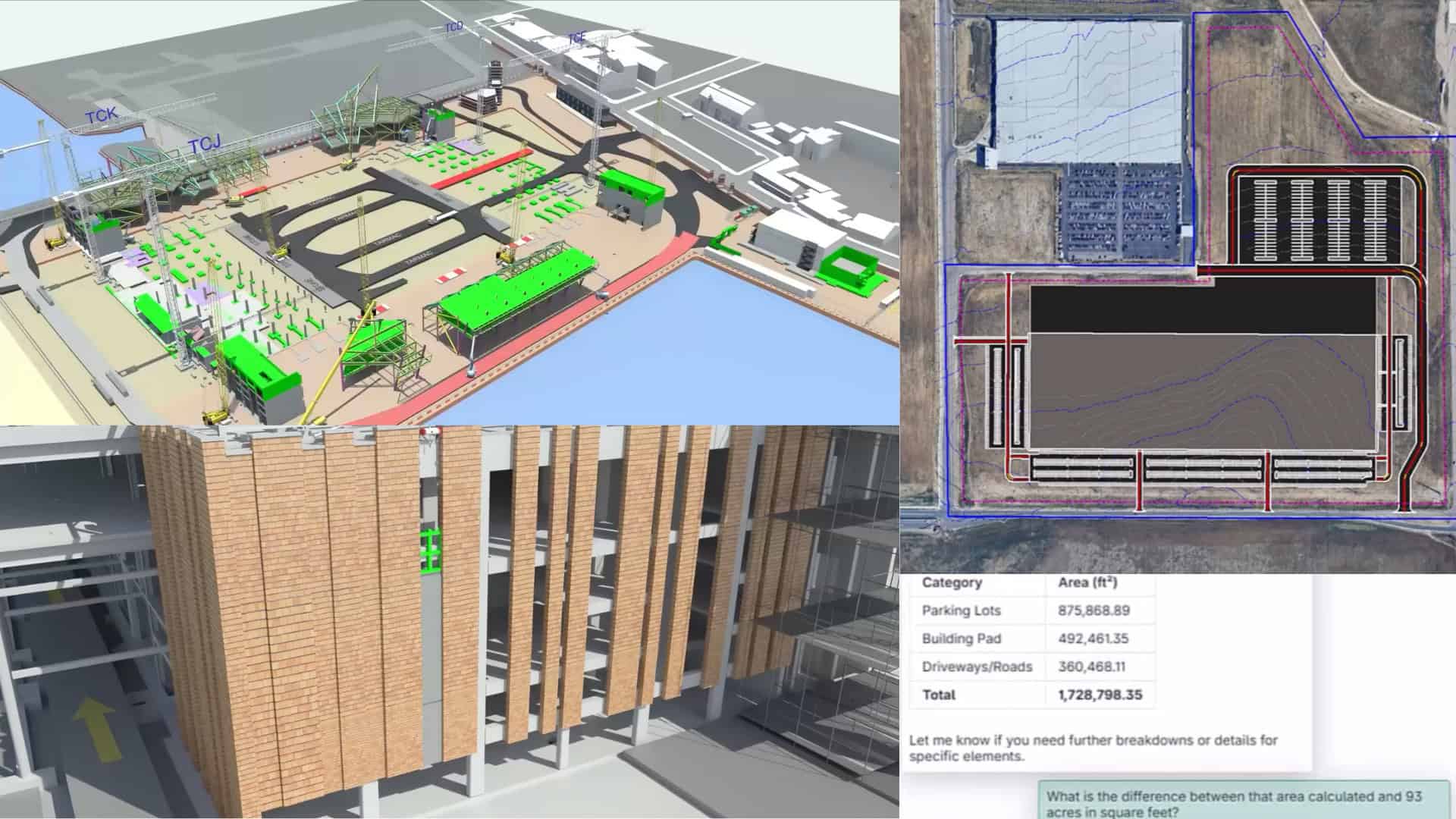
For example, in software like OpenSite+, an engineer can now use natural language prompts—typed or spoken—to execute complex calculations that the AI contextually understands. They don’t have to type in complicated code or formulas. (read more)

OpenSite+, the first in this next-generation lineup, enables site engineers to work dramatically faster by automating tedious tasks. The software delivers projects up to 10 times faster without sacrificing accuracy. It’s an all-in-one solution: data-centric, digital twin-native, and AI-powered, with integrated drainage design and automated drawing production.

Another new product with an AI feature is OpenUtilities Substation+. It uses intelligent 3D modeling, AI-enabled design assistance, and collaborative workflows to ensure aging infrastructure can meet today’s demands.

Bentley is also bringing these AI capabilities to existing infrastructure engineering applications, starting with OpenRoads Designer and OpenRail Designer for modeling road and rail projects.

Bentley Copilot has also been added to these applications, while a new AI tool automatically organizes labels on complex drawings with a single click, eliminating overlapping text and making drawings easier to read—saving significant time during the review and revision process.

Bentley’s solution also employs machine learning to automatically optimize label placement, leader line length, text rotation, and spacing. AI-powered automation takes the tedium out of producing drawings while maintaining the consistency and quality that contractors and regulators require.

What makes infrastructure AI different from consumer applications? Specifically, “infrastructure context”—the layered understanding of design intent, environmental constraints, historical data, and engineering logic that transforms AI into an engineer’s assistant.

Furthermore, Bentley also safeguards its software users’ intellectual property. Users can choose to contribute data for AI training that benefits the broader user community, but Bentley doesn’t use their data without permission.

Collage shows 3D site plans, an aerial view with outlined zones, and a table listing area calculations for parking, building, and driveways—ideal for Bentley or AI-enabled applications.
- Video Advertisement -

Related Post

Infrastructure Leaders Overcome Data Silos with Unified Reality Modeling

Infrastructure organizations are increasingly turning to Bentley Systems’ iTwin Capture suite to transform disjointed data into powerful, intelligent digital twins. Previously, project teams struggled with “data silos,” where incompatible formats from lidar, photogrammetry, and geospatial sensors remained isolated, preventing comprehensive site analysis. This manual, disconnected approach often led to slow, costly processes that hindered real-time […]

Bentley Systems Declares Q2 2026 Dividend Amidst Wave of AI-Driven Infrastructure Innovation

Bentley Systems, a global leader in infrastructure engineering software, has recently declared a cash dividend of $0.07 per share for the second quarter of 2026. This financial milestone comes during a period of significant momentum for the company, as Bentley accelerates its efforts to modernize the global infrastructure landscape through advancements in Artificial Intelligence (AI) […]

Future of Construction Symposium Spotlights Digital Innovation in Infrastructure

The recent Future of Construction symposium at ETH Zurich, sponsored by Bentley Systems, highlighted how cutting-edge digital tools are fundamentally transforming the design and construction landscape. The event brought together industry leaders and academics to explore the integration of robotics and artificial intelligence in building complex, modern infrastructure. Bentley Systems played a central role in […]

Construction Industry Leaders Converge in Berlin to Address Looming Infrastructure Data Crisis

Industry analysts from Verdantix report that the infrastructure sector is facing a potential €12 trillion investment gap by 2040, driven largely by fragmented information that is often lost or siloed during project handovers. The warning is concluded at the Bentley Systems Illuminate 2026 conference where infrastructure experts gathered to address potential crisis within the industry. […]

How AI Is Rewiring the Way Engineers Design Infrastructure

Bentley Systems is integrating advanced AI technologies directly into its professional engineering software, aiming at transforming the way civil and structural engineers approach infrastructure design by automating repetitive tasks and streamlining complex workflows. This technological evolution centers on two primary approaches: helping engineers use AI coding tools to automate manual processes and deploying new AI […]

Infrastructure Leaders Call for Better Data Foundations to Unlock AI Potential

Industry leaders has emphasized that modernizing infrastructure requires moving beyond one-time data collection toward integrated, operational intelligence that can guide decision-making throughout a project’s entire lifecycle. The note was shared at the recent Transforming Infrastructure Performance (TIP) NYC Summit 2026, where infrastructure experts, investors, and public officials gathered to address a critical bottleneck in U.S. […]