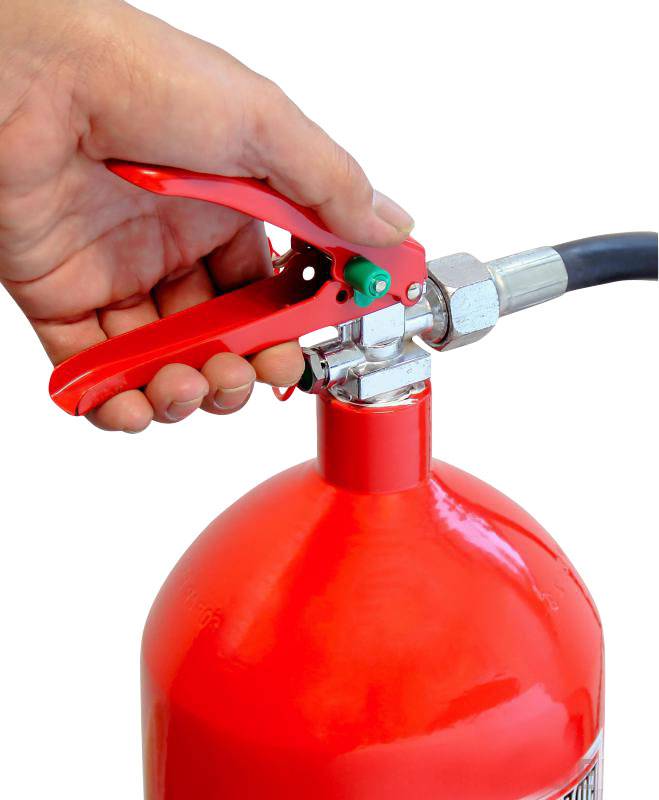
Choosing the Best Fire Extinguishers

Last issue, I talked about the need for standards that are specific to the risks faced in Cambodia, and not just trying to adapt someone else’s standards. In a similar way, you need to look at your specific risks when selecting the best fire extinguisher for your needs.

Fire extinguishers come in many different types, sizes, and standards of quality, all of which need to be taken into account when selecting the best extinguisher for your needs.

Fire extinguishers act in a number of different ways to extinguisher a fire; some cool, some smother or take the oxygen away, and some break the chemical chain reaction that allows combustion to occur. By selecting the wrong type of fire extinguisher you may not only be ineffective, but potentially dangerous to those who use it.

Fire types can be broken into classes of fire as follows;

• A Class – Carbon-based products – Wood, Paper, Plastic, Textile

• B Class – Flammable Liquids – Petrol, Diesel, Paints

• C Class – Flammable Gases – LPG

• D Class – Flammable Metals – Magnesium, Aluminium

• E Class – Electrically charged materials

• F Class – Cooking Oils and Fats

The most common type of fire extinguisher found in Cambodia is the Dry Chemical Powder type. This type of extinguisher comes in 2 main versions ABC and BC, with the most common one being the BC due to it being a couple of dollars cheaper. The BC extinguisher is very effective on fuel and gas fires as this is what it is designed for; however they are not very effective on common fires which are generally A Class. The ABC type dry chemical powder fire extinguisher is the most effective all round fire extinguisher for general purpose use.

Fire extinguishers also come in many sizes from 1kg through to 50kg. Where bigger extinguishers give you more chance of extinguishing the fire, you also need to look at the ability to handle the extinguisher. Larger wheeled-type fire extinguishers are good for specific risks such as a generator, but would not be suited to an office corridor. The most common size of extinguisher used here is 8kg or 9kg however these can appear heavy and intimidating to potential users in an emergency situation when they are needed, leading to people not trying to extinguish the fire. I generally recommend the use of 4kg or 4.5kg ABC dry chemical powder extinguishers as they are sufficient for most small fire and very easy to handle.

The quality of the extinguisher you purchase is also important, even though some of the cheaper extinguishers meet a standard, they have a very limited lifespan, and may end up costing more money to regularly replace them. Having a fire extinguisher that doesn’t work when you need it the most is not really an acceptable risk, so looking at better quality products is definitely recommended.

Maintaining your fire extinguishers is also important to ensure they are in good working condition in the event of a fire. By mounting fire extinguishers on the wall, you ensure that they are not sitting in water and rusting, or being kicked over and damaged. Regular inspections to ensure that the extinguisher is in good working order is also essential.

Lastly, ensuring that your fire extinguisher is clearly identifiable is important to ensure it can be found quickly in the event of fire. Storing fire extinguishers in cupboard or behind furniture lead to people forgetting about them and making them difficult to find when you need them in a hurry. Clear signage is recommended in all commercial installations to ensure the fire extinguishers can be identified from any place in a room.

Please feel free to contact me if you have any queries on fire safety, or have any topics you would like me to write about in future editions. Paul Hurford: paul@azisafe.com.

- Video Advertisement -

Related Post

AI-Powered Software Tackles Civil Engineering Talent Shortage

Civil engineering firms are facing a critical labor shortage, with millions of infrastructure workers needing replacement over the coming decade. To combat this, leading engineering firm Stantec has adopted Bentley Systems’ OpenSite+, an AI-powered design solution designed to automate the most time-consuming and complex aspects of site development. Site grading—the intricate process of sculpting terrain […]

Airport Operator SCA Plans Expansion into Cambodia’s Logistics Sector and Supply Chain Connectivity

Newly appointed CEO Julien Bert meets with investment officials to discuss Sihanoukville airport development and supply chain integration as Cambodia strengthens investor confidence Société Concessionnaire de l’Aéroport (SCA), Cambodia’s long-standing airport operator, is seeking to expand its investment footprint into the Kingdom’s logistics sector to support sustainable economic growth and strengthen regional supply chain connectivity. […]

Bentley Systems Advances Data-Driven Engineering with MicroStation and iModels

Bentley Systems is helping engineering teams modernize project delivery by shifting from traditional file-based workflows to a data-driven approach using MicroStation and iModels. Engineers can continue working in familiar CAD software such as MicroStation, AutoCAD, and Revit while keeping standard file formats like DWG, DGN, and RVT. Instead of exchanging files by email, project data […]

Cambodia’s $3 Billion Aircraft Deal Marks a New Era in US-Cambodia Aviation Cooperation

Strategic investments, a landmark $3.2 billion Boeing fleet acquisition, and regional logistics plans mark a major leap forward in bilateral trade and infrastructure development… Phnom Penh, Cambodia – The aviation relationship between the United States and Cambodia continues to reach new operational milestones, driven by massive capital investments, commercial aircraft agreements, and expansive infrastructure developments […]

Bentley AssetWise Helps Highways England Cut Road Closures and Improve Traffic Flow

Highways England has transformed the way it manages England’s Strategic Road Network by using Bentley Systems’ AssetWise platform to power its cloud-based Network Occupancy Management System (NOMS). The software gives engineers and asset managers a real-time view of road closures, maintenance activities, and infrastructure assets on a single digital map, making it easier to plan […]

Cambodia and Malaysia Forge Stronger Ties in Logistics, Renewable Energy, and Agriculture

Outcomes from the 3rd Joint Commission for Bilateral Cooperation highlight expanded trade initiatives, cross-border energy integration, and diversified agricultural exchanges Cambodia and Malaysia have reaffirmed their commitment to deepening bilateral economic ties by expanding strategic cooperation across several high-growth sectors, with a strong emphasis on logistics, renewable energy, and agricultural trade. According to an official […]