Construction Safety: Minimizing the Hazards
Despite the building boom in Cambodia, very few construction workers and some project supervisors pay much attention to the risks they can face on construction sites.
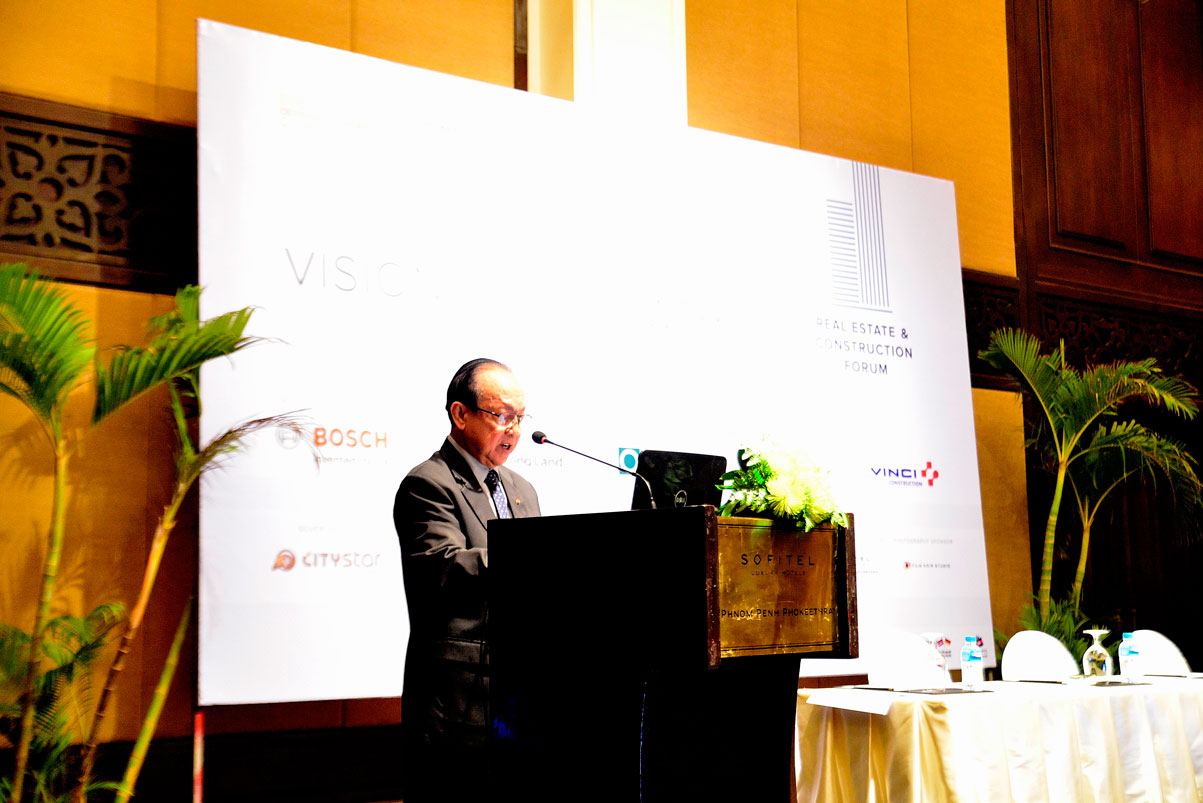
A construction and real estate forum launched in early October 2014 revealed some of the major risks at Cambodia’s construction sites. It was also touted as a concerted effort to improve dialogue between industry and the government over planning policy, regulation, and construction safety standards.
Speaking at the “Real Estate and Construction Forum” hosted by the European Chamber of Commerce in Cambodia (EuroCham-Cambodia), Nasir Milki, Quality and Environmental Manager of French-based VINCI that constructed the kingdom’s three international airports, raised five main safety issues relevant to Cambodia.
Firstly, he raised the hazards of work in and around excavations, alerting builders to never underestimating the risks involved in working on excavations. Secondly, noise at work can lead to the loss of workers’ hearing. “Hearing loss is preventable, but once your hearing has gone, it won’t come back,” he said.
Thirdly, excessive vibration caused by power tools can lead to hand-arm vibration syndrome. Mr Milki’s advice was to, “Reduce your finger vibration now to save your hands forever.”
Mentioning fire safety and working at height as the last two hot issues for Cambodia, Milki believes that most fires are preventable if the contractor implements a fire risk assessment at the design stage. He also said if the right safety procedures and support are not in place, workers are at greater risk of injury, or even death, when working at height.
Having mentioned these hazards, Nasir Milki said VINCI has applied all relevant safety laws and regulations from the UK and Cambodia. “Contractors should consider that safety during design offers the most pay-off. To ensure safety at work, builders should consider controlling hazards, managing emergencies, know the law, and conduct risk assessments, and accident investigation,” he suggested.
Despite the fact that no serious accidents involving lifts or escalators have yet been reported in Cambodia, Denis Astgen, Managing Director of Comin Khmere said that, ‘’Although, there are no mandatory regulations for Cambodian lift owners to follow safety standards, installation safety and proper maintenance should remain a main focus for owners.’’ Phnom Penh alone has 386 buildings higher than five floors with higher rise buildings being erecting nationwide. “Better and stricter norms and standards would mean more safety for the public but also more efficient traffic flow in buildings and longer life duration for the equipment.” he added.
Since 2007, Comin Khmere has been the exclusive distributor and service provider of KONE Elevators and Escalators, from Finland, which are manufactured, installed, and maintained in compliance with European standards EN-81.
“We wish to advocate some changes so Cambodia moves up towards better practices when it comes to lifts,” he said, adding that, “Therefore, we commit to the safety of our customers despite cost constraints. Some of our competitors do not bear such costs as their lifts do not hold any safety devices and do not comply with any sorts of safety standards.”
In some countries (e.g. Myanmar, NZ), all elevators are registered by government services which conduct annual risk assessments on the installation resulting in the issuance of an operating certificate for each elevator.
“The lack of regulations in Cambodia on lift maintenance enables lift owners to put passengers at risk just to save small costs,” he said expressing his disappointment in not having seen such a practice yet implemented in Cambodia.
Micheal Cassagnes, Architectural Design Director for Archetype, which uses advanced building codes and architectural designs, stressed the need to insure for fire safety at a structure’s design stage to comply with the standard fire safety code.
After the fire incident at Siem Reap’s night market in December 2012 that caused 8 deaths and US$1 million worth of damage was identified as being caused by an electrical fault, he blamed the death toll on no safe evacuation route, uncontrollable fire, and no access to the fire-brigade.
Christophe Bourdon, Vice Chairman of EuroCham’s Real Estate and Construction Committee (RECC), urged the government and pertinent professionals to adopt adequate safety procedures on construction sites and inside finished projects in the absence of any overarching authority within Cambodia.
“In terms of investment, it is also a matter of protection – protecting your properties and the reputation of investors as well as the reputation of Cambodia and its construction industries,” Bourdon said.
Bourdon called for basic measures such as construction helmets, work boots, and harnesses on construction sites, and compulsory fire detection devices, evacuation plans, and the use of firefighting devices in the country’s increasingly numerous high-rise buildings.
While Bourdon raised the lack of training, lack of awareness from workers themselves, a general weakness in the enforcement of the rules, and the contractors’ irresponsibility as the factors behind the casualties and deaths, Simon Griffiths, Senior Manager at CBRE Cambodia stressed the need for a standardized code of measurements for surveyors, standardized valuation practices, real estate agency licensing to strengthening condominium laws, land titling, and building and safety codes.
The Government’s Interventions
H.E. Im Chhun Lim, Minister of Land Management Urban Planning and Construction acknowledged at the forum that the government admits the need for an improvement in the construction industry prior to regional integration. Most especially for high-rise buildings to be correctly built in accordance with the laws and regulations, and with the use of highest forms of technology and standards in order to ensure safety, efficiency, and protection of the environment.
“So far we have appropriate policies, laws, and regulations and there are good projects developed with international investment companies. However, we still face some challenges, in particular the use of different standards by different nations. There is also a lack of studies on weather factors, earthquakes, construction materials, etc,” he said, noting that the ministry has been in close contact with international partners to improve the industry.
Dr. Huy Nara, Director General of the Ministry’s Construction General department added that the Cambodian construction sector does need certain building standards, since presently investors are using varied standards such as British Standards (BS), Euro Code, French Standards, American Concrete Institute (ACI), Uniform Building Code, International Building Code, and other similar standards/codes from Japan, Thailand, Hong Kong, Korea, Singapore, and Australia.
“Those varied standards have partially provided positive application guidelines which have been used until now. Investors have confidently used those varied standards without any major problem, but some standards have not complied with local conditions because they have not fully considered all aspects such as local weather, building materials, seismic issues etc,” he worried.
Agreeing with Dr. Nara, Martin Russell Croucher, Director of Sustainability and Special Projects for the Royal Institute of Chartered Surveyors (RICS), the UK’s professional body that has been raising standards for industries since 1968, emphasized the need for Cambodia to have its own standard, asserting that, “The checklists that other nations are using to ensure their buildings are built conforming to safety standards can be a good example for Cambodia.”
Croucher recommends having a reliable building inspection regime approved by the government to ensure investors’ confidence over the construction industry here. “Soon Cambodia will have the construction law and building standards, but we need somebody that will check whether the projects have followed the standard or not.”
Dr. Pen Sophal, the Ministry’s Secretary of State, admits the poor building safety standard enforcement. He, however, argues that the ministry is struggling hard to promote building safety to attract back investors’ confidence by strictly controlling the issuance of construction permits especially for buildings that make requests to change the role of the structure.
- Video Advertisement -
 English
  ខ្មែរ
ខ្មែរ