Bentley Systems and its subsurface company, Seequent, are pioneering a fully connected digital workflow that integrates deep ground insight with structural engineering. The collaboration aims to eliminate costly silos, enhance design confidence, and significantly reduce project risks and environmental impact.
One of the case studies is the construction of Israel’s tallest building. Part of the “Vertical City” mega-development, the 450-meter tower will be packed with commercial, residential, and hospitality space. Yet the project’s lofty structural ambitions hinged on a much less visible milestone: the performance of the ground.
Geotechnical engineers wanted to learn more about how the ground would behave under immense loading, of 10,000 to 20,000 tons per column. So the project team constructed a 47-meter-long —a kind of reinforced steel cage—and used it to perform a ground-loading test—the first of its kind in Israel. A meticulously orchestrated trio of cranes positioned the sensor-laden barrette, and three powerful jacks applied a total of 6,000 tons of force.
The ground test results and analysis, fed into a geotechnical model in Bentley Systems’ Plaxis 3D software, gave engineers the confidence to reduce the length of foundation elements by up to 8 metslashed concrete used by 10%, reduce the project’s ultimate carbon footprint, and save millions in materials.
This is what happens when deep ground insight and structural design move together. Infrastructure workflows often treat the ground, foundations, and structure as distinct phases or responsibilities, but in reality, they form a single, dynamic system where cause and effect run in every direction.
When those elements are handled in disconnected workflows, critical feedback loops between site data and design can break down—increasing the risk of late-stage surprises. “Unanticipated ground conditions are among the top causes of claims and overruns in the industry,” says Pat McLarin, Seequent’s segment director for civil infrastructure. “The remedy isn’t more siloed thinking, but greater connection.”
Pat McLarin
Bentley Systems is uniquely positioned to support that shift, moving workflows from disconnected tasks to an end-to-end coordinated process, powered by data flowing between disciplines instead of down a chain. Bentley and Seequent—Bentley’s sub-surface company—are connecting a digital workflow that links trusted ground data, geotechnical analysis, engineering design, construction planning, and operational insights into a single digital thread.
That capability matters more now than ever, as infrastructure faces mounting pressure from urbanization, shifting transport needs, and decades of underinvestment. “The pressure to accelerate delivery is compressing delivery timelines,” McLarin says. “It means you need a tighter interaction between your geotechnical understanding and your structure, because you’re trying to evolve those things concurrently.”
Ground investigation is often seen as a project cost, not the critical insurance policy it truly is, says Carl Grice, who leads geotechnical data management at Seequent. “Having a good understanding of the underground is how you de-risk your project, and that starts with good data,” he says.
Site investigation data—such as boreholes, core photos, field tests, and lab results—needs to be captured, quality-checked, and instantly made available across disciplines. Everyone involved in the design process should be working from the same trusted ground model.
This is where OpenGround comes in. Seequent’s cloud platform for subsurface data management, OpenGround tracks every site test, sample, and lab result, showing exactly which boreholes informed which models and which analyses were run using them. This transparency is essential for collaboration, accountability, and learning—especially on multi-year projects.
But good data doesn’t only come from today’s investigations. The industry is waking up to the untapped value locked in decades of legacy records. “There’s a frenzy of activity across the industry,” Grice says, “to extract information from historic ground investigation reports—sometimes stored in boxes and boxes of paper.”
Carl Grice
When done right, the payoff is substantial. For example, the U.S. Army Corps of Engineers recently used OpenGround to centralize its historical ground investigation data from 8,600 sites across the U.S., including boreholes, lab results, and cone penetration testing data. That’s roughly 2.5 million meters of exploration. The Corps now has a half-billion-dollar data asset that will enable future savings from more targeted drilling and data reuse.
Carl Grice“Having a good understanding of the underground is how you de-risk your project, and that starts with good data.”
Historically, ground investigation was a slow, linear sequence: desk study, drill, lab tests, and then weeks or months later, modeling and analysis. Sometimes, critical insights arrived too late to optimize the design. “Even today, some geotechnical engineers are still using a notepad and pen on site, which in the era of cloud computing, I find remarkable,” Grice says.
“Cloud-connected workflows allow us to be truly iterative, rapidly using preliminary lab results to redirect test drilling to target the greatest areas of uncertainty on site,” he says. “This kind of adaptability simply didn’t exist a decade ago.”
That’s the point of the Bentley–Seequent ecosystem: to seamlessly move verified ground data through geological modeling, design, and construction, without the data loss or conservative guesswork that can arise when disciplines work in silos.
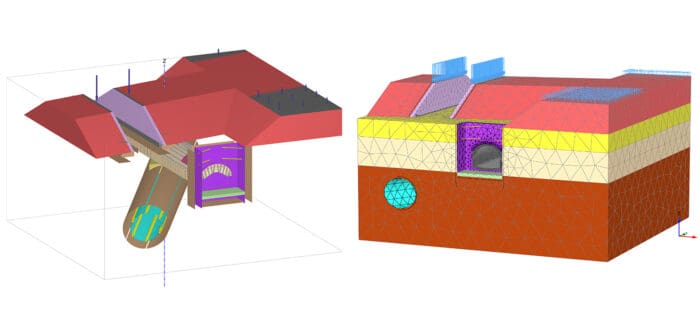
Engineers used Plaxis 3D for the ground modeling and structural planning for Madrid’s Metro Line 5 project.
Seequent, the Bentley Subsurface Company, has announced its return to the Prospectors & Developers Association of Canada (PDAC) Convention from March 1 to 4, 2026. As a global leader in mining software, the company plans to demonstrate how its latest innovations in artificial intelligence and cloud computing are fundamentally altering the landscape of mineral exploration. […]
According to a new industry report from Bentley Systems, 88% of mining organizations now recognize digital twins as high-impact technology, with nearly 90% already implementing or planning projects. For decades, mining data has been trapped in silos—split between geological reports, manual inspections, and disconnected sensors. The industry is now pivoting toward “Evergreen Digital Twins,” virtual […]
Anglo American has unlocked an estimated USD 100 million in value at its Barro Alto mine, leveraging Bentley Systems software to slash geomechanical model update times. The project also earned a profile in the Bentley Year in Infrastructure (YII) Awards, highlighting how a “connected digital ecosystem” can replace traditional, disconnected manual workflows. The success of […]
Flux Energy Solutions has achieved a remarkable feat in renewable energy development, leveraging artificial intelligence (AI) and GPU-accelerated simulation to compress a 60-month geothermal reservoir modeling project into just 12 months. The successful optimization of a 69.5-megawatt (MW) geothermal field in western Turkey delivered a 500% gain in modeling efficiency and significant cost savings. The […]
By Colleen O’Hanlon Seequent Evo represents a new era of innovation for both Seequent and its customers, setting the foundations for AI and machine learning, Chief Executive Graham Grant has said. Grant told customers and media gathered at a Seequent event in Toronto that the arrival of Seequent Evo was a continuation of Seequent’s track […]
By Paul Colbert Dataforensics unlocked incredible value for the US Army Corps of Engineers by moving subsurface data to the cloud, saving years in migration time and 62,700 work hours along the way. For decades, the US Army Corps of Engineers (USACE) has been gathering subsurface data essential to its operations – literally millions of […]