Engineering and Planning for a Sustainable Phnom Penh

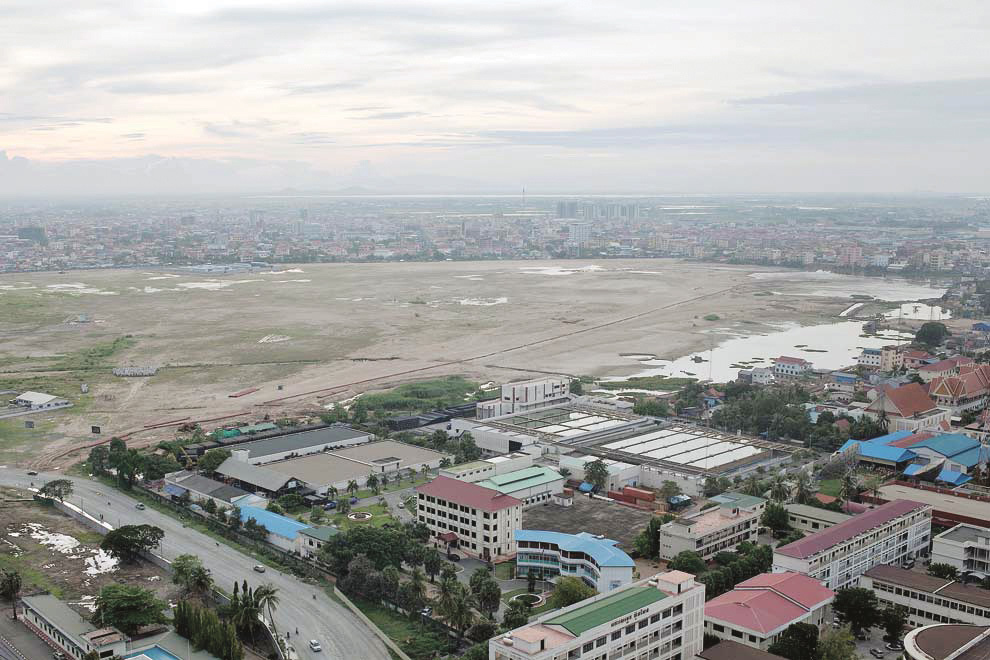
In Phnom Penh, where land is already scarce, proper planning for future growth is crucial. As a Civil Engineer, I was recently able to visit and see first-hand large, on-going land development projects on lakes surrounding the city.

Boeung Kak is about 100 ha = 1km x 1km. “Chroy Changvar City” on part of that peninsula is about 350 ha = 1km x 3.5km. And in the south of the capital, “ING City” on Boeung Tompun is about 600 ha = 1km x 6km for Phase 1 only, but will be over 2000 ha = 10km x 20km after all 4 phases.

My main initial geotechnical engineering concern for all these developments was ground settlement. These lands were originally seasonal wetland lakes, now reclaimed by filling them with pumped in, dredged river sand. The issue is that when the weight of this metres-high sand is exerted, the muddy soft ground layer underneath is compressed into a thinner layer. This happens by displacing water in the pores of soil beneath and becoming a harder solid layer over time.

The softer the ground underneath is, the heavier the weight required is and the longer it takes to consolidate. In the worst case, the final ground level may continually and gradually subside, and may require extra surcharge, that is a top-up fill, to account for the height difference. Prior to land reclamation, there are number of ways to improve the ground condition, such as by mixing mud with cement to solidify it, or by extracting water from pores to accelerate the settlement. However, I could only observe the process of letting the sandy soil exert its own weight for long periods of time.

To monitor the ground settlement process, we must first analyse the ground condition. I was first able to share my concerns with the Board of Engineers of Cambodia, which led then to a local soil testing company. And with much appreciation to them, I was given some indicative “N-values” – that is how hard the ground is, measured instrumentally – in the vicinity of those lakes. An N-value of less than 3 is very soft, 3 to 8 is soft-ish, 5 to 10 is soft to medium and so forth. I was told by them that in some areas, an N-value of less than 5 is measured at near the ground surface up to over some metres deep. If a measured N-value is less than 3, I would generally consider there is some risk of consolidation settlement.

Let us not forget that measured N-values can greatly vary depending on the exact sample location, layer thickness, soil property, ground water level, etc. All this means that invisible underground hardness or softness can change over time and place. On the ground surface, there are no confirmed reports of subsidence yet. Most reclamation has already been left to settle for some years and will be for many more to come. If we can confirm the final consolidation settlement, there will be no problem in constructing infrastructure on top.

Furthermore, many of my civil engineering concerns also lead to town planning. True high-quality Master Plan visions will only be realised by pursuing sustainability. I was once simply taught that sustainability is a balance of environmental, social, and economic factors over time. In terms of environment alone, as I walked around Boeung Trabek, the sight of rotten rubbish and the unbearable stench was not what I expected to encounter. As this putrid water flows through to Boeung Tompun, nobody would like to get close to the lake shore if there is no water treatment there. I thought to myself, if only I could measure this water quality to show to the people there to see.

In the near future, it is the Cambodian people who will be seeking a better place to live in these soon to be satellite cities in the capital. I solemnly hope for an engineering and planned solution to being a brighter and sustainable Cambodian future.

Akio Kudoh is Japanese-Australian Civil Engineer active in South-East Asia

based in Phnom Penh.

- Video Advertisement -

Related Post

Kampong Cham Becomes First Cambodian Province to Finalize Precise Local Administrative Boundary Maps

Landmark mapping initiative paves the way for advanced economic corridors, digital integration with Google Maps, and comprehensive rural modernization under the Pentagonal Strategy In a historic milestone for Cambodia’s local governance and territorial management, Kampong Cham has officially become the first province in the nation to establish accurate, clear, and definitive administrative boundary maps for […]

Cambodia Nears Completion of Strategic Border Ring Road in Northeastern Provinces

Funded by the Border Infrastructure Fund, the infrastructure project in Mondulkiri and Ratanakiri achieves over 95% of its construction targets Cambodia’s ambitious infrastructure initiative to establish a continuous border ring road is nearing full completion, with construction teams successfully executing the vast majority of planned developments in Mondulkiri and Ratanakiri provinces. From the commencement of […]

Bentley Systems Unveils OpenUtilities Substation+ to Fix Fragmented Grid Design          

Bentley Systems has launched OpenUtilities Substation+, an AI-supported 3D design software designed to eliminate fragmented utility data. By unifying isolated civil, electrical, and structural information into a single standards-aligned model, the platform fixes the data gaps that stall automation and derail digital twin initiatives. By consolidating these distinct disciplines into a single architecture, the software […]

Chinese Enterprises Expand Industrial Footprint in Svay Rieng Special Economic Zone

Two manufacturing firms pledge capital to the Qilu SEZ following a successful provincial delegation visit to Shandong Province and Zibo City Svay Rieng Province is poised for further industrial expansion as two Chinese companies have officially committed to investing in the region’s prominent Qilu Special Economic Zone. This new capital injection aims to significantly expand […]

Borey Peng Huoth Unveils Phum Nimith Project Bridging Major Economic Hubs in Phnom Penh

On the occasion of its official sales launch on June 5, 2026, Borey Peng Huoth unveiled its brand-new residential masterpiece, the Phum Nimith Project. Serving as the inaugural development of the company’s highly anticipated third phase, known as Vibol Phum, this project is uniquely situated within a sprawling 600-hectare mixed-use development enclave owned by Borey […]

Execution Over Ambition: Bentley Systems Drives the Next Era of Wind Energy Infrastructure

At the WindEurope 2026 conference, the wind energy sector marked a major shift from setting ambitious clean energy targets to executing them at scale. Driven by corporate power purchase agreements and massive demand from data centers, the industry is moving away from government subsidies. However, this rapid growth faces significant hurdles, including complex permitting processes, […]