Future Vision: Planning Mass Transit in Phnom Penh
Congestion, traffic jams, and gridlock are becoming familiar, time-consuming daily experiences for Phnom Penh’s residents. Despite the government’s efforts to ease the problem through the construction of flyovers, tunnels and widened roads, and a limited public bus service, many architects and urban planners are increasingly advocating the implementation of a more comprehensive plan as the only sustainable solution.
One such advocate is architect Ruben Castillero-Mortera, a lecturer at Raffles International College in Phnom Penh, who has developed a proposal for a public transport system in Phnom Penh.
Ruben, who has a BA in Architecture from the National University of Mexico and a Master’s in Advanced Architectural Studies from the University of Strathclyde in the UK, has worked for a number of architectural practices and also as a freelance architect developing different projects including residential, retail, hospitality, and for education. He has also worked as a lecturer at several universities around the world.
Ruben’s proposal analyzes the congestion and other related problems the capital is suffering from due to the lack of a transportation system and seemingly inadequate or nonexistent urban planning for the present and the coming years. His project was selected to be exhibited at the Our City Festival 2014 in Phnom Penh and was also the subject of a feature article in the Phnom Penh Post in August this year.
“I have always been attracted to urban design ideas and how a city and the people interact between each other and are integrated like a unique organism; thus developing this project that could be useful for Phnom Penh (despite the long hours and hard work invested developing my idea) was a pleasure and an exciting time for me,” Ruben explained.
Ruben generously shared his vision for a Phnom Penh Bus Rapid Transport (BRT) with Construction & Property Magazine.
The BRT concept is based on a complete sustainable transportation alternative covering all Phnom Penh; this is better than individual bus lines that are not integrated as a system. It is also a cheaper alternative than a subway system based on train tracks and underground tunnels.
At the moment Phnom Penh doesn’t have any kind of public transport, besides the buses that were implemented this year as a trial. A rapid transit system is a good alternative with the aim of building a proper network of lines and stations for the users to move faster, in order, and safely around the city. At the same time it will help to reduce the traffic and pollution by reducing the number of vehicles.
If a percentage of the population uses a rapid transit system instead of their own vehicles it will help to ease traffic congestion and reduce travelling time from one point to another. With a rapid transit system that runs on exclusive lanes and where stations don’t interfere with other vehicles, the number of road accidents would be reduced. Rapid transit systems use exclusive lanes that are integrated in a series of lines making it easy to commute to different areas of the city through the network of stations because cars and motorcycles are not allowed to use these lanes.
A Bus Rapid Transit System is a better alternative to a normal system of bus lines with the stops on the side of the road. This is because the users go to designated stations like in a subway or metro system to wait for their bus that is not in contact with the rest of cars. On the other hand an underground subway system based on trains would be much more expensive than a rapid transit system based only on buses. Buses are also a better alternative for medium sized cities or where the lack of space makes difficult to build a subway like Phnom Penh.
A Bus Rapid Transit System (BRT) is more realistic to build in Phnom Penh than other alternatives such as a subway, monorail, a cable car or other futuristic projects that are more expensive and don’t justify the size of the population of Phnom Penh.
Additionally several BRT systems have been built on different continents; since the first one was introduced in Curitiba Brazil in 1974; or the “Transmilenio” BRT in Colombia that is one of the most advanced in the world, they have already been proved successfully and financially viable.
The Phnom Penh BRT proposal is based on a series of lines that cross the main avenues of the city. It consists of 7 lines; including one circular non-stop line that covers the most important part of the city, and an express line that runs directly from the airport to the city centre, stopping only at the most important intersections with other lines to commute to other stations. Most stations are calculated to be reachable within a walking distance in a radius of 400m located near important places and/or in the intersections of main arteries.
Where different lines cross, stations are integrated so commuters can change lines without going to street level. The system is similar than an underground train system but is cheaper in construction and operative costs. The lines run on exclusive surface lanes for buses without competing for the space that cars and motorcycles use, reaching each station faster.
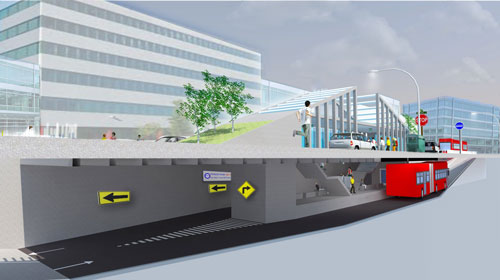
The design of the Phnom Penh BRT is unique because buses stop in special underground stations to avoid obstacles in the road at surface level. Underground stations provide more space for cars and motorcycles and reduce traffic congestion and provide more comfort and security for the users that access the station.
The research also includes the design and 3D virtual model of a prototype station with one platform with two exclusive lanes for buses running in opposite directions. The design of the stations explores the incorporation of landscape architecture to beautify the urban design of the city and integrates sustainability factors and disability access.
If the BRT system is more efficient, comfortable, safe and fast, the users would prefer it to private transport to move to some points. The model also integrates smaller, exclusive “cyclo” lanes for bicycles that would help cyclists to circulate safer and faster and help to reduce pollution and ease congestion. And of course all the sidewalks would need to be free of obstacles for the pedestrians to walk; unlike today’s Phnom Penh.
The considerable initial cost could be offset by investment from a mix of the government, private investors and international loans. It can be constructed in stages line by line, as other cities have done to reduce the initial cost impact and disruption.
A transportation system is typically an urban idea, a bet for the future development and survival of a city, and ultimately something that will benefit all its inhabitants. To propose and explore how to improve the mobility in the city is fundamental, and allows the population to think about the repercussions and implications for the future of their city.
- Video Advertisement -
 English
  ខ្មែរ
ខ្មែរ