The Development and Registration of a Borey
 Proeksa Meas
- 23 August 2017
- Local News
- 12687 Views
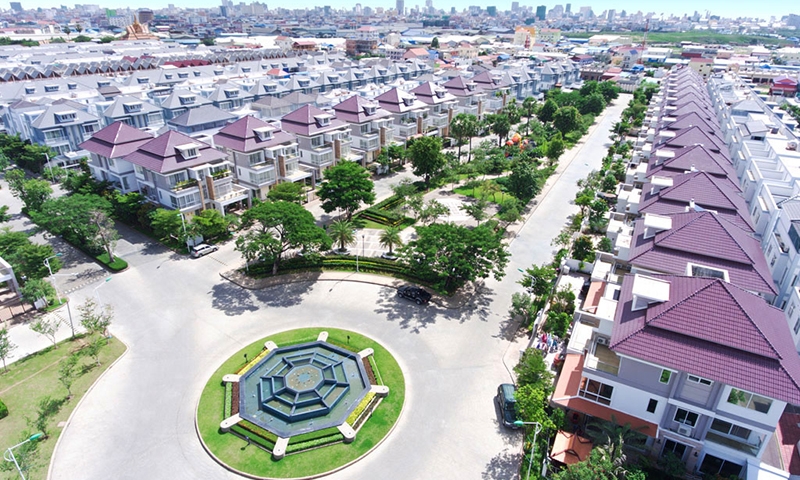
A study of the borey market in Cambodia shows that in addition to the standard development and registration of a borey done by developers, there is another way to develop an allotment project. We will see that the choice made by the developers can have financial impacts on the tax and charges of a borey and have different advantages and challenges for the owners and the State. Since the enactment of Sub-Decree No. 39 on the Management of Borey, dated 10 March 2011 (“Sub-Decree No. 39”), the development of boreys has significantly increased in Cambodia and, in particular, in Phnom Penh.
Compared with the condominium market, the acquisition of units located in a borey is normally reserved for Cambodian people, as foreigners are prohibited from owning land in Cambodia according to Article 44, paragraph 1 of the Constitution and Article 8 of the Land Law. This also corresponds to the habits of Cambodians who generally prefer to live in a borey rather than in a condominium.
We will see that, in practice, in parallel to the development and registration of a borey, we see many developments of allotments which are not governed by Sub-Decree No. 39 even if they use the commercial name of “borey”. This can be explained by the fact that Sub-Decree No. 39 uses the term “public space” rather than “common areas” and by the fact that the development of boreys existed in Cambodia before the enactment of Sub-Decree No. 39.
Pursuant to Article 4 of Sub-Decree No. 39, a “borey” is defined as “a location developed as lots, residential buildings, other construction, public space and other infrastructure on a single land parcel in accordance with the officially approved overall plan of the borey.
The reference of public space is also used in Articles 8 and 9 of Sub-Decree No. 39.
The use of the term “public space” can create confusion as it generally refers to areas which are free and open to the general public and, as a consequence, owned by the State. The term “common areas” however is generally used to refer areas dedicated to the use of owners of units on the property and which are subject to undivided ownership.
However, there is no doubt that the Royal Government of Cambodia refers to common areas and not public areas when Sub-Decree No. 39 has been drafted and adopted. Indeed, Article 9 of Sub-Decree No. 39 provides that “public space, gardens, entries, common services, and a borey’s fences shall be registered under undivided ownership of all owners living in the borey for the purpose of common use.
Therefore, it is clear that the roads and gardens located within a borey are considered as common areas instead of public areas.
Consequently, boreys and condominiums are similar as both include private units/lots and common areas. The difference is that a borey is a horizontal development and a condominium is a vertical development.
In this respect, the developer of a borey must register the common areas of the borey under the undivided ownership of all owners in the borey.
However, in practice, we have seen that some developers still register their borey project under the procedure in place before the enactment of Sub-Decree No. 39. They register the common areas (gardens, roads) of the borey as public areas and, as a consequence, are considered as State property.
Even if this practice is not in compliance with the provisions of Sub-Decree No. 39, this kind of development is perfectly legal and in compliance with the laws and regulations in force in Cambodia.
Indeed, a developer is free to decide the form of development it wants for its project. The developer can decide to develop a borey project or an allotment project, which is a classic real estate project. This classic real estate development is in compliance with the practice developed before the enactment of Sub-Decree No. 39.
In practice, there can be many advantages of having public areas instead of common areas and this explains why some developers and municipalities/local authorities are sometimes more favorable to this kind of development rather than a borey.
Having public areas instead of common areas can be advantageous for owners as their charges and taxes will be reduced compare to charges and taxes that they will have to pay if their properties are located within a borey.
Indeed, for example, in case of an allotment development, the owners will not pay the land tax on the public areas as they are not the owners of these areas. However, in the case of a borey, the common areas are subject to undivided ownership and the owners will have to pay the land tax on these common areas.
This will be also the same for the charges relating to the maintenance and cleaning of the public areas or common areas and for the payment of the electricity for the lighting of these areas.
Therefore, it can be beneficial for owners if these areas (gardens, roads) are considered as public areas in order to reduce the amount of charges that they will have to pay each month.
The developer will also benefit of it as it can be a selling point for units/lots of the allotment as the charges and taxes will be lower compared to a borey project.
The municipality of Phnom Penh also has an interest in having public areas instead of common areas. Indeed, Public roads will help the municipality address issues of road traffic as the public will have new road access that they can use. The public will also be entitled to use the gardens and parks created within the borey. The municipality will be the owner of these common areas without cost as they are transferred to the State without any payment or indemnity owed by the State.
In conclusion, it is recommended before starting the construction of a borey that developers take into account the impact of their choice of development and registration and how it will affect owners and the State. The assistance of a lawyer will be very helpful in this respect.

ON THE AUTHORS
ING Sophealeak and Charles AMAR, lawyers at Bun & Associates, advise domestic and foreign clients seeking expert advice and innovative solutions in dealing with significant and complex transactions involving both raw and developed properties. Their work includes advising on all issues relating to real estate investment, project development, construction and asset management. Our real estate team has also hands-on expertise and experience in advising clients on matters related to economic land concessions, special economic zones, agriculture, the environment and mining.
This publication is for your information only. It is not intended to be comprehensive and it does not constitute and must be not relied on as legal advice. You must seek specific advice tailored to your circumstances.
Any use of the information contained in this article or the receipt of this article is not intended to create nor does it create a solicitor-client relationship between you and Bun & Associates. Unless otherwise indicated, Bun & Associates owns the copyright of this article. If you seek to reproduce or otherwise use this article or any part of it in any way, it is your responsibility to obtain approval for such use where necessary.
For further information, please contact us at: Bun & Associates
#29, Street 294, Phnom Penh, Cambodia, P.O. Box 2326
T: +855 23 999 567
F: +855 23 999 566
E: ing@bun-associates.com
amar@bun-associates.com
www.bun-associates.com
- Video Advertisement -
 English
  ខ្មែរ
ខ្មែរ