

US tariffs: Impact on data centre construction

The US tariffs will negatively impact data centre construction and, as a result, drive up the cost of AI processing. Building data centres requires materials and supplies, construction equipment, electrical components, and cooling systems, even before IT and network infrastructure are deployed. As all construction costs increase, so will the cost of data centre builds, which will be passed on to enterprise customers, according to Yahoo Finance.

The current uncertainty makes long-term planning harder, and data centre design and construction require careful consideration and strategic planning for project delivery. Tariffs on steel, aluminium, and copper, materials used for data centre buildouts, will translate into higher costs. US tariffs will disrupt the internal US market because most components used in data centre construction are manufactured outside the US, and even US-made products are bound to become more expensive due to higher demand and the rising costs of imported raw materials.

Equipment, including electrical infrastructure and cooling systems, imported from countries with some of the highest tariffs, such as China, Taiwan, and other nations in APAC, will be more challenging to access, delaying data centre expansion plans. Although there has been a 90-day pause in the application of tariffs on all imported goods, the deadline could potentially cause more chaos from July 9, 2025, when the truce in the trade war is due to expire. The tariffs include rates of 32% for Taiwan or 46% for Vietnam, where many electronic components are manufactured, and will be back on again on that date. This deadline adds another spanner in the works for importers sourcing from these regions.

Beatriz Valle, a senior analyst at GlobalData, noted that the zeal in applying US tariffs seems contradictory because it will undermine the US administration’s plans to incentivise the AI market: “The tariffs will have the unintended consequence of making the US lose competitiveness in the global race for AI leadership. Other protectionist measures, such as the restrictions in the sales of semiconductors, implemented years before the tariffs, have had the opposite effect and strengthened the Chinese semiconductor market.

“Another unintended consequence will be the flourishing of data centres in domestic markets to avoid the financial impact of the US tariffs. This will spur new dynamism among European cloud computing companies as businesses look for alternatives to the traditional US-based hyperscalers. Sovereignty, compliance, pricing, latency, and security issues may lead enterprises to consider smaller cloud computing providers based within the EU.”

Looking at the global overview, supply chain disruptions will occur because many components used in data centre buildouts are sourced internationally. US companies may have to reconsider their expansion plans as demand for generators, switches, and transformers intensifies. Data centre components were already highly sought-after, even before the latest tariff spike. Essential hardware, including networking and server equipment, will be more expensive.

New construction proposals will be affected because the scarcity of power units or specialised cooling hardware will create supply chain bottlenecks. Overall, the US tariffs mean that data centre service providers will raise prices, for example, colocation providers renting out space in their data centres to other companies will charge their customers more. This will hurt the global market.

Navigate the shifting tariff landscape with real-time data and market-leading analysis.

Request a free demo for GlobalData’s Strategic Intelligence here.

“US tariffs: Impact on data centre construction” was created and published by Verdict, a GlobalData-owned brand.

- Video Advertisement -

Related Post

Battambang Launches Strategic Urban Infrastructure Project on Street 154

Extensive road expansion and drainage system upgrades in Wat Kor Sangkat signal the start of a city-wide modernization initiative The Battambang Provincial Administration has officially broken ground on a comprehensive infrastructure project in Battambang City, focusing on road restoration and the construction of advanced drainage systems. The ceremony, held on March 9, 2026, was led […]

Cambodia and South Korea Explore Small-Scale Hydropower Potential at Dauntri and Reaksa Reservoirs

Joint feasibility study focuses on integrating renewable energy and solar power to secure sustainable water and electricity supplies for local communities The Ministry of Water Resources and Meteorology has partnered with the Korea Water Resources Corporation, known as K-water, to conduct a comprehensive feasibility study on the installation of small-scale hydropower facilities at the Dauntri […]

Borey Peng Huoth Announces Exclusive Pre-Sale Event for New Phum Nimith Project in Chbar Ampov

Early access to prime locations within the prestigious Grand Star Platinum development starting this March Following the successful groundbreaking ceremony held on January 30, 2026, Borey Peng Huoth is pleased to announce the official pre-sale launch of its newest residential development, Phum Nimith. This highly anticipated event will take place over three days from March […]
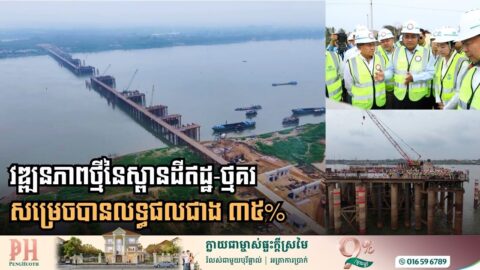
Accelerating Connectivity: Mekong River Bridge Connecting Dei Edth-Thmor Kor Surpasses 35% Completion

Minister Peng Ponea inspects the strategic infrastructure project in Kandal province to ensure rigorous technical standards and timely delivery for the public The construction of the major bridge across the Mekong River Dei Edth-Thmor Kor connecting Dei Edth commune in Kien Svay district to Thmor Kor commune in Lvea Em district has reached a significant […]

Cambodia and Laos to Fast-Track Cross-Border Connectivity with New Ratanakiri-Attapeu Road Link

Joint inspection team to finalize construction zones this February to unlock new trade and economic opportunities Cambodia and Laos have reached a pivotal agreement to conduct a joint technical inspection aimed at defining the specific zones for a new road project connecting Ratanakiri province in Cambodia to Attapeu province in Laos. This initiative is a […]

Kratie City Drainage and Pumping Station Project Surpasses 68% Completion

Provincial authorities and ADB-funded initiative accelerate infrastructure development to eliminate seasonal flooding and boost local economic appeal Kratie City is undergoing a significant infrastructural transformation as the construction of its comprehensive drainage network and rainwater pumping station reaches 68 percent completion. This development is a key sub-project of the Fourth Greater Mekong Subregion Corridor Towns […]