Being Professional

If you ask moto-taxi drivers or even people living in remote areas of Cambodia, they can tell you about some properties for sale or rent in their neighborhoods. But when it comes to standard real estate services, these “citizen brokers” cannot compare with professional agents who have graduated with real estate education.

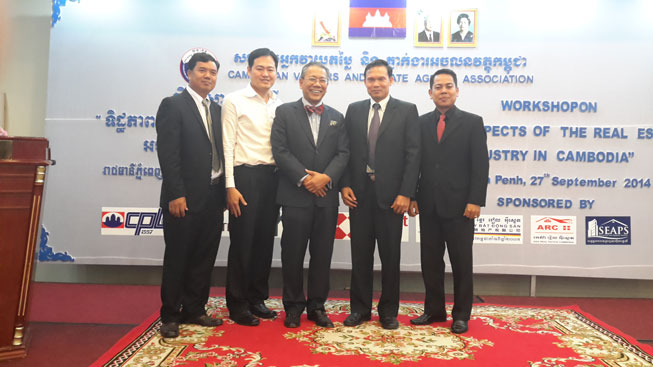
Cheng Kheng, President of Cambodia Valuers and Estate Agents Association (CVEA), believes that out of 10,000 Cambodians in the real estate sector, about 7,000 of them have been involved in brokerage businesses. “Most people treat real estate brokerage as an easy career that anyone can do, but the reality is far beyond what they ever know.”

Kheng explained various reasons why professional brokers outperform unprofessional ones. Trained brokers can advise clients who want to buy a piece of land about businesses which can be developed on the land, the proper number of building floors the land can handle, whether the land has a soft or hard title and whether the title is under retention or not. Citizen or untrained brokers generally aren’t able to help clients with these complex issues.

The complexity increases for transactions on condos or boreys which untrained brokers don’t have enough skills to deal with. Unlicensed brokers can’t tell clients whether the condominium or borey is licensed, whether the client will get a hard or soft title deed, or whether the project’s master plan is under retention somewhere or not. Most importantly, they are unable to advise on whether the client can make a sale-purchase agreement with developer or other party relevant to the project which may lead to a breach of contract if any problems occurred on the purchased property.

“While citizen brokers can’t help clients on these issues, professional agents who gain higher respect from developers than unprofessional ones, will check these matters for clients,” Kheng said.

Professional agents are not able only to ensure secure transactions for buyers/sellers, but they can also plan the businesses on the purchased properties for clients.

“A professional broker isn’t like a guide that knows the properties for sale or lease then brings buyers or tenants to meet owners and then finishes the deal. A skilled broker needs to add value to the buyer on why they should buy or rent that property and analyse for the client what can they do with that property to generate revenue,” he stressed.

Today Cambodia’s real estate market is dominated by 78 licensed real estate offices and hundreds of other unlicensed offices. CVEA, which currently manages 44 members with over 100 agents, is lobbying other offices to either join the team or legalise themselves.

They have also lobbied the Ministry of Economy and Finance, the government body that manages the real estate services, to demand that only licensed individual brokers are permitted to legitimately serve real estate businesses.

Real estate guru Kheng has noticed more people start relying on professional agents especially for big projects. He also believes the current number of agents isn’t very high in the market as other large cities often have up to 4,000 to 5,000 agents.

As well as upgrading its members’ agents though training courses, the CVEA team is also considering whether to establish real estate technical training schools or insert real estate as a subject at universities after they realized that very few Cambodian students are aware about this profession.

To upgrade local real estate agents and its members’ agents, CVEA has partnered on a training program with Century 21, the world’s biggest global franchised real estate operation that inaugurated its Cambodia office this September.

“Century 21 Cambodia will soon open the Century 21 University, the Kingdom’s first-ever real estate school to improve the skills of local real estate agents,” said Kevin Goos, the firm’s CEO. “In the next 18 months, we expect to have around 200 sales agents under Century 21 Cambodia, excluding some other foreign agents coming in and open offices inside Cambodia.”

As we move toward the upcoming ASEAN Economic Integration in 2015, Cheng Kheng and Kevin Goos see both threats and opportunities for local agents when more investments come into Cambodia. They say that if local brokers keep improving their competency, they will still fare better than foreign professionals. If they don’t, they risk being overtaken by those highly skilled foreigners.

- Video Advertisement -

Related Post

Kampong Cham Becomes First Cambodian Province to Finalize Precise Local Administrative Boundary Maps

Landmark mapping initiative paves the way for advanced economic corridors, digital integration with Google Maps, and comprehensive rural modernization under the Pentagonal Strategy In a historic milestone for Cambodia’s local governance and territorial management, Kampong Cham has officially become the first province in the nation to establish accurate, clear, and definitive administrative boundary maps for […]

Cambodia Nears Completion of Strategic Border Ring Road in Northeastern Provinces

Funded by the Border Infrastructure Fund, the infrastructure project in Mondulkiri and Ratanakiri achieves over 95% of its construction targets Cambodia’s ambitious infrastructure initiative to establish a continuous border ring road is nearing full completion, with construction teams successfully executing the vast majority of planned developments in Mondulkiri and Ratanakiri provinces. From the commencement of […]

Bentley Systems Unveils OpenUtilities Substation+ to Fix Fragmented Grid Design          

Bentley Systems has launched OpenUtilities Substation+, an AI-supported 3D design software designed to eliminate fragmented utility data. By unifying isolated civil, electrical, and structural information into a single standards-aligned model, the platform fixes the data gaps that stall automation and derail digital twin initiatives. By consolidating these distinct disciplines into a single architecture, the software […]

Chinese Enterprises Expand Industrial Footprint in Svay Rieng Special Economic Zone

Two manufacturing firms pledge capital to the Qilu SEZ following a successful provincial delegation visit to Shandong Province and Zibo City Svay Rieng Province is poised for further industrial expansion as two Chinese companies have officially committed to investing in the region’s prominent Qilu Special Economic Zone. This new capital injection aims to significantly expand […]

Borey Peng Huoth Unveils Phum Nimith Project Bridging Major Economic Hubs in Phnom Penh

On the occasion of its official sales launch on June 5, 2026, Borey Peng Huoth unveiled its brand-new residential masterpiece, the Phum Nimith Project. Serving as the inaugural development of the company’s highly anticipated third phase, known as Vibol Phum, this project is uniquely situated within a sprawling 600-hectare mixed-use development enclave owned by Borey […]

Execution Over Ambition: Bentley Systems Drives the Next Era of Wind Energy Infrastructure

At the WindEurope 2026 conference, the wind energy sector marked a major shift from setting ambitious clean energy targets to executing them at scale. Driven by corporate power purchase agreements and massive demand from data centers, the industry is moving away from government subsidies. However, this rapid growth faces significant hurdles, including complex permitting processes, […]