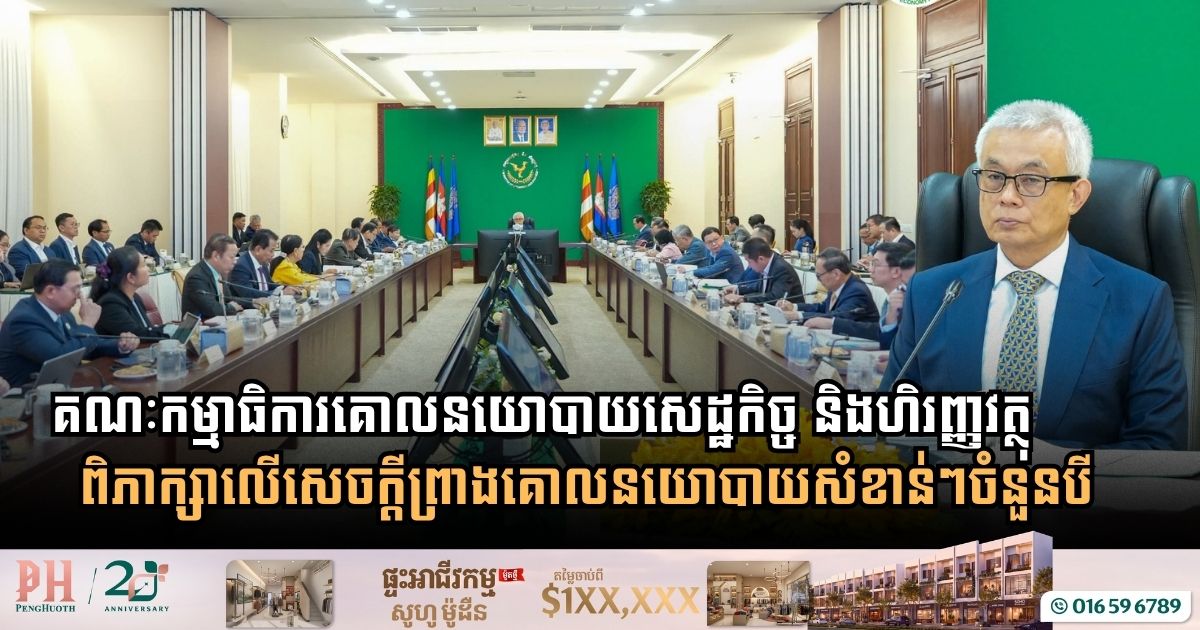

The Economic and Financial Policy Committee Deliberates on Three Major Draft Policies

Government Leadership Drives Industrial Modernization, Workforce Upskilling, and Labor Market Development for the Next Ten Years

Efforts to accelerate national economic growth and diversify the production base advanced significantly as His Excellency Aun Pornmoniroth, Deputy Prime Minister, Minister of Economy and Finance, and Chairman of the Economic and Financial Policy Committee (EFPC), led a high-level committee meeting on November 26, 2026, to review three critical policy agendas. The session focused on the draft Industrial Development Policy of Cambodia 2026-2035, the draft National Policy on Technical and Vocational Education and Training 2026-2035, and the draft National Policy on Employment 2026-2035. The meeting gathered key government leaders, including His Excellency Say Samal, Deputy Prime Minister and Minister of Land Management, Urban Planning and Construction; His Excellency Koeut Rith, Deputy Prime Minister and Minister of Justice; His Excellency Hem Vanndy, Minister of Industry, Science, Technology and Innovation; His Excellency Chay Borin, Minister of Cults and Religions; and His Excellency Heng Sour, Minister of Labor and Vocational Training, alongside senior leadership and technical officials from relevant ministries and institutions.

The formulation of these three strategic policy documents is anchored in Phase 1 of the Pentagonal Strategy of the Royal Government of the 7th Legislature of the National Assembly, which prioritizes economic diversification, human capital development, and capitalizing on the demographic dividend. Amid rapid socio-economic structural transformations, these updated frameworks are designed to steer Cambodia’s industrial and labor development over the upcoming decade. Drafted by the Supreme National Economic Council working group, the Industrial Development Policy 2026-2035 aims to modernize Cambodia’s industrial structure from low-skill, labor-intensive activities to skill- and high-technology-driven sectors. Its four core objectives include enhancing quality investment, deepening industrial roots for long-term growth, building supportive sectors to boost productivity, and preparing all stakeholders for future environmental trends and sustainable industrial management.

Concurrently, the draft National Policies on TVET and Employment for 2026-2035, spearheaded by the Ministry of Labour and Vocational Training, seek to cultivate a resilient, adaptable, and skilled workforce. The TVET policy envisions building a high-quality, inclusive, and future-ready ecosystem through robust public-private partnerships to provide lifelong learning aligned with digital and green economic transformations. Meanwhile, the national employment policy aims to foster a resilient and competitive labor market, ensuring that all citizens secure sustainable livelihoods with higher incomes and decent work conditions. Prior to this committee deliberation, all three draft policies underwent rigorous studies and extensive consultations with relevant ministries, private sector representatives, and development partners to guarantee implementation feasibility.

Following comprehensive discussions, the committee highly commended the drafting teams and provided constructive feedback to refine and ensure absolute consistency across all documents. In concluding the session, Deputy Prime Minister Aun Pornmoniroth expressed profound appreciation to all participating ministries, particularly the Supreme National Economic Council working group and the Ministry of Labour and Vocational Training, for their rigorous efforts. He instructed the working groups to closely collaborate with relevant institutions and the EFPC General Secretariat to finalize all three comprehensive draft policies by the end of November 2026, ahead of formal submission to the Royal Government for review and approval.

The deliberations led by the Economic and Financial Policy Committee under the stewardship of Deputy Prime Minister Aun Pornmoniroth mark a pivotal milestone in charting Cambodia’s long-term economic roadmap. The implementation of these forward-looking policies for industry, technical training, and labor will serve as a robust catalyst in transforming the national economic landscape, boosting global competitiveness, and fostering sustainable, inclusive prosperity for all Cambodian citizens. (read more)


- Video Advertisement -

Related Post

Cambodia Registers Over 2,600 Domestic Products in First Nine Months of 2026

Prime Minister Hun Manet highlights a significant surge in local product registrations, urging broader public and commercial support to bolster national manufacturing and economic resilience. Domestic manufacturing in Cambodia has achieved a major milestone, with approximately 2,600 local products officially registered with the Ministry of Industry during the first nine months of 2026. This figure […]
Advancing Sustainable Transport: Cambodia’s Vision for Economic Resilience and Regional Integration

Cambodia highlights infrastructure progress under Pentagonal Strategy–Phase I, emphasizing multi-modal transport development, reduced logistics costs, and smart digital systems Beijing: Advancing sustainable transport systems and embracing digital innovation have become essential drivers for reinforcing economic resilience, facilitating international trade, and deepening regional integration. On the morning of September 22, 2026, during the Global Sustainable Transport […]
Ministry of Land Management Urges Construction Sector Modernization to Drive Economic Flow and Elevate Living Standards

Ministry leadership highlights strict enforcement of the Law on Construction, master planning, and technical certification systems to safeguard urban safety and improve residents’ quality of life Phnom Penh: Modernizing the construction and real estate sector remains a critical pillar for sustaining national economic growth and elevating living conditions across Cambodia. On September 10, 2026, the […]
Cambodia’s Land Ministry Expands Legal Framework with Over 230 Regulatory Instruments to Upgrade Construction and Urban Standards

Ministry enacts 65 legal codes and advances 165 draft regulations to ensure safety, structural quality, and sustainable urban development across the Kingdom Phnom Penh: Establishing a comprehensive legal framework and clear technical guidelines remains a foundational priority for the Royal Government of Cambodia in regulating urban development and building practices. In early September, the Ministry […]

Cambodia Accelerates Legal Reforms Through National Workshop on Regulatory Impact Assessment and Good Practice Regulation

Permanent Deputy Prime Minister Vongsey Vissoth leads multi-agency session with British experts to refine regulatory drafting and enhance economic competitiveness Phnom Penh: Modernizing Cambodia’s legal ecosystem and improving the efficiency of regulatory frameworks achieved a key institutional benchmark aimed at strengthening public administration and fostering a predictable business environment. On August 25, 2026, the Office […]
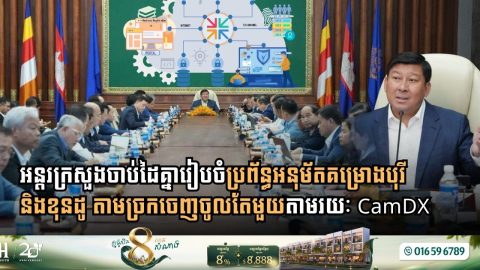
Cambodia Streamlines Borey and Condo Approvals Through Inter-Ministerial CamDX Framework

Ministry of Land Management coordinates multi-agency integration via the single-window system to reduce real estate investment risks and enhance buyer confidence Phnom Penh: Real estate development and housing administration in Cambodia have entered a transformative phase aimed at establishing transparent investment protocols and protecting consumer rights. On August 26, 2026, the Ministry of Land Management, […]