



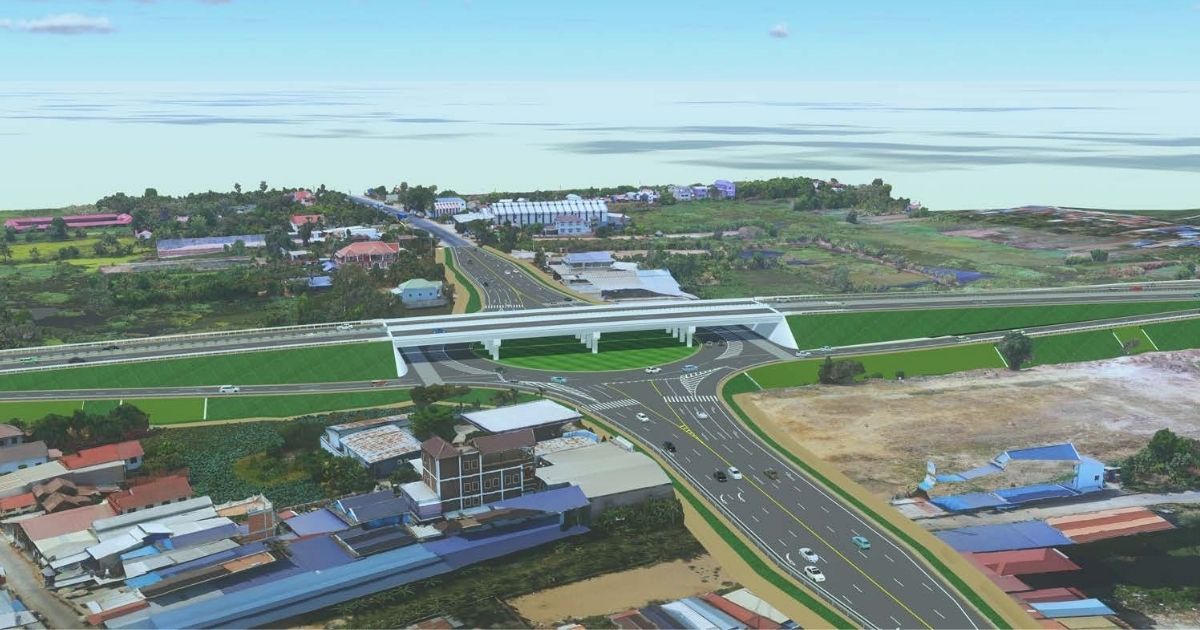

Digital Twin Technology Paves the Way for Cambodia’s New PP-Bavet Expressway

The construction of Cambodia’s second major expressway, the 138-kilometer Phnom Penh-Bavet Expressway, is leveraging cutting-edge digital twin technology from Bentley to overcome significant geographical and cultural hurdles.

The project, implemented by the aims to enhance Cambodia’s logistic connectivity with Vietnam. The expressway starts from the Third Ring Road in Phnom Penh and ends in Bavet City.

During the design and planning stage, CRBC faced several complex challenges. First, the initial 33 kilometers of the project lie within a floodplain where heavy seasonal rains can cause the Mekong River to overflow, creating water depths of up to six meters for up to six months. Second, the proposed route could affect a large number of existing temples and cultural relics that cannot be moved. Lastly, the first section of the project passes through a heavy traffic area of Phnom Penh city with numerous houses, which makes the required relocation more complicated.

To solve these problems, CRBC turned to Bentley’s software, which helped the company lower earthworks by two million cubic meters, improve modeling efficiency, reduce modeling time by 50%, and shorten the design cycle by 20%.

To begin, CRBC used Bentley ProjectWise and iTwin to create a digital resource management platform and a connected data environment, ensuring all project information was always current and accessible to every stakeholder.

The team then built a model of the project site using Bentley iTwin Capture, which helped them visualize and better lay out the expressway route. This 3D virtual environment allowed participants to “quickly find out the design problems, such as the road encroaching on temples,” and provide timely feedback.

Bentley MicroStation, OpenRoads, and OpenBridge, along with interoperable third-party applications, the team successfully created a digital twin of the highway and its facilities.

The OpenRoads application was critical for testing traffic simulations for future years to identify potential congestion areas and design effective intersections. Furthermore, the analysis within the application helped them design the road to be 0.5 meters above the maximum flood level.

By working collaboratively on a single 3D digital twin, all teams and specialists were able to boost design efficiency and road quality.

Using photographic site data in the digital twin helped the team identify land acquisition boundaries. This approach reduced the adverse impact on surrounding communities by minimizing disruption to temples, schools, houses, historical sites, graves, and other facilities, while also improving communication with local residents regarding demolition.

The digital twin was used to optimize vertical alignment and reduce the fill height, leading to a reduction in earthworks by two million cubic meters and eliminating 142,860 kilometers of truck travel.

Creating a parameterized cross-section template in OpenRoads allowed CRBC to efficiently test variables and solutions, improving modeling efficiency and reducing modeling time by 50%.

A deeper understanding of the project site via the digital twin allowed the team to change part of a bridge in the flood zone into a partial subgrade road, which saved a significant amount of money and eliminated the need for 16,000 tons of concrete.

- Video Advertisement -

Related Post

Tech Pivot Saves Germany’s First All-Digital Highway Project

A landmark infrastructure project in Germany is back on track and shattering efficiency records after a critical mid-course correction in its digital strategy. Viscan GmbH, the company tasked with creating a “digital twin” for the B29 highway expansion in Baden-Württemberg, successfully rescued the project from technical failure by overhauling its data processing systems. The ambitious […]
How Data-Driven Workflows Are Changing Engineering Delivery

For decades, the engineering and construction industry has relied on the exchange of digital files—the familiar DWGs and PDFs—as the bedrock of project delivery. However, as global infrastructure grows in complexity, a new paradigm is emerging. Experts are calling for an evolutionary crossroads where the industry moves beyond static file handovers toward dynamic, data-driven workflows. […]
Tech Giant Bentley Systems Partners with CET to Revolutionize Engineering Education in India

Bentley Systems has officially signed a Memorandum of Understanding (MoU) with the College of Engineering Trivandrum (CET), aiming to transform one of Kerala’s premier institutions into a hub for digital infrastructure excellence, ensuring that the next generation of Indian engineers is equipped for a rapidly evolving global market. Under this MoU, there will be the […]

How AI-Driven Digital Twin Saves Critical Saudi Food Hub from Ground Collapse?

Saudi firm GeoStruxer has won the YII Envision Award for a high-tech rescue of a failing 12,000-square-meter grain warehouse. The facility, which secures food for 1.5 million people, was sinking due to unstable “salt dome” ground. By replacing traditional construction with a Bentley-powered digital twin, the team saved USD 2.1 million and cut carbon emissions […]

Seequent Set to Showcase AI-Driven Geoscience Breakthroughs at PDAC 2026

Seequent, the Bentley Subsurface Company, has announced its return to the Prospectors & Developers Association of Canada (PDAC) Convention from March 1 to 4, 2026. As a global leader in mining software, the company plans to demonstrate how its latest innovations in artificial intelligence and cloud computing are fundamentally altering the landscape of mineral exploration. […]

The Quiet Revolution: How AI is Reshaping America’s Highways

The US Department of Transportation (DOTs) is now utilizing AI to maintain roads and highways, as Alabama has become the latest state to bet its infrastructure budget on AI. For years, the Alabama Department of Transportation (ALDOT) relied on “performance-based budgeting,” a system designed to fund projects based on actual road needs rather than historical precedent. […]