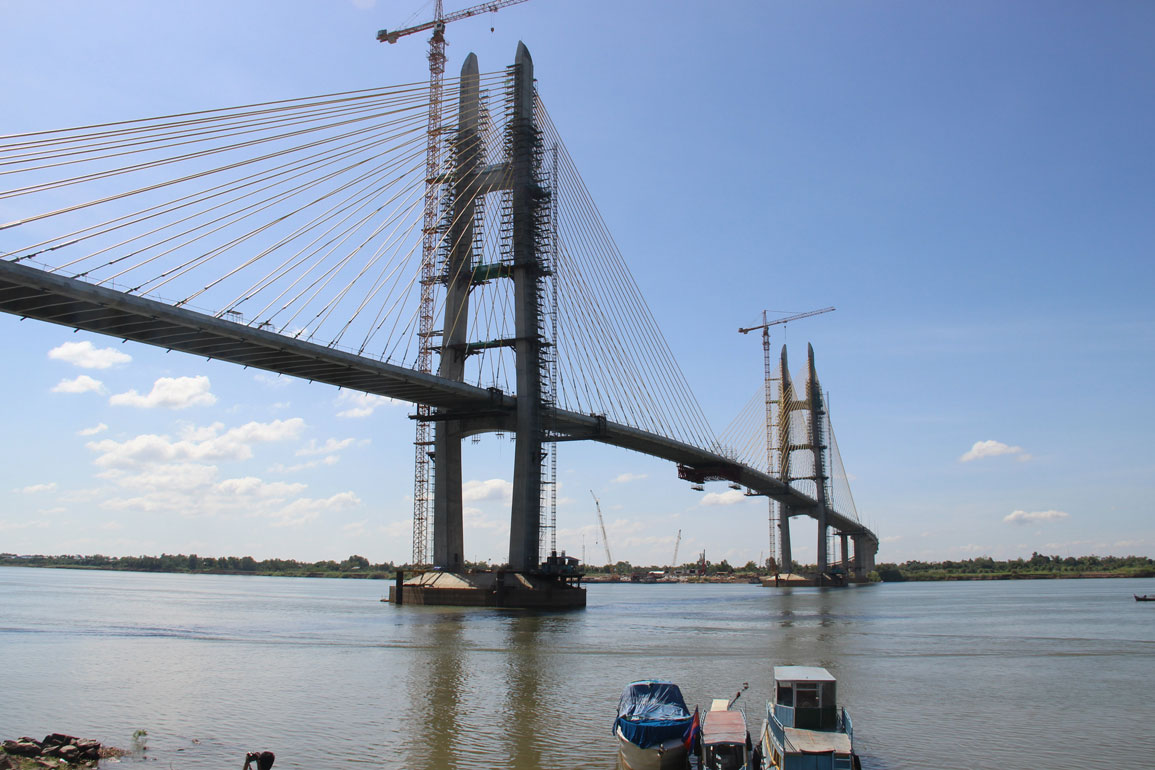
Neak Loeung Bridge to Open Early April 2015

Once it is opened to traffic in early April 2015, the new Neak Loeung Bridge will be Cambodia’s first cable-stayed bridge. It will also be the nation’s biggest and longest bridge and one of the finest modern bridges in the region.

By the end of 2014, the construction of Neak Loeung Bridge was about 93.5 percent complete. Construction will be fully complete by mid-March and is scheduled to be inaugurated in the first week of April 2015 by the Cambodian Prime Minister and Japanese vice-Foreign Minister. The opening has been timed to ease travel times during Khmer New Year in the second week of April, according to officials from the Japan International Cooperation Agency (JICA) and the Cambodian government.

Prime Minister Hun Sen will preside over the bridge connecting ceremony on the bridge on January 14.

“The rest of works are mostly pavement works, electrical facilities works, embankment protection works for approach roads, and drainage and sidewalks. It is scheduled to be opened in early April before Khmer New Year,” said Daisuke Fukuzawa, JICA’s Representative for Land Transport Sector.

Located at Neak Leoung town in Prey Veng province, about 60 kilometers southeast of Phnom Penh along National Road No. 1 to Vietnam, Neak Loeung Bridge is built across the Lower Mekong River and connects the eastern part of Kandal province to the western part of Prey Veng province. It is 13.5 meters wide, 2,215 meters long, and 37.5 meters above the water level during the rainy season to allow bigger ships to pass underneath. The road will eventually become part of ASEAN Highway-1.

Construction commenced in February 2011, and has taken 51 months. While Sumitomo Mitsu Construction Co., LTD (SMC), a leading Japanese contractor, is the project’s main contractor, the consortium of Chodai Co., Ltd and Oriental Consultants Co., Ltd are the project consultants. The total construction cost 11.94 billion JPY (EN/GA amount) or about US$130 million (based on the exchange rate in June 2010). Construction has been funded under grant aid from the Japanese government.

738 staff have worked to bring the bridge to reality; 9 Japanese managers, 57 Cambodian staff, 647 Cambodian workers, and 25 third country staff.

Speaking at a media tour to the bridge on 26 December, Mr. Chhim Phalla, Director of International Cooperation Department, at the Ministry of Public Works and Transport, said the bridge has used Japanese standards, is designed to last up to 100 years, and can bear transport loads from 25 tons up to 43 tons.

To allow ships to cross below the bridge easily, the main structure uses 160 cables to enlarge the bridge’s span from a normal length of around 220 meters (without using columns) to 330 meters (with cable assistance), according to Phalla.

Phalla explained that the bridge width of 13.5 meters is based on the calculation of estimated traffic volume from 2015 to 2020 that it will be able to handle. “We haven’t projected up to 2050 or longer. If the traffic volume increases greater than the bridge capacity by that time, we will consider building another parallel bridge.”

After construction on Neak Loeung Bridge began, a study financed by JICA was launched in mid- 2014 looked at constructing an expressway linking Phnom Penh to Ho Chi Minh City by crossing Bavet City. This plan will include the construction of another bridge across the Mekong River, according to Fukuzawa of the JICA Cambodia Office.

“After the bridge is operating, the lives of the people will change and traffic volume will increase rapidly. In order to accommodate that traffic, we are now starting to think about the expressway from Phnom Penh to Bavet,” he said.

It should be noted that the Neak Loeung Bridge project was proposed because the traffic volume across the Neak Loeung ferry had already exceeded its capacity in 2009. Once the bridge is opened, the land where the Neak Loeung ferry is located will be developed into a Japanese-dominated special economic zone.

“The bridge will potentially contribute to the development of Cambodian and regional economies because it will link the ASEAN Highway and the Great Mekong Sub-region Highway, said Prime Minister Hun Sen at the bridge ground-breaking ceremony in 2011. “The bridge will also respond in a timely way to the implementation of the bilateral transport agreement between Cambodia and Vietnam.”

Japan has so far financed a number of bridge constructions in Cambodia, including the Cambodia-Japan Friendship Bridge, known as Chroy Changvar Bridge, in Phnom Penh and the Kizuna Bridge in Kampong Cham province.

According to figures from the Cambodian Ministry of Economy and Finance, Japanese Official Development Assistance (ODA) to Cambodia for socio-economic development is about US$130 million a year.

- Video Advertisement -

Related Post

Bentley Systems Advances Data-Driven Engineering with MicroStation and iModels

Bentley Systems is helping engineering teams modernize project delivery by shifting from traditional file-based workflows to a data-driven approach using MicroStation and iModels. Engineers can continue working in familiar CAD software such as MicroStation, AutoCAD, and Revit while keeping standard file formats like DWG, DGN, and RVT. Instead of exchanging files by email, project data […]

Cambodia’s $3 Billion Aircraft Deal Marks a New Era in US-Cambodia Aviation Cooperation

Strategic investments, a landmark $3.2 billion Boeing fleet acquisition, and regional logistics plans mark a major leap forward in bilateral trade and infrastructure development… Phnom Penh, Cambodia – The aviation relationship between the United States and Cambodia continues to reach new operational milestones, driven by massive capital investments, commercial aircraft agreements, and expansive infrastructure developments […]

Bentley AssetWise Helps Highways England Cut Road Closures and Improve Traffic Flow

Highways England has transformed the way it manages England’s Strategic Road Network by using Bentley Systems’ AssetWise platform to power its cloud-based Network Occupancy Management System (NOMS). The software gives engineers and asset managers a real-time view of road closures, maintenance activities, and infrastructure assets on a single digital map, making it easier to plan […]

Cambodia and Malaysia Forge Stronger Ties in Logistics, Renewable Energy, and Agriculture

Outcomes from the 3rd Joint Commission for Bilateral Cooperation highlight expanded trade initiatives, cross-border energy integration, and diversified agricultural exchanges Cambodia and Malaysia have reaffirmed their commitment to deepening bilateral economic ties by expanding strategic cooperation across several high-growth sectors, with a strong emphasis on logistics, renewable energy, and agricultural trade. According to an official […]

Japan-Funded 20,000-Hectare Southwest Phnom Penh Irrigation Scheme Nears 99% Completion

Inspected by Water Resources Minister Thor Chetha, the major JICA infrastructure project across Kampong Speu, Kandal, and Takeo promises to boost rice yields for nearly 8,000 farming families Agricultural productivity and flood management southwest of Cambodia’s capital are set for a major transformation as the Rehabilitation and Improvement of Irrigation and Drainage Systems Project in […]

3 Things That Will Change the Future of Infrastructure

Bentley Systems has revealed that AI, digital twins, and data-driven technologies are transforming how infrastructure is planned, built, and maintained as governments face growing climate challenges and aging assets. The company highlights how its digital twin, AI, collaborative modeling, and subsurface modeling technologies allow engineers to test designs, improve collaboration, monitor infrastructure in real time, […]