The Future of Infrastructure Engineering is Open

By Nicholas Cumins, Chief Executive Officer

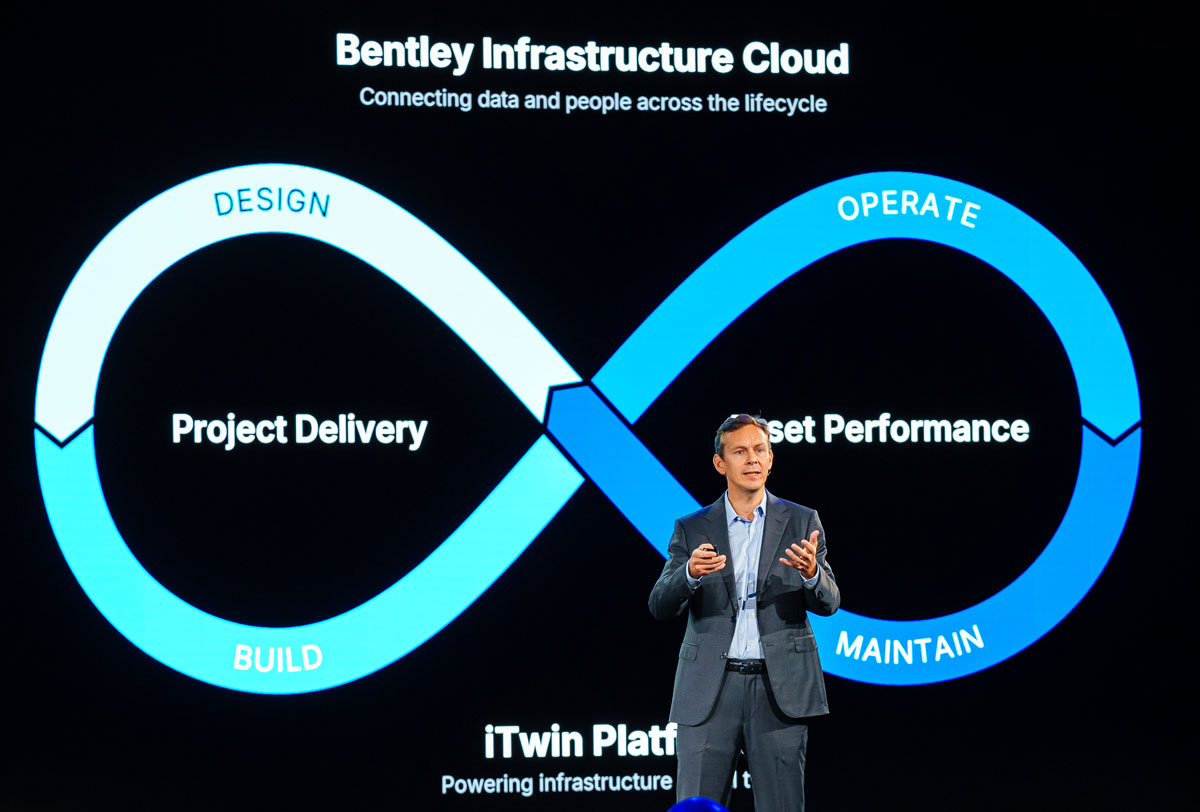
This post is an excerpt from the keynote delivered by Bentley CEO Nicholas Cumins to open the 2024 Year in Infrastructure conference.

Infrastructure today is facing unprecedented challenges. Around the world, demand for better, more resilient infrastructure is surging—whether it is to expand energy grids, modernize transportation networks, or retrofit existing structures to meet sustainable development goals. These are massive undertakings, requiring trillions of dollars in investment and decades of effort.

Despite the urgent needs, there are not enough engineers to meet this demand. Backlogs are growing, and projects are stacking up. The shortage of skilled engineers and technical professionals is widening the gap between what is needed and what can realistically be delivered.

“The future of infrastructure engineering is open,” said Bentley Chief Executive Officer Nicholas Cumins during his keynote at the 2024 Year in Infrastructure conference.

While we have a shortage of engineers, we do not have a shortage of data. And there lies the biggest paradox of our industry. We have so much data, but comparatively few insights. Many assets generate gigabytes of data every day—whether from sensors on a bridge, a utility network, or any other system. But only a small fraction of this data is ever analyzed. Some say 10% of collected data is used, others say not even that much.

As we advance toward more sophisticated asset operations and AI-driven insights, one thing has become abundantly clear: to unlock the full potential of these innovations, we must connect them to a broader data ecosystem.

Openness is vital given the long lifecycle of infrastructure. A road, a bridge, or a dam might be in operation for 50 years or more, undergoing repairs, upgrades, and expansions. During this time, the software and platforms used to manage these assets will evolve. By ensuring that our systems remain open, we allow organizations to adopt new technologies and innovations while still being able to access and build on historical data.

But openness is not just about connecting different software—it is about structuring and organizing data so that it can be queried, analyzed, and reused across multiple platforms. This is where Bentley’s Base Infrastructure Schema comes into play. Over the past 10 years, we have developed a robust, open-source schema specifically for infrastructure. It is a mature, proven framework that goes beyond basic data exchange. Our schema ensures that data is not just accessible, but its meaning can also be understood. Whether dealing with materials, structures, or subsurface data, the schema organizes information in a way that enables engineers, constructors, and organizations to reuse and fully leverage the value of their data.

By ensuring that data aligns to a common schema, we are allowing infrastructure teams to work better together, and make better-informed decisions. Openness will drive infrastructure forward.

A perfect example of how we are expanding the boundaries of openness is our partnership with Google—a partnership based on a shared vision of sustainable infrastructure. By integrating Google’s geospatial data into Bentley’s applications and platforms, we are elevating our capabilities to a whole new level. Google’s massive scale of geospatial data is unmatched. When this data is combined with Bentley’s infrastructure engineering expertise, the result is an ecosystem where data can flow seamlessly, providing users with the most comprehensive and actionable geospatial insights available.

Consider a large urban development project where multiple infrastructure systems—roads, bridges, energy and water networks—must be coordinated across various stakeholders. By integrating Google’s vast 3D geospatial data with Bentley’s Cesium technology and iTwin platform, stakeholders can visualize their assets (both existing and planned) in full, real-world context. This integration enables teams to make better-informed decisions about everything from design to operations, from improving project outcomes to reducing the risk of service outages.

Our partnership with Google reflects the reality within infrastructure: the reality is that no single vendor can address the complexity of today’s challenges alone. By bringing together the best of both worlds—Google’s unmatched geospatial data and Bentley’s industry-leading infrastructure engineering software—we are creating an open ecosystem that allows organizations to access the tools, data, and insights they need, whenever they need them. We are unleashing the potential of 3D geospatial data for infrastructure.

The future of infrastructure engineering is open. It is flexible, collaborative, and built on a foundation of data that can be shared securely. And at Bentley, we are leading the way—ensuring that the applications, platforms, and solutions we create meet the evolving needs of our industry.

- Video Advertisement -

Related Post

Digital Safety Nets — How Software is Preventing Workplace Disasters

In the high-stakes world of industrial maintenance, a split-second decision can lead to a catastrophic “arc flash”—an electrical explosion of intense heat and pressure. Today, we look at how manufacturing leaders are turning to advanced modeling software, specifically EasyPower, to transform these life-threatening risks into manageable business data. A routine inspection at a local manufacturing […]

Bentley’s SACS Software Saves Millions for India’s Offshore Energy Sector

The Oil & Natural Gas Corporation (ONGC) has utilized Bentley’s SACS software to digitally assess 18 unmanned wellhead jacket platforms off India’s western coast, aiming at achieving energy independence through modernization. These existing structures required modifications, such as adding clamp-on conductors, to enhance oil production. However, the platforms first had to be tested against much […]

Cambodia and China Partner to Advance Satellite Imagery Technology for Environmental Modernization

Strategic MoU aims to build ecological safety and a green future through enhanced data management and precision monitoring Cambodia and China have committed to a new era of technical cooperation aimed at modernizing the Kingdom’s environmental sector through advanced satellite imagery technology. The partnership was formalized through a Memorandum of Understanding (MoU) signed on March […]

Digital Twins and Drones Slashing Bridge Recovery Times in Kentucky

Emerging technologies are transforming how disaster-stricken areas rebuild, with Kentucky recently demonstrating that “digital twins” and aerial surveillance can reduce infrastructure recovery timelines from months to mere hours. Following devastating floods in 2022, the state leveraged its Bridging Kentucky initiative to bypass traditional, slow-moving survey methods. By deploying drones and 3D laser scanning, engineering teams […]

OpenRail Designer 2025: Redefining Efficiency for Global Rail Infrastructure

Bentley Systems has officially launched OpenRail Designer 2025, a major update designed to eliminate the manual bottlenecks that have long challenged rail engineers. By focusing on advanced automation, data integrity, and high-fidelity geospatial integration, this release transforms how complex rail networks—from routine maintenance to high-speed megaprojects—are designed and managed. As global demand for resilient infrastructure […]

How Portugal Uses Digital Tools to Manage Water Network During Heat Waves

As summer temperatures in northern Portugal consistently climb past 38°C, regional water utility Águas do Norte has successfully pivoted from reactive repairs to proactive management by leveraging Bentley Systems’ OpenFlows Water solution. Serving nearly 2 million residents across 63 municipalities, the utility faced recurring crises where extreme heat caused water tanks to hit critical lows, […]