Company unveils first-to-market AI-powered civil engineering application that delivers optimized, accurate site designs up to 10 times faster than traditional methods
VANCOUVER (Bentley Systems’ Year in Infrastructure 2024) – Bentley Systems, Incorporated (Nasdaq: BSY), the infrastructure engineering software company, today announced new generative AI capabilities for civil site design, including a design copilot, site layout optimizations, and automated drawing production that will drive new levels of productivity and accuracy.
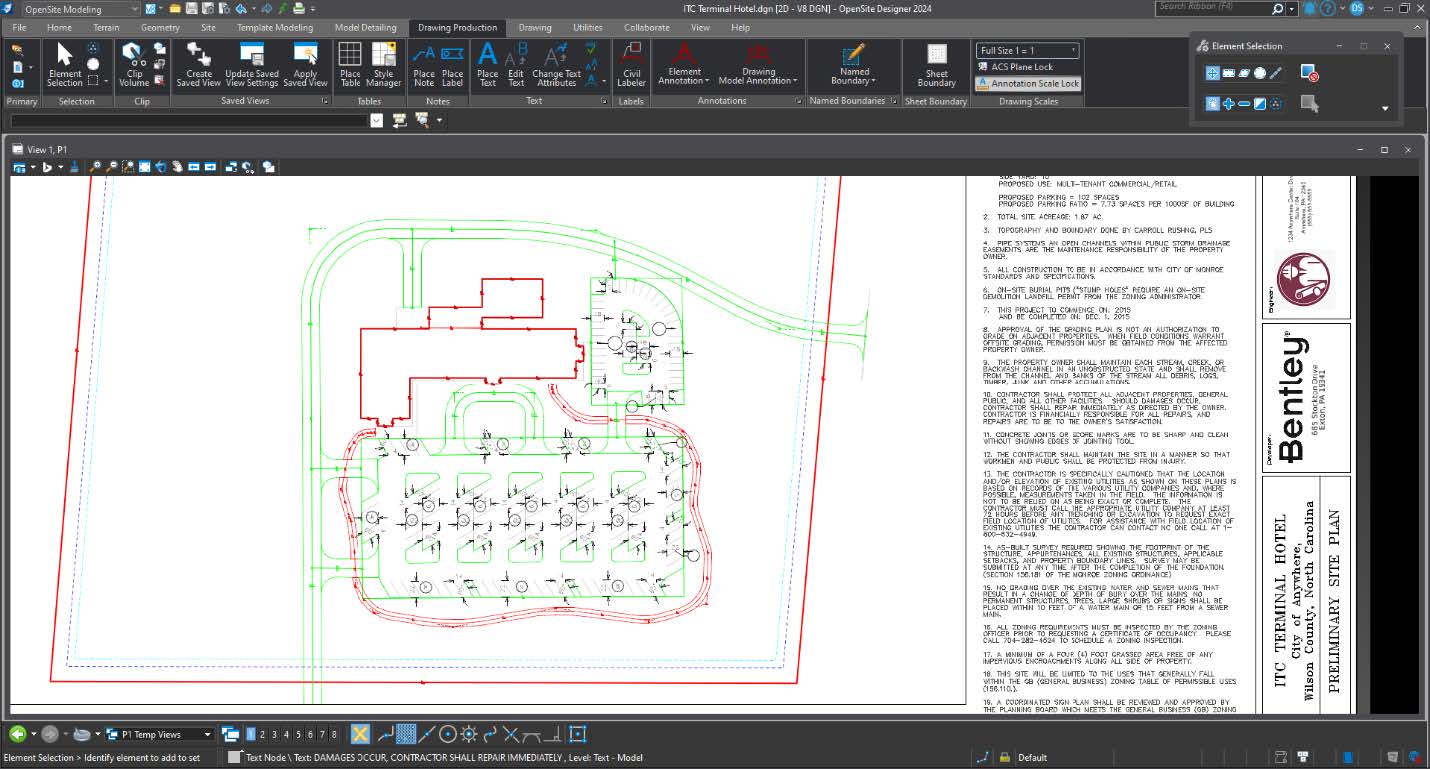
Bentley’s OpenSite+ software uses AI to automate annotation and plan production for civil site design. (Photo Bentley Systems)
Building on its success in applying AI-powered digital twins to asset maintenance—to detect and assess problems before failures occur—Bentley is bringing AI to the design phase of the infrastructure lifecycle to automate repetitive tasks, such as drawing production, so that engineers can focus on higher-value activities.
Putting AI into Action—Introducing OpenSite+
Bentley’s OpenSite+ is the first engineering application leveraging generative AI for civil site design. It helps engineers swiftly design residential, commercial, and industrial sites with AI tools, significantly boosting productivity and accuracy.
A digital twin-native product, built with Bentley’s iTwin platform, OpenSite+ delivers AI-powered efficiencies and better-quality designs with:
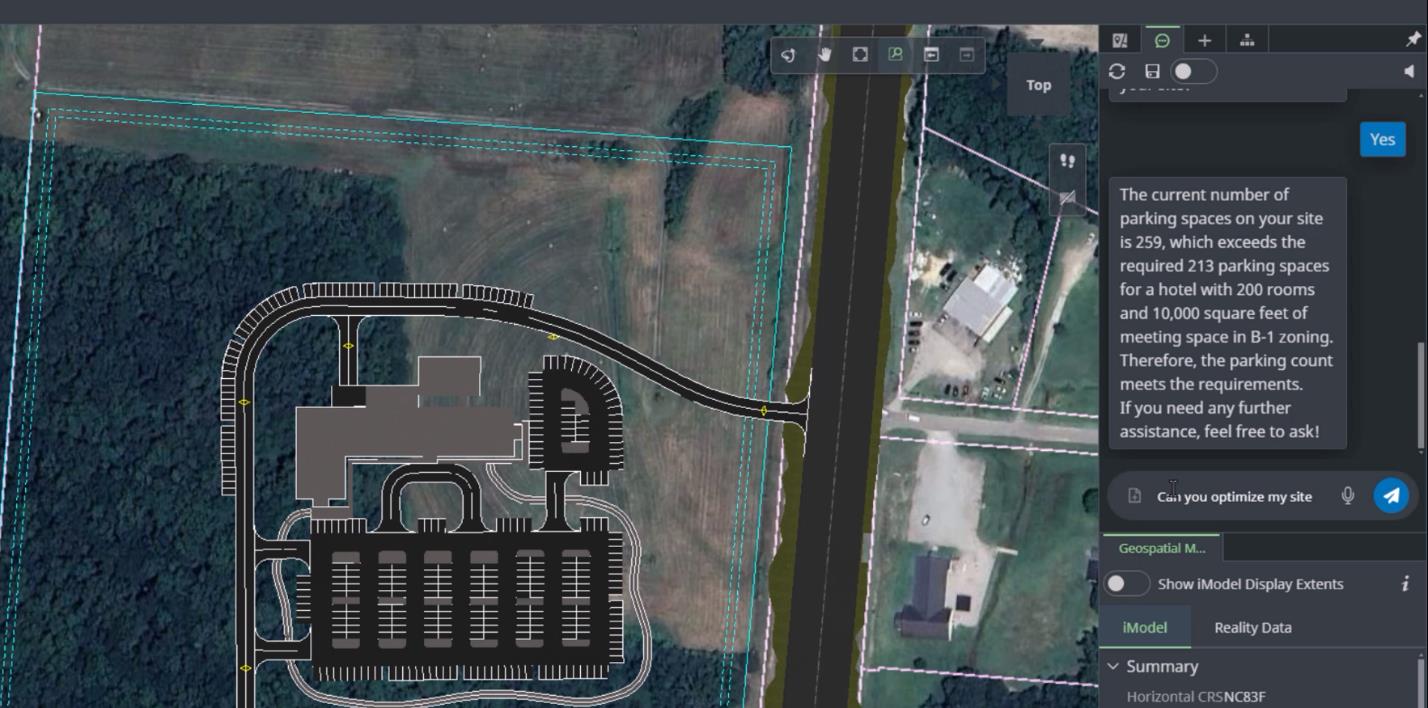
Enhanced Design Experience with Copilot: Users can quickly create, revise, and interact with requirements documentation and 3D site models through natural language interactions—to automatically make real-time design changes with precision and ease.
Layout Optimization: Users can enhance efficiency, reduce errors, and rework site designs in minutes with one-click earthwork optimization. Bentley’s AI-powered design layout agent can evaluate thousands of layout options and suggest alternative designs in real-time, helping users make better design decisions sooner, saving time and money.
Automated Drawing Production: Users can reduce time spent on mundane drawing tasks, accelerating drawing production by up to 10 times, and improve drawing accuracy using AI-powered annotation, labeling, and sheeting that automatically places labels and dimensions according to organizational standards that are optimized for legibility and aesthetics.
Smart Design Tools: Users can create and revise designs using intelligent, editable objects such as building pads, parking layouts, driveways, sidewalks, and ponds to complete projects in a fraction of time compared to traditional CAD software.
With OpenSite+, users also maintain control over their proprietary data during AI training, which creates a solid foundation to responsibly guide the development of AI models.
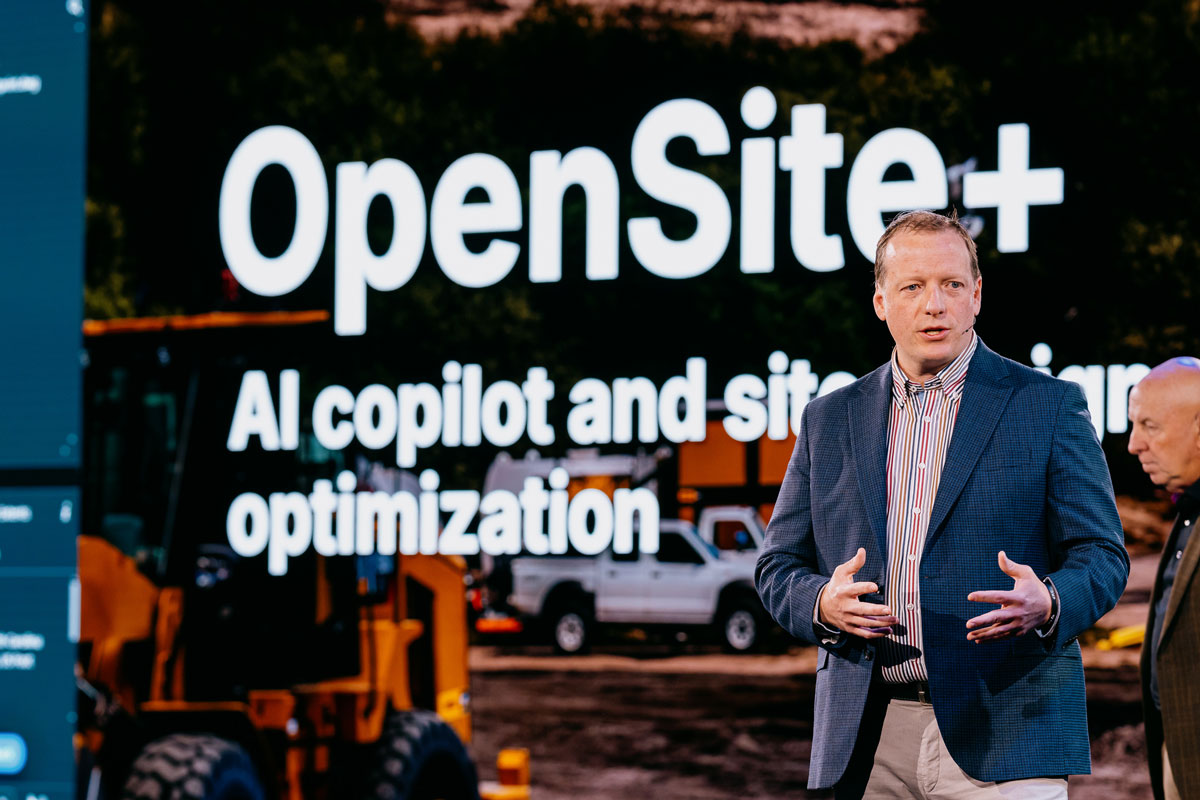
“By leveraging their past data to optimize future work, generative AI will revolutionize infrastructure design, improving engineers’ productivity and accuracy without sacrificing on quality,” said Mike Campbell, chief product officer at Bentley Systems. “OpenSite+ is just the first example of how Bentley is applying generative AI to benefit infrastructure design and project delivery.”
OpenSite+ early adopter, Joe Viscuso, senior vice president and director of Strategic Growth at Pennoni, commented, “OpenSite+ is a game-changer. By combining design and routine tasks into one powerful platform, it eliminates the need to switch between multiple programs. It streamlines our workflow, automates repetitive tasks, and ensures accuracy as we make changes in real-time. This means faster project completion with superior results, helping Pennoni stay ahead of the curve in both technology and innovation.”
OpenSite+ is the first of a new generation of Bentley Open Applications which run on desktops for optimal responsiveness, while offering the benefits of cloud-based applications, such as automatic updates and cross-operating system availability. The iTwin-native architecture enables seamless collaboration and data-centric workflows. Data is saved directly in a digital twin, which in turn can include data from other sources to provide full context for design work.
Availability
North American site engineering firms can apply for early access.
Bentley’s OpenSite+ software with copilot uses organization-specific documents and design models for quick insights and edits. (Photo Bentley Systems)
About Bentley Systems Bentley Systems (Nasdaq: BSY) is the infrastructure engineering software company. We provide innovative software to advance the world’s infrastructure – sustaining both the global economy and environment. Our industry-leading software solutions are used by professionals, and organizations of every size, for the design, construction, and operations of roads and bridges, rail and transit, water and wastewater, public works and utilities, buildings and campuses, mining, and industrial facilities. Our offerings, powered by the iTwin Platform for infrastructure digital twins, include MicroStation and Bentley Open applications for modeling and simulation, Seequent’s software for geoprofessionals, and Bentley Infrastructure Cloud encompassing ProjectWise for project delivery, SYNCHRO for construction management, and AssetWise for asset operations. Bentley Systems’ 5,200 colleagues generate annual revenues of more than $1 billion in 194 countries. www.bentley.com
For more information, contact: Press: Chris Phillips, PR@news.bentley.com Investors: Eric Boyer, IR@bentley.com
As urbanization accelerates and the demands on global infrastructure reach unprecedented heights, the industry stands at a major turning point. From managing complex subterranean geology for major metropolitan transit lines—like Vienna’s ambitious metro expansion using advanced 3D subsurface models—to navigating new paradigms in artificial intelligence and connected data, modern civil engineering is undergoing a massive […]
As Vienna’s population continues to surge and tourism hits record-breaking highs, the Austrian capital is looking downward to secure its future. The city is currently boring a brand-new metro line through some of the trickiest, most varied geological terrain in Europe—guided by an innovative 3D subsurface model that began, fittingly, on a rooftop. A Legacy […]
The people shaping the world’s infrastructure deserve an experience as extraordinary as the work they do. This year, Bentley built one. Bentley’s Year in Infrastructure Awards opened in Singapore with a new look. Now in its 22nd year, the event often called the “Oscars of Infrastructure” has a new host, a new keynote format, and […]
Engineers have developed a methodology using PLAXIS 2D to simulate tunnels built with the Traditional Method of Madrid (TMM), offering a faster alternative to complex three-dimensional analyses. Used in the Madrid Metro since 1917, the TMM divides tunnel excavation into small sections, typically less than 5 square meters. Each section is temporarily supported with timber […]
Mumbai’s Versova-Bandra Sea Link (VBSL), a 17.17-kilometer, eight-lane bridge set to become India’s second-longest, is being built with the help of digital project management software designed to keep a hugely complex construction effort organized and on schedule. Once finished, the bridge will connect Versova to Bandra and is expected to cut commute times sharply for […]
Automated calibration is helping transportation planners make travel demand modeling faster, more efficient and responsive to changing travel patterns. Traditionally, calibrating travel demand models required months of manual adjustments to ensure model results matched real-world data such as traffic counts, transit ridership and household travel surveys. Automated calibration simplifies the process by using optimization algorithms […]
 English
 ខ្មែរ