





Bentley’s New AI-Enabled Open Applications Deliver 10x Faster Project Completion

New OpenSite+, Substation+ use AI, automation, and collaboration to speed work as demand strains engineering capacity.

Demand for new infrastructures is growing faster than engineers can design and build them. By 2030, nearly 60% of the world’s population will live in urban areas, placing immense pressure on already-strained resources.

Bentley Systems has introduced a couple of Open Applications that are purpose-built to address this engineering capacity gap.

Tools like OpenSite+ and OpenUtilities Substation+ are now equipped with intelligence (AI) to help with engineering workflows from the start.

Traditional CAD-based workflows rely on manual, time-consuming processes, particularly in drawing production. This is where AI is transformative, according to Ian Rosam, product management director for Bentley’s civil engineering applications.

Rather than treating artificial intelligence as an add-on, Bentley has embedded large language models (LLMs) trained on engineering-specific knowledge, like building codes and environmental rules. The result is a fundamental mindset shift in how engineers work.

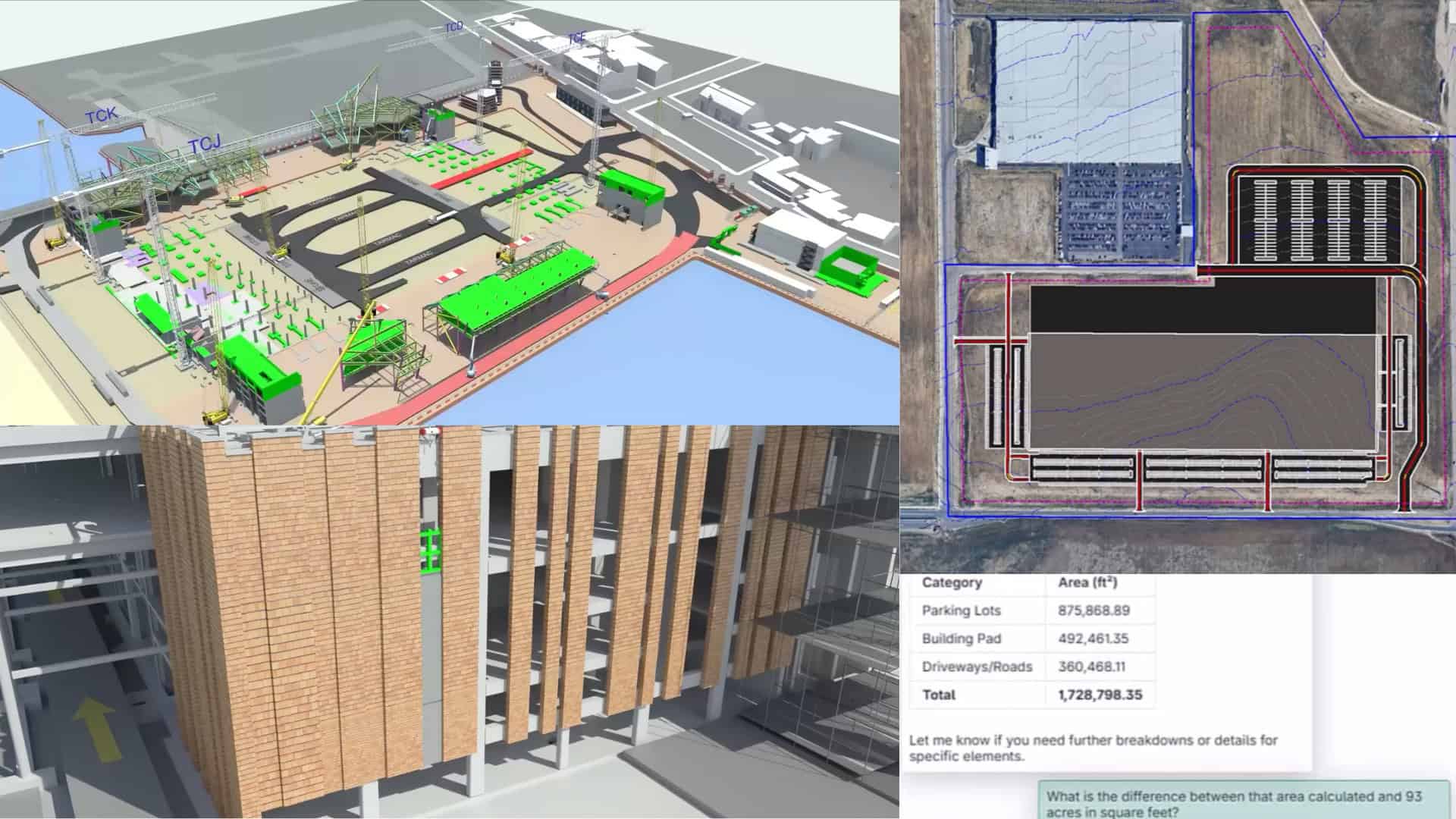
For example, in software like OpenSite+, an engineer can now use natural language prompts—typed or spoken—to execute complex calculations that the AI contextually understands. They don’t have to type in complicated code or formulas. (read more)

OpenSite+, the first in this next-generation lineup, enables site engineers to work dramatically faster by automating tedious tasks. The software delivers projects up to 10 times faster without sacrificing accuracy. It’s an all-in-one solution: data-centric, digital twin-native, and AI-powered, with integrated drainage design and automated drawing production.

Another new product with an AI feature is OpenUtilities Substation+. It uses intelligent 3D modeling, AI-enabled design assistance, and collaborative workflows to ensure aging infrastructure can meet today’s demands.

Bentley is also bringing these AI capabilities to existing infrastructure engineering applications, starting with OpenRoads Designer and OpenRail Designer for modeling road and rail projects.

Bentley Copilot has also been added to these applications, while a new AI tool automatically organizes labels on complex drawings with a single click, eliminating overlapping text and making drawings easier to read—saving significant time during the review and revision process.

Bentley’s solution also employs machine learning to automatically optimize label placement, leader line length, text rotation, and spacing. AI-powered automation takes the tedium out of producing drawings while maintaining the consistency and quality that contractors and regulators require.

What makes infrastructure AI different from consumer applications? Specifically, “infrastructure context”—the layered understanding of design intent, environmental constraints, historical data, and engineering logic that transforms AI into an engineer’s assistant.

Furthermore, Bentley also safeguards its software users’ intellectual property. Users can choose to contribute data for AI training that benefits the broader user community, but Bentley doesn’t use their data without permission.

Collage shows 3D site plans, an aerial view with outlined zones, and a table listing area calculations for parking, building, and driveways—ideal for Bentley or AI-enabled applications.
- Video Advertisement -

Related Post

Bentley Unveils MicroStation 2026: The AI-Powered Future of City Planning and Engineering

Bentley Systems has announced the launch of MicroStation 2026, a major upgrade to its flagship design software. The new release aims to tackle the global shortage of engineers by using artificial intelligence and “real-world” 3D mapping to help professionals design roads, bridges, and utilities faster than ever before. As infrastructure projects become more complex and […]

Tech Pivot Saves Germany’s First All-Digital Highway Project

A landmark infrastructure project in Germany is back on track and shattering efficiency records after a critical mid-course correction in its digital strategy. Viscan GmbH, the company tasked with creating a “digital twin” for the B29 highway expansion in Baden-Württemberg, successfully rescued the project from technical failure by overhauling its data processing systems. The ambitious […]

The Quiet Revolution: How AI is Reshaping America’s Highways

The US Department of Transportation (DOTs) is now utilizing AI to maintain roads and highways, as Alabama has become the latest state to bet its infrastructure budget on AI. For years, the Alabama Department of Transportation (ALDOT) relied on “performance-based budgeting,” a system designed to fund projects based on actual road needs rather than historical precedent. […]

ALDOT Integrates Bentley’s AI to Refine Performance-Based Highway Budgeting

Alabama Utilizes Bentley Tech to strengthen data-driven maintenance planning The Alabama Department of Transportation (ALDOT) is enhancing its long-standing performance-based budgeting model by integrating Blyncsy, an AI-powered solution from Bentley Systems. For more than 15 years, ALDOT has led the way in using data to drive financial decisions, but the manual collection of condition data […]

Bentley Systems Breaks Bottlenecks with New iTwin Capture Workflow

Bentley Systems is redefining the digital twin landscape by launching a more flexible, scalable approach to reality modeling. The new iTwin Capture workflow aims to eliminate the traditional “hardware wall” and high upfront costs that have long hindered engineers and urban planners. For years, infrastructure professionals have struggled with massive datasets—from LiDAR point clouds to […]

Europe’s Aging Power Grid Faces Digital “Makeover” to Meet 2030 Climate Goals

With many distribution grids expected to exceed their 40-year lifespan by 2030, EU policymakers and industry leaders are pivoting toward a “digital-first” strategy to prevent the system from buckling under the pressure of the green transition. The EU electricity infrastructure currently spans over a million kilometers, serving 600 million customers. To meet climate targets, the […]