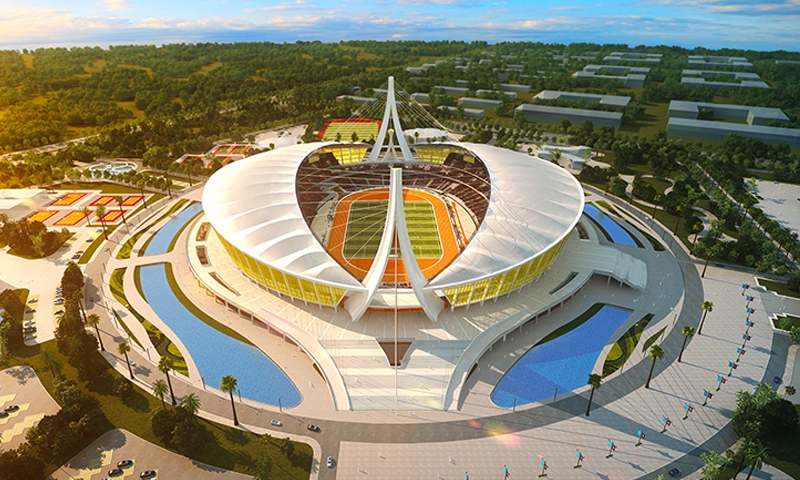
Born From Khmer Art to Meet Global Standards

Designed to meet traditional Khmer architectural concepts, the Morodok Techo National Sports Complex will also be built to international standards.

To welcome the 32nd Southeast Asia Games (SEA Games) in 2023 that will be hosted in Cambodia, as well as other large-scale national and international games; Cambodia began building the Morodok Techo National Sport Complex, in April 2013. The nation’s largest and most modern mega-sports facility and community is being constructed at Prek Tasek Commune in the capital’s Russei Keo District. To learn more about the architectural aspects so as the construction challenges for this massive masterpiece, Mr. Varheng Dawuth, Principal Architect at Architect Solutions Company gave an exclusive interview with Constuction and Property Magazine reporter Chhhuth Buntheoun.

1. What have been your experiences in the construction industry? What is your role in this new mega project?

I graduated in 1995 majoring in Architecture from Saigon, Vietnam. After graduation, I have acquired extensive experience in architectural design, and have designed numerous projects over the past two decades including hotels, factories, apartments, public offices, residential houses etc., Being a principal architect of this mega project, I am confident that the Morodok Techo National Sports Complex is no doubt one of the biggest challenges that an architect can take on. My role in this mega project; I am a principal architect responsible for designing the whole project.

2. How many stages are applied to the construction of Morodok Techo National Sports Complex?

Construction of this enormous stadium is divided into three phases covering 85 hectares of the landmass. Phase 1 began in April 2013; costing USD38 million, solely financed by the Cambodian government and built by the local firm L.Y.P. Group that owns the land. It is expected to be finished by the end of this year. Phase II, which is the construction of the main stadium with a capacity of 60,000 spectators and equipped with an international standard emergency exit system, incepted its construction in April 2017. The second phase costs USD157 million, financed by Chinese government, and is taking 40 months to complete. While the master plan for Phase III is already finished and is expected to be completed in mid-2021, we are now waiting for the requested budget from the government to kick off the work. During his four-day visit in May 2017 to Beijing to attend the One Belt, One Road Forum, Samdech Prime Minister Hun Sen also requested additional aid from his Chinese counterpart to cover the construction for the last phase. However, there are no updates thus far whether or not the Chinese side will inject some extra finance to finish the sport complex.

3. What are the key features to build in each stage? Which stage are you working on now?

Constructions for Phase I are the indoor sport centre, training halls, aquatic centre, athletes’ village, and training fields. Four buildings are targeted in Phase II: main stadium, hockey fields, traditional sports hall, and gymnastic centre. Phase III will consist of health care facilities, sports medical centre and tennis centre. We intend to utilise locally-sourced building materials and building workers as much as possible for economic reasons.

4. Which company is the main contractor? How about the architectural and engineering firm? Are many Cambodian firms sub-contracted there or are they mostly Chinese firms?

The Chinese government is footing the bill for Phase II after Cambodia’s coffers stumped up the funds for the first phase of development. Thus, the Chinese firm is entirely responsible for construction, partnered with L.Y.P Group as the developer. Yet, the architect firm is represented by Architect Solution Company, mainly responsible for initiating the design of its layout. This mega project has absorbed over 400 Cambodian workers; and only 25 local skilled workers are employed on the engineering aspect.

5. What are the biggest challenges in building this project?

Our last sports complex, the National Olympic Stadium Sports Complex, was built more than 50 years ago. To ensure we are up to date with modern standards for 35 different sports in our sport facilities, we have to work extremely hard by starting everything from scratch. We had to learn from our ASEAN friends: Thailand, Singapore, Malaysia, Vietnam, and Myanmar, yet we are still insufficient. We had to expand our journey to Europe, Spain, France and Italy – to learn about their standards as well. Thus, we spent a lot of times visiting the international stadiums; learning each stage thoroughly to ensure that this enormous sport complex will be built to international standards for the upcoming SEA Games to hosted in Cambodia in 2023 as well as many other large scale games to come.

6. What are the key special aspects of this mega stadium compared to other international stadiums?

The overall plan of this complex is inspired by the traditional and exceptionally rich architectural history of Cambodia. Several other elements of the layout, from the water system to road systems, are also inspired by the structure of the famed Angkor Wat Temple. Apart from the layout, each building’s design is inspired by various architectural styles and symbols from the past, from Angkor Wat to Banteay Srey Temple to the symbols of dragons and elephants just to name a few. Moreover, in each of its buildings, the Morodok Techo National Sports Complex is equipped with specialised, standardised sports equipment. It also is a natural sports location, teeming with fresh air and beautiful green scenery as different types of the green landscape will cover 70 percent of the 85-hectare land area.

- Video Advertisement -

Related Post

Bassac Riverbank Stabilization Project in Kandal Reaches 60% Completion

The ongoing infrastructure initiative to reinforce the Bassac riverbank in Sampov Poun City, Kandal Province, has achieved a significant milestone, with construction teams completing approximately 60% of the designated works. Local authorities and engineering crews remain heavily committed to accelerating the remaining phases to ensure the project concludes entirely on schedule. During a recent field […]

Cambodia and Vietnam Partner to Build Major Drug Rehabilitation Center in Svay Rieng

Cambodia and Vietnam are joining forces to establish an expansive National Drug Treatment and Rehabilitation Center in Svay Rieng Province. The planned facility will cover more than fifty-three hectares of land, marking a significant step forward in bilateral efforts to address substance dependency and long-term recovery. The project advanced further following a strategic meeting on […]

Kampong Cham Becomes First Cambodian Province to Finalize Precise Local Administrative Boundary Maps

Landmark mapping initiative paves the way for advanced economic corridors, digital integration with Google Maps, and comprehensive rural modernization under the Pentagonal Strategy In a historic milestone for Cambodia’s local governance and territorial management, Kampong Cham has officially become the first province in the nation to establish accurate, clear, and definitive administrative boundary maps for […]

Cambodia Nears Completion of Strategic Border Ring Road in Northeastern Provinces

Funded by the Border Infrastructure Fund, the infrastructure project in Mondulkiri and Ratanakiri achieves over 95% of its construction targets Cambodia’s ambitious infrastructure initiative to establish a continuous border ring road is nearing full completion, with construction teams successfully executing the vast majority of planned developments in Mondulkiri and Ratanakiri provinces. From the commencement of […]

Bentley Systems Unveils OpenUtilities Substation+ to Fix Fragmented Grid Design          

Bentley Systems has launched OpenUtilities Substation+, an AI-supported 3D design software designed to eliminate fragmented utility data. By unifying isolated civil, electrical, and structural information into a single standards-aligned model, the platform fixes the data gaps that stall automation and derail digital twin initiatives. By consolidating these distinct disciplines into a single architecture, the software […]

Chinese Enterprises Expand Industrial Footprint in Svay Rieng Special Economic Zone

Two manufacturing firms pledge capital to the Qilu SEZ following a successful provincial delegation visit to Shandong Province and Zibo City Svay Rieng Province is poised for further industrial expansion as two Chinese companies have officially committed to investing in the region’s prominent Qilu Special Economic Zone. This new capital injection aims to significantly expand […]