Chan Sim: Cambodia?s Living Human Treasure

Angkor Wat and its pantheon reflects Cambodia’s pride in traditional sculpture, carving and architectural decoration. But whenever these traditional arts are discussed today, Prof. Chan Sim is usually mentioned.

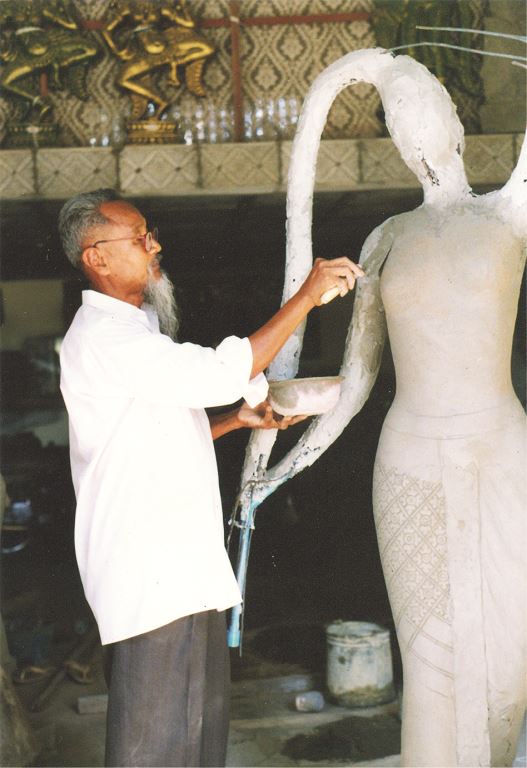
Born in 1936, Prof. Chan is among the nation’s few surviving legendary artists with advanced skills in carving, sculpture and traditional architectural decoration. This master has sacrificed over half a century of his lifetime training young Cambodians in these skills.

Throughout his career, he has produced masterpiece sculptures, statues, and Buddha statues nationwide. This legendary artist also decorated the exterior design of the National Assembly building to ensure it complies with traditional Khmer architectural principles.

Thanks to his catalogue of work, coupled with his long-standing social services, Prof. Chan has been bestowed with various national titles, including Honorary Artist by the Ministry of Culture and Fine Arts (2000), Khmer Classical Artist Academician (2004) from the Royal Academy of Cambodia, and later on as the Nation’s Living Human Treasure by the Ministry of Culture and Fine Arts (2013).

The Board of Architects of Cambodia (BAC), the state-run architectural body established in 2012, is also considering granting him another honorary title to celebrate his tremendous contribution to the nation.

“I will die one day, so what I can do now is to share what I have learned from my teachers to the next generation; we must preserve our own cultural treasure,” said Prof. Chan.

The master enrolled in metal sculpture education at fine arts school in 1952, inspired to learn the subject by his relatives not on his own preference. Two years after he graduated, he became the teacher at that school.

“In the beginning, I didn’t know why I should study this major, but only later on, I came to realize the great value of fine arts as the nation’s pride,” he said. “It is really my great honor to study this subject.”

In 1969, Sim continued with his education in the field of Tragedy Performance and Decoration and graduated in 1974. Later, he wished to pursue his education in archaeology, but unfortunately, his dream was washed away by the Khmer Rouge regime. After the regime collapsed, he came back to Phnom Penh and began his teaching career again; this time at the Ministry of Culture and Fine Arts.

In 1979, he resumed his teaching career at the same school. In 1993, he started lecturing on Khmer architecture. Despite reaching retirement age in 1996, he is still privileged to train Cambodian architect students in Khmer architectural design, sculpture and carving at the Royal University of Fine Arts and Norton University despite now being 79 years old.

After being nominated as a Living Human Treasure, he has stopped carving big sculptures, but he still provides ongoing support to the Ministry of Culture and Fine Arts by educating a new generation of young artists.

Although the architectural faculty was only established in Cambodia in 1958, Chan sees great improvements in the sector, though he would like to remind Cambodian architecture students and those working architects to not forget Khmer traditional decoration principles which are the nation’s pride. “Khmer traditional architectural decoration and sculpture has greatly developed now, but I would like to see all Khmer architecture conserved and promoted.”

- Video Advertisement -

Related Post

Kampong Cham Becomes First Cambodian Province to Finalize Precise Local Administrative Boundary Maps

Landmark mapping initiative paves the way for advanced economic corridors, digital integration with Google Maps, and comprehensive rural modernization under the Pentagonal Strategy In a historic milestone for Cambodia’s local governance and territorial management, Kampong Cham has officially become the first province in the nation to establish accurate, clear, and definitive administrative boundary maps for […]

Cambodia Nears Completion of Strategic Border Ring Road in Northeastern Provinces

Funded by the Border Infrastructure Fund, the infrastructure project in Mondulkiri and Ratanakiri achieves over 95% of its construction targets Cambodia’s ambitious infrastructure initiative to establish a continuous border ring road is nearing full completion, with construction teams successfully executing the vast majority of planned developments in Mondulkiri and Ratanakiri provinces. From the commencement of […]

Bentley Systems Unveils OpenUtilities Substation+ to Fix Fragmented Grid Design          

Bentley Systems has launched OpenUtilities Substation+, an AI-supported 3D design software designed to eliminate fragmented utility data. By unifying isolated civil, electrical, and structural information into a single standards-aligned model, the platform fixes the data gaps that stall automation and derail digital twin initiatives. By consolidating these distinct disciplines into a single architecture, the software […]

Chinese Enterprises Expand Industrial Footprint in Svay Rieng Special Economic Zone

Two manufacturing firms pledge capital to the Qilu SEZ following a successful provincial delegation visit to Shandong Province and Zibo City Svay Rieng Province is poised for further industrial expansion as two Chinese companies have officially committed to investing in the region’s prominent Qilu Special Economic Zone. This new capital injection aims to significantly expand […]

Borey Peng Huoth Unveils Phum Nimith Project Bridging Major Economic Hubs in Phnom Penh

On the occasion of its official sales launch on June 5, 2026, Borey Peng Huoth unveiled its brand-new residential masterpiece, the Phum Nimith Project. Serving as the inaugural development of the company’s highly anticipated third phase, known as Vibol Phum, this project is uniquely situated within a sprawling 600-hectare mixed-use development enclave owned by Borey […]

Execution Over Ambition: Bentley Systems Drives the Next Era of Wind Energy Infrastructure

At the WindEurope 2026 conference, the wind energy sector marked a major shift from setting ambitious clean energy targets to executing them at scale. Driven by corporate power purchase agreements and massive demand from data centers, the industry is moving away from government subsidies. However, this rapid growth faces significant hurdles, including complex permitting processes, […]