Construction Focus – Asean in Brief
THAI GOVERNMENT APPROVES $75 BILLION TRANSPORT PLAN
After the Thai Constitutional Court ruled the Yingluck Shinawatra government’s plan to borrow $63 billion to build a high-speed train network unconstitutional in March this year, the new military government has approved a $75 billion scheme to upgrade the nation’s infrastructure over the next 8 years. The plan reinstates the high speed rail deal with the Chinese government signed by Yingluck.
The infrastructure master plan will help bolster consumption and investment to give a boost to the struggling economy the government said in a press conference after the ruling council’s weekly meeting. Large-scale Thai transport upgrades have been in the pipeline since Thaksin was in power in 2006, but political instability has meant plans have been consistently delayed.
The new plans include expanding six dual-line rail tracks which, with extra investment, will eventually be able to handle 200km/h high speed trains; extending the elevated train lines in Bangkok; and increasing the capacity of airports, seaports, border areas, and cargo areas. Chinese companies are expected to be involved in assisting Thailand to upgrade its domestic rail network.
The two high-speed rail links will eventually link with Kunming, in the southern Chinese province of Yunnan. The $23 billion plan, scheduled for completion in 2021, will connect Map Tha Phut, south-east of Bangkok, to Nong Khai in the north, and Ban Pachi, in Ayutthaya, to Chiang Khong, just south of the Lao PDR capital Vientiane.
These rail links are part of a Chinese plan to construct a 3,000km rail network from Kunming to Singapore running through Lao PDR, Thailand, and Malaysia. A former chairman of China’s railways told the China Daily the network would increase the nations’ involved GDP by $375 billion and is seen to be a part of China’s ‘railway democracy’. Analysts have predicted that with the ease of travel and commerce that the new network will bring the region will fundamentally change, and Yunnan will effectively become the capital of Southeast Asia.
MYANMAR CONSTRUCTION AND PROPERTY MARKETS
Myanmar’s construction and property investment market is rapidly becoming the most dynamic in the region following the economic and political reforms which began in November 2011. A recent ADB report indicated that Myanmar’s economy is set to grow 7.8% over the next two years.
Energy, infrastructure and property development projects have been one of the main drivers of this growth with US$46 billion in government-approved foreign investment confirmed by the end of last year. The energy sector represents the largest percentage of foreign investment accounting for $19.28 billion, with the oil and gas sector not far behind totalling $14.37 billion. Gas exports alone accounted for income of $10 billion since 2011. The multi-billion dollar 2,400km China-Myanmar Gas Pipeline saw 1.8 billion cubic metres flow from Shwe fields off the coast of Myanmar’s western state of Rakhine to the Chinese city of Kumning its first year of operation alone.
In July this year, Thailand’s Siam Cement Group announced a $400 million investment to construct a cement factory in Mawlamyine, Mon State, scheduled for completion in the middle of 2016. According to company representatives and Myanmar officials, the growing investments in the industry and housing construction sectors, especially in major cities, means the manufacture of cement and ready mixed concrete and precast concrete blocks are priorities.
By 2020 Myanmar is expected to be welcoming 7.5 million tourists annually, up from 1 million in 2013, making construction of transport infrastructure a priority. A $1.5 billion Yangon International Airport project was originally slated to begin construction this year, but the bid ran into cost difficulties after Korea’s Incheon Airport Consortium initially won the contract in 2013. Myanmar is currently seeking $75 million (50% of the expected costs) from ODA (overseas development assistance) to complete the project.
This booming emerging construction market is also being driven by the need to build and upgrade the majority of Myanmar’s infrastructure including national projects (schools, hospitals etc), commercial projects (industrial zones, hotels, factories etc), transport (roads, bridges, airports, seaports etc), and housing (affordable, condominiums, luxury etc). Reflecting this construction growth, Yangon will be hosting the Building & Construction Myanmar trade show from 30 October to 1 November, 2014. The 2013 show attracted 171 exhibitors and the 2014 show is expected to attract many more.
The property market is also experiencing a boom as a result with new offices, hotels and apartment complexes quickly sprouting up in Yangon, Myanmar’s largest city. According to recent surveys in downtown Yangon, the cost of land has rapidly risen to as much as $1,500 per square foot (around $16,000 per square metre). That is approximately six times the price of similar plots in the Thai capital, Bangkok.
Fears remain however over Myanmar’s exposure to risk from natural disasters, like Cyclone Nargis in 2009, which can potentially disrupt and destroy growth. A new disaster management law was enacted in June 2013 and, in response, a new building code was instituted in March 2014 which takes into account new knowledge on possible effects from earthquakes and strong winds in the country.
However, despite fears in some quarters about the long-term economic and political stability, it is clear that in 2014 the construction and property sectors in Myanmar are booming and are set to do so for the immediate future.
INDONESIA INFRASTRUCTURE GETS BOOST FROM 2018 ASIAN GAMES
After a period of political uncertainty, the Indonesian construction sector is back on track with massive infrastructure projects to come on line as part of preparations for the 2018 Asian Games.
Jakarta governor Joko Widodo announced during a meeting between the Indonesian Olympic Committee and the Asian Olympic Committee that the city has begun construction to ensure the infrastructure is in place ready for the games.
Completing the landmark BMW Stadium in Pappongo, North Jakarta within two years is the major priority with upgrades to Ciracas, Cibubur and Senayan stadiums also planned. A MRT (Mass Rail Transit) system is also being constructed in Jakarta and is expected to start carrying passengers in 2018.
In anticipation of increased government spending on infrastructure projects and in response to the new government, Semen Indonesia, the country’s largest cement manufacturer, has set aside $500 million in capital expenditure for 2015. This 25% increase over 2014 will be used to build, or upgrade, cement plants and improve Semen’s distribution network. The state-controlled company aims to produce up to 40 million metric tons of cement by 2017, foreseeing a jump in cement demand between 2014 and 2019 from infrastructure projects with the country’s new administration.
LAO PDR CEMENT MARKET FIRMS UP
The Lao PDR government has halted coal exports to protect cement and other key national industries, according to the Lao Ministry of Energy and Mines. The country has six cement plants, which import a large volume of high-price coal, the ministry reported.
According to local cement producers, the price of locally produced cement is currently higher than that in Thailand. This poses a challenge for the industry when the Association of Southeast Asian Nations (ASEAN) Economic Community is established in 2015. Hence they are supporting a legal means to secure an adequate supply of coal mined inside the country.
The move comes after Siam Cement announced plans in May to build a $370 million 1.8mt/yr cement plant in Lao PDR with production expected to start in the second quarter of 2017. “This plant is meant to serve the greater Mekong region,” said President and CEO of Siam Cement, Kan Trakulhoo. Siam Cement intends to continue investing within ASEAN which is set to introduce a common market at the end of 2015. Siam Cement’s revenue for the first quarter of 2014 increased by 11% year-on-year to US$3.74bn.
THREE BILLION DOLLAR PROJECTS CLOSE TO COMPLETION IN VIETNAM
Vietnam is close to completing three interconnected mega-development projects in Hanoi worth almost a $1 billion each, jointly funded by the Japan Bank of International Cooperation (JIBC) and the Vietnamese government.
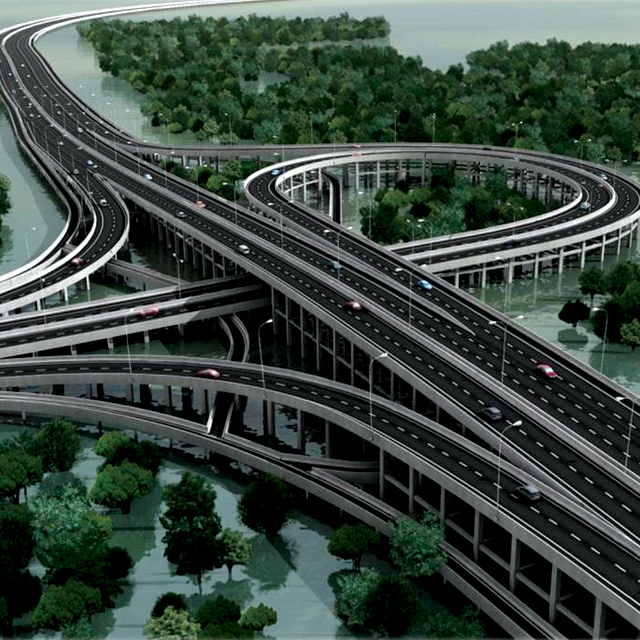
Linking the main section of Hanoi with Noi Bai International Airport, the magnificent Nhat Tan bridge will be the longest in Hanoi. At 33.2m wide, 8.9km long, and with 8 traffic lanes, the stunning construction will be Vietnam’s largest cable-stayed bridge. After construction started in March 2009, the $639.2 million project will be inaugurated on October 10, 2014.
Construction of the $968 million Terminal 2 at Hanoi’s Noi Bai International Airport is also nearing completion and is expected to come on line by the end of 2014. The 4-storey, 139,216 square meter building will add significant capacity to the airport and will be able to serve up to 10 million passengers a year.
Linking these two mega-developments together is a $317 million road which will be opened to traffic simultaneously with Nhat Tan bridge.
Also, following JICA’s reinstatement of ODA in July, a delegation visited Vietnam in August to appraise the $120 million Phase II of the Tien Sa seaport in Danang planned to be capable of receiving container ships of up to 70,000DWT and cruise ships of 100,000GRT.
- Video Advertisement -
 English
  ខ្មែរ
ខ្មែរ