Future of Phnom Penh Public Transportation: Lessons Learnt & Suggested Strategies

A researcher has suggested that Phnom Penh should redesign its public transport system master plan by learning from past mistakes and adapting successful policies from developed countries to achieve an inclusive and effective future public transportation system.

Future Forum’s urban policy researcher Ses Aronsakda wrote in an article published in The Southeast Asia Globe on 15 September that Phnom Penh remains one of the few Southeast Asia capital cities without a meaningful public transportation.

To mitigate the issues, the government has been thus far establishing different modes of public transport systems such as bus, airport train, and water taxi service.

However, the system has not seemed to succeed. All three networks still lack a unified payment system, which makes it inconvenient and expensive to hop between lines.

“Since 2018, the water taxi along Phnom Penh’s riverfront has run from north to south, with stops along the way at important destinations. However, the ridership tanked in the months afterwards. This was because each stop was disconnected from other transit, effectively stranding passengers after they left the station,” read the article.

Around the same time, the Airport Rail Link was inaugurated for public use. The train was forced to share a route with other vehicles, creating a dangerous environment due to lax traffic enforcement and unseparated tracks. As the result, it was also later suspended.

“Similarly, the bus network also failed to reach more adopters because it suffered from poor traffic management, including a lack of bus priority stoplights and separated lanes. The result led to lowered bus speed and inconsistent service, compounded by a lack of sheltered bus stops and the poor walkability of Phnom Penh’s streets,” the article added.

Given all the issues, the government has its eyes set on developing a modern light rail network. However, all the three proposed plans including monorail, sky train, and AGT are still under consideration.

Meanwhile, the author suggested that Cambodia policy planners should go beyond just executing a single system, and focus on developing a multi-layered, integrated and accessible transit system.

They can achieve this by building well-designed transit hubs, adopting a unified payment system, disentangling modes of transport into separate networks and using the street space gained to emphasize active commutes.

First of all, Cambodia can learn the strategy known as “disentanglement” from the Netherlands. This policy is a conscious, carefully planned effort to separate the various modes of transit and place them into different street networks designated specifically for them.

For instance, north and south travel can utilise the central and expansive Preah Norodom and Preah Monivong boulevards, which are ideal for light rail and city bus service. The more moderately sized Preah Trassak Peam and Pasteur streets can be designated as part of the private car network. Preah Yukanthor Street, a quieter route, can be part of the motorcycle network. This leaves Preah Sisowath Quay, a riverside avenue, as the perfect candidate for a pedestrian and cyclist path.

Phnom Penh must also establish transit hubs as the nucleus of a future public transit system. These are strategic intersections of major thoroughfares located across the city centre and immediate ring road.

Urban planners must then identify and design new routes connecting these transit hubs. In doing so, Cambodian planners should thoughtfully consider which streets best suit a particular mode of transit and apply a focused street design to accommodate the selected option.

This outline is a path for Phnom Penh to avoid the empty carriages and open seats of the present and move toward a future where sustainable urban mobility is a reality for every inhabitant.

- Video Advertisement -

Related Post

MPWT and AIIB Review Feasibility Study for National Road 8 Upgrade Connecting Prek Tamak to Ponhea Kraek

High-level technical session examines environmental-social assessments and financial modeling to accelerate a critical transit corridor across eastern Cambodia Phnom Penh: Upgrading Cambodia’s strategic transport corridors gained momentum as government officials and international financial partners reviewed preliminary engineering and environmental evaluations for a vital regional thoroughfare on National Route 8. According to the meeting session on […]

Prime Minister Inaugurates 98-Kilometer Road Network Worth Nearly $44 Million in Northeastern Cambodia

Modernizing National Road 73 alongside Provincial Roads 377 and 377A, the $43.95 million project enhances climate resilience, boosts agro-logistics, and strengthens trade routes across Kratie and Tboung Khmum. In a major boost to northeastern Cambodia’s transport networks, Prime Minister Samdech Thipadei Hun Manet officially inaugurated three upgraded national and provincial road sections in Kratie and […]

Cambodia Advances Strategic Infrastructure Plan with Upgraded National Road 1 and New Mekong River Bridge

Discussions on JICA’s draft final report highlight a 53-kilometer road widening project and an Extradosed Bridge connecting Phnom Penh to Areyksat along the Southern Economic Corridor As Southeast Asian nations continuously upgrade their transport networks to drive economic integration and regional competitiveness, Cambodia is taking significant strides to modernize its core transit corridors. On Wednesday, […]
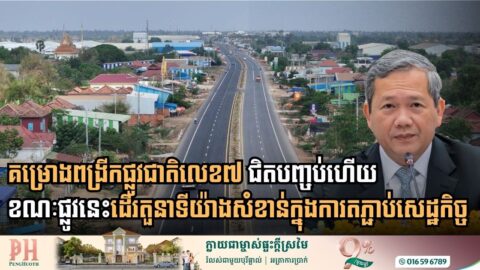
National Road 7 Expansion Project Nears Completion as Vital Economic Link Reaches 90% Finish

Accelerated construction on the Skun to Kampong Cham corridor aims for early delivery to boost regional trade and transport efficiency The expansion and upgrade of National Road 7, a critical infrastructure project connecting the Skun area to Kampong Cham city, has reached nearly 90% completion as of March 2026. This significant milestone was highlighted by […]

Cambodia Road Network Expands to Over 20,000 Kilometers in 2025

Strategic infrastructure development adds 426 kilometers to the national network to boost logistics and economic growth The total length of developed roads in Cambodia reached 20,733.91 kilometers by the end of 2025, marking a notable increase of approximately 426.32 kilometers compared to the previous year. This data was highlighted in the 2025 Annual Progress Report […]

Cambodia and Laos to Fast-Track Cross-Border Connectivity with New Ratanakiri-Attapeu Road Link

Joint inspection team to finalize construction zones this February to unlock new trade and economic opportunities Cambodia and Laos have reached a pivotal agreement to conduct a joint technical inspection aimed at defining the specific zones for a new road project connecting Ratanakiri province in Cambodia to Attapeu province in Laos. This initiative is a […]