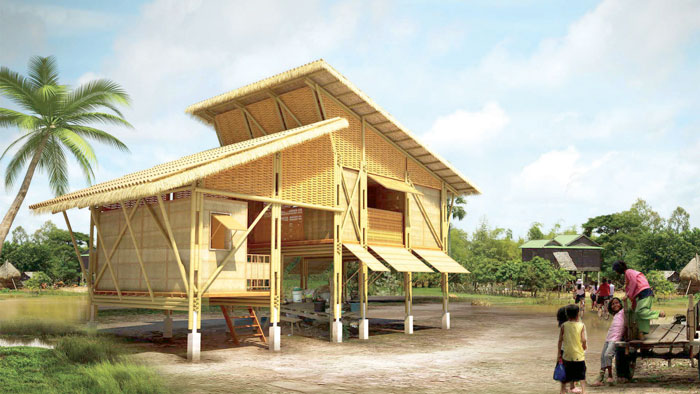
Government to Supply Social Housing in 2017

By Pich Kanhchanak

Despite 20 percent of Cambodian people reported to live at or under the poverty line, having access or ownership of decent shelter remains a hot issue for most low-income citizens among the population of 15 million.

However, solutions for these low-income residents are set to be deployed in the next two to three years, after a national housing policy drafted by the Ministry of Land Management, Urban Planning and Construction’s newly-established Housing Department is finalised and approved.

Dr. Penghong Socheat Khemro, General Director of the Ministry’s Housing Department told Construction and Property Magazine that Ministry officials, other public authorities and experts from relevant development partners (such as the Catholic Church organisation CARITAS, the German international development agency GIZ, and the Asian Coalition for Housing Rights (ACHR)) are presently conducting joint feasibility studies on this issue. He explained that they are currently working on project locations, design technicalities, legal frameworks, types of residences, and the target beneficiaries for this project.

“We are now at the step of preparing the regulations of public housing, and we have lots of steps to do,” he said, adding that, “We have to conduct surveys to identify the [living conditions] of the people.”

Once the technicalities and financing of this national housing mechanism are drafted and approved by the government, this new housing department consisting of three divisions will launch a public housing development pilot project in 2017 or 2018 before applying it nationwide. “In the meantime, we are setting up housing departments in every province/city and they are working to set up their respective housing development mechanisms for their territory as well,” said Dr Penghong.

Since the process is still at the interim stage, no details of the funding package have yet been released. But Dr. Penghong confirmed that once the mechanism and the responsible officials are ready, the government ‘might’ offer budget support for this project. He also indicated that CARITAS, GIZ, ACHR and other development partners are also likely to contribute some financial support for this project.

It is planned that two kinds of shelters will be built, i.e. houses for sale and for rent to low and medium income citizens. The property value and rental price will be dependent on the outcome of the feasibility studies.

Three categories of citizens will benefit from this housing policy; those with medium-income, low incomes, and the vulnerable.

Aside from the government’s national housing policy, the Overseas Cambodian Investment Cooperation (OCIC), the country’s leading property developer, announced a few years ago that it also launched a public housing development project that will be sold to low and medium-income officials to be built at the 387-hectare Chroy Changvar Peninsular—Phnom Penh’s future satellite city. Officials interested in owning a house in this project can take out a mortgage from Canadia Bank with payment terms up to 15 years.

According to a report by the World Bank, about 21 percent of the Cambodian population still lives at or below the poverty line of $1.25 per day. About 56 percent live within the “vulnerable poor” bracket, with an expenditure of between $1.25 and $2.60 per day; and about 20 percent account for the middle class income bracket.

- Video Advertisement -

Related Post

Kampong Cham Becomes First Cambodian Province to Finalize Precise Local Administrative Boundary Maps

Landmark mapping initiative paves the way for advanced economic corridors, digital integration with Google Maps, and comprehensive rural modernization under the Pentagonal Strategy In a historic milestone for Cambodia’s local governance and territorial management, Kampong Cham has officially become the first province in the nation to establish accurate, clear, and definitive administrative boundary maps for […]

Cambodia Nears Completion of Strategic Border Ring Road in Northeastern Provinces

Funded by the Border Infrastructure Fund, the infrastructure project in Mondulkiri and Ratanakiri achieves over 95% of its construction targets Cambodia’s ambitious infrastructure initiative to establish a continuous border ring road is nearing full completion, with construction teams successfully executing the vast majority of planned developments in Mondulkiri and Ratanakiri provinces. From the commencement of […]

Bentley Systems Unveils OpenUtilities Substation+ to Fix Fragmented Grid Design          

Bentley Systems has launched OpenUtilities Substation+, an AI-supported 3D design software designed to eliminate fragmented utility data. By unifying isolated civil, electrical, and structural information into a single standards-aligned model, the platform fixes the data gaps that stall automation and derail digital twin initiatives. By consolidating these distinct disciplines into a single architecture, the software […]

Chinese Enterprises Expand Industrial Footprint in Svay Rieng Special Economic Zone

Two manufacturing firms pledge capital to the Qilu SEZ following a successful provincial delegation visit to Shandong Province and Zibo City Svay Rieng Province is poised for further industrial expansion as two Chinese companies have officially committed to investing in the region’s prominent Qilu Special Economic Zone. This new capital injection aims to significantly expand […]

Borey Peng Huoth Unveils Phum Nimith Project Bridging Major Economic Hubs in Phnom Penh

On the occasion of its official sales launch on June 5, 2026, Borey Peng Huoth unveiled its brand-new residential masterpiece, the Phum Nimith Project. Serving as the inaugural development of the company’s highly anticipated third phase, known as Vibol Phum, this project is uniquely situated within a sprawling 600-hectare mixed-use development enclave owned by Borey […]

Execution Over Ambition: Bentley Systems Drives the Next Era of Wind Energy Infrastructure

At the WindEurope 2026 conference, the wind energy sector marked a major shift from setting ambitious clean energy targets to executing them at scale. Driven by corporate power purchase agreements and massive demand from data centers, the industry is moving away from government subsidies. However, this rapid growth faces significant hurdles, including complex permitting processes, […]