Prime Minister Samdech Hun Sen Opens Stung Mean Chey Flyover

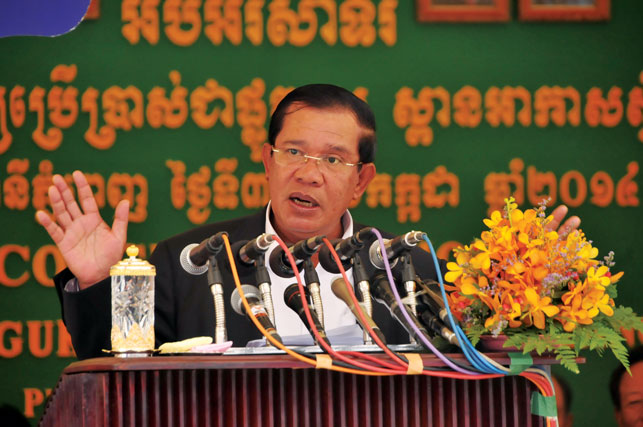
On 31 July, Prime Minister Samdech Hun Sen officially inaugurated Phnom Penh’s third flyover in Stung Mean Chey to reduce traffic congestion on the capital’s increasingly crowded roads.

During the inauguration ceremony, PM Samdech Hun Sen evoked memories of a Phnom Penh without traffic not too long ago, but expressed his hope that, “the launch of the third flyover will respond to the traffic congestion in the city today.”

With a population of nearly 2 million people using 300,000 cars, and a million motorcycles in the city every day, significant infrastructure upgrades are required to reduce current congestion and also prevent future gridlock as population and vehicle numbers grow together with the development of the nation. The government’s willingness to fight against traffic congestion has taken a number of approaches to reduce and improve the rush hour traffic flow, including twinned bridges, expanded roads, flyovers, tunnels, and public bus services.

The butterfly-shaped Stung Mean Chey flyover spans the intersection of Mean Chey, Chamkarmon, and Tuol Kork districts in the southwest of Phnom Penh, and consists of four main bridges. According to the Municipal Department of Public Works and Transportation, the first main bridge is 429 meters long by 9 meters wide; the second is 376 meters long by 9 meters wide; the third is 18 meters long by 11 meters wide; with the fourth spanning 20 meters by 12.7 meters. The last two bridges cross the Stung Mean Chey sewage canal.

In his inauguration speech PM Samdech Hun Sun said, “The overpass will not only ease the traffic congestion in the area, but also add to the city’s beautiful landscapes,” adding an apology for disturbing the people who live in the construction area with sound, dust and congestion.

The Premier stressed the project’s contribution to new development in the capital, and announced the construction of a green park and playground under the overpass covering the sewage canal for locals to do exercise and in order to create a gorgeous area. “The new outcome will improve not only the hard traffic conditions, but also the economic activities and the environment as well,” he added.

Worth US$19 million, the 20-month flyover construction was designed and built by the Overseas Cambodian Investment Corporation (OCIC) with local architects and constructors. “I am really proud of this project and others, including the Peace Palace and other flyovers, resulting from Cambodian builders and architects without assistance from foreign experts,” PM Samdech Hen Sen said. The new flyover’s design certainly showcases and qualifies Cambodia’s increased capacity in the architecture and construction sectors and their ability to respond to the increasing development requirements of the nation.

PM Samdech Hun Sen also announced a new public bus service with 43 buses run by City Hall. The new service is likely to operate on four straight-lined routes on the capital’s main roads with low-priced fares, with exemptions for the disabled and students, to decrease the number of vehicles moving around the city.

“A public bus service is a big part of a response to the overcrowded traffic flow,” he said, adding that despite the second failure of operating the public bus service, it would not come to an end, and the government has enough capacity to handle it.

Following a 2012 groundbreaking ceremony, the government is soon going to build the city’s fourth flyover at the intersection of Russian Blvd and Mao Tse Toung Blvd in the west of Phnom Penh at an estimated cost of US$14 million, covered by OCIC. This next overpass project will also include a tunnel, and construction is expected to take about 18 months.

According to Phnom Penh Municipality, the government will continue the campaign against increasing traffic flow and congestion with more significant projects including tunnel construction projects near Canadia Tower, a pavement for pedestrians along the riverside on Sisowath Blvd, and another new overpass constructed at the intersection of Russian Blvd and Hanoi Road.

- Video Advertisement -

Related Post

Virtual Reality Brings America’s Historic Engineering Marvels to Life

As the nation approaches its 250th anniversary, a new virtual project is offering an immersive look at the structural innovations that shaped the United States. By utilizing Cesium’s advanced, open-source geospatial technology, this initiative maps 17 iconic landmarks—ranging from the Statue of Liberty and the Hoover Dam to the Empire State Building—into a precise 3D […]

Public and Private Sectors Join Forces to Elevate Cambodia into a Regional Automotive Hub

Cambodia’s ambitions to modernize its industrial economy and establish itself as a competitive regional center for vehicle assembly gained significant momentum following a landmark joint session between government leaders and private automotive stakeholders. On July 31, 2026, HE Sun Chanthol, Deputy Prime Minister and First Vice President of the Council for the Development of Cambodia, […]

Borey Peng Huoth Unveils SOHO Modern Home Design with Exclusive Promotional Offers

Leading Cambodian real estate developer Borey Peng Huoth is set to unveil its latest architectural creation for 2026, the SOHO Modern, during a special weekend celebration themed the “8 Lucky Fortunes” event on August 8 and 9, 2026. Thoughtfully designed to harmonize contemporary urban living with commercial functionality, the SOHO Modern home model offers an […]

Bentley Systems Highlights AI and Digital Tools for Smarter Asset Performance

Bentley Systems is showcasing how artificial intelligence (AI) and digital technologies are transforming asset management, enabling organizations to predict equipment failures, reduce downtime, and improve the performance and reliability of critical infrastructure and industrial assets. The company’s software enables maintenance, inspection, and operational data to be captured digitally and combined into a single platform, giving […]

Kampot Cement Operations Reach 2 Million Ton Capacity to Fuel Cambodia’s Infrastructure Growth

Cambodia’s domestic industrial base continues to play a vital role in powering the Kingdom’s rapid physical infrastructure development, led by Kampot Cement, the country’s first and largest cement manufacturing facility. Situated in Kampot province, the state-of-the-art industrial plant maintains a robust production capacity of approximately 2 million metric tons per year. On July 28, 2026, […]

GGGI and Ministry of Environment Partner to Advance Biodiversity and Carbon Neutrality by 2050

A newly signed cooperation agreement for 2026 to 2028 focuses on climate resilience, forest restoration, and Article 6 carbon market development across Cambodia Cambodia is reinforcing its commitment to a sustainable future through an expanded partnership with the Global Green Growth Institute, aimed at safeguarding national biodiversity and accelerating the Kingdom’s journey toward net-zero emissions. […]