United States Deploys Multi-Billion Dollar Strategy to Anchor Security and Technological Leadership in Southeast Asia

Secretary Marco Rubio’s high-level diplomacy in Manila signals a major U.S. push to enhance infrastructure, energy security, and regional competitiveness across ASEAN

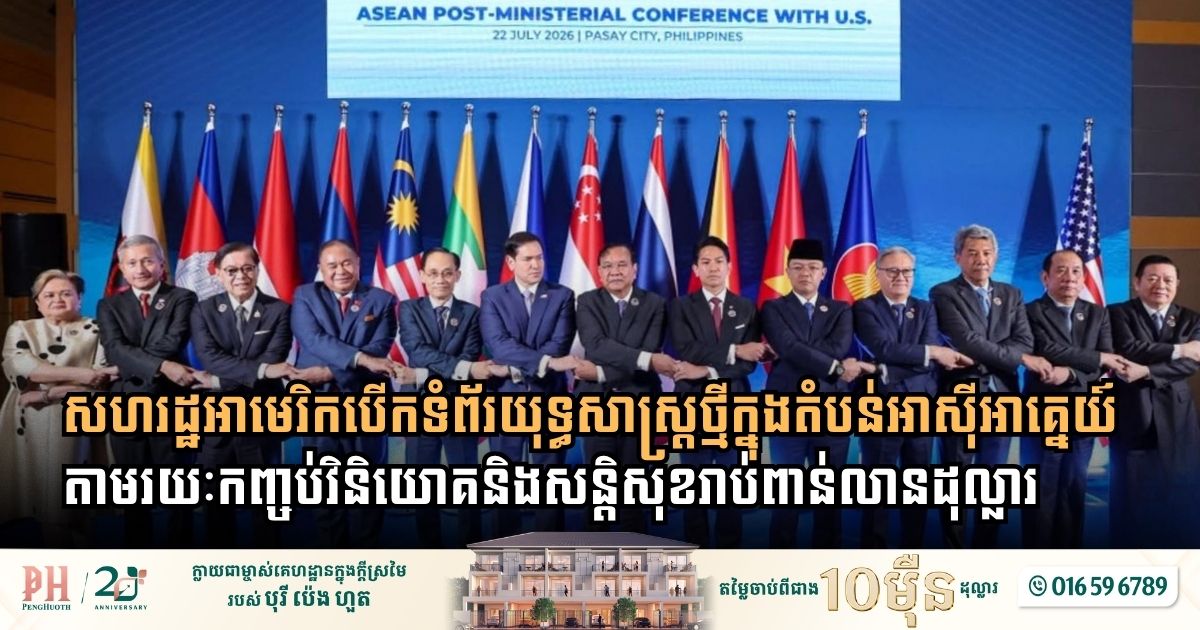
Manila: In a decisive bid to reinforce its strategic presence and counterbalance competing global powers in Southeast Asia, the United States has unveiled a massive multi-billion-dollar initiative designed to deepen ties across the Indo-Pacific. During his official diplomacy in Manila from July 21 to 23, 2026, U.S. Secretary of State Marco Rubio met with ASEAN leaders to reaffirm American commitment to ASEAN centrality and advance the vision of a Free and Open Indo-Pacific. As part of this visit, Washington announced over $2.5 billion in targeted investments and grant programs spanning strategic infrastructure, energy security, technology exports, counter-transnational crime, and defense cooperation.

At the center of the economic and technological pillar is the new AI SPARK initiative under the Pax Silica framework, which aims to make Southeast Asia a major destination for American artificial intelligence exports while backing public sector deployments. To support critical digital systems, Washington is committing $10 million to secure and modernize the information and communications technology infrastructure of the Philippines. In the energy sphere, the Millennium Challenge Corporation approved a $60 million grant to Manila, complemented by $17 million for the Mekong Minerals Partnership and $4 million for Philippine critical mineral investments. Furthermore, through the Japan-U.S.-Mekong Power Partnership (JUMPP), $5 million is allocated to develop power markets and cross-border electricity trade across Cambodia, Laos, Thailand, and Vietnam.

Strategic infrastructure and commercial ties form another core dimension of the U.S. regional engagement. The U.S. International Development Finance Corporation is establishing a landmark $1.5 billion energy investment platform, marking the largest single project investment in the agency’s history. Washington also unveiled plans for over $100 million in strategic assistance for the Philippines, focusing on Subic Bay within the Luzon Economic Corridor to upgrade port facilities and construct a fuel storage terminal with a capacity exceeding 120 million liters. These public investments align with booming private sector activity, as U.S. firms generated over $14 billion in commercial deals across ASEAN over the past year, highlighted by Philippine Airlines’ intent to purchase up to 20 Boeing 787 aircraft powered by GE Aerospace GEnx engines.

On the defense and security front, the U.S. is allocating $100 million in Foreign Military Financing to the Philippines for fiscal year 2026, representing a $60 million increase over historic annual baselines. Maritime and counterterrorism capabilities are being bolstered through a $9 million expansion of the Philippine Coast Guard Pier in Palawan, $19 million for counterterrorism operations, a $6.5 million contract for the Rhombus AI Concierge strategic decision platform, and $3 million for cyber training. Across the broader region, Washington is funding $21.45 million for International Military Education and Training (IMET) programs, which includes restarting IMET in Cambodia and launching a new program in Brunei, alongside $2.5 million to combat transnational crime. Demonstrating a sustained commitment to legacy war issues and public health, the U.S. is allocating over $130 million for unexploded ordnance demining in Cambodia, Laos, and Vietnam, while committing up to $685 million under a five-year joint health agreement with the Philippines.

Washington’s comprehensive funding package reflects a sophisticated recalibration of U.S. foreign policy in Southeast Asia, blending hard security guarantees with high-value economic and technological partnerships. By delivering tangible infrastructure, clean energy solutions, and advanced technology transfers, the United States offers ASEAN member states a compelling alternative to foster economic resilience and sovereign security. As geopolitical competition intensifies across the Indo-Pacific, this multi-faceted strategy positions the U.S. as an indispensable partner in driving long-term stability and regional competitiveness.

- Video Advertisement -

Related Post

Cambodia Outlines Four Strategic Pillars for Long-Term Investor Security

The Royal Government of Cambodia has officially rolled out a comprehensive, four-pronged strategic roadmap designed to elevate national competitiveness and cultivate a highly favorable long-term environment for international and domestic investors. The macroeconomic blueprint was detailed by HE Sun Chanthol, Deputy Prime Minister and First Vice Chairman of the Council for the Development of Cambodia […]

Maritime Geopolitical Rivalry Intensifies as Vietnam Accelerates $4 Billion Deep Sea Port Project in the Far South

The massive infrastructure development on Hon Khoai Island serves as both an economic gateway for the Mekong Delta and a strategic maritime shield amid shifting regional dynamics Ho Chi Minh City: The geopolitical and trade landscape of Southeast Asia is entering a highly competitive phase as nations across the region race to build strategic advantages. […]

Cambodia Establishes Six ‘Rong Cham’ Villages in Banteay Meanchey

Split from Sla Kram Commune, the new administrative entries institutionalize a symbolic border settlement originally named by Samdech Techo Hun Sen. The Royal Government of Cambodia, acting through the Ministry of Interior, has officially authorized the establishment of six new villages—designated as Rong Cham 1, Rong Cham 2, Rong Cham 3, Rong Cham 4, Rong […]

Cambodia and China Lock in Four Strategic Mega-Infrastructure Projects

Following high-level talks in Beijing between DPM Sun Chanthol and CIDCA, a fresh bilateral consensus secures fast-tracked implementation for the Funan Techo Canal, key national highways, and coastal environmental protection. In a major diplomatic breakthrough aimed at reshaping Cambodia’s trade and logistics landscape, Cambodia and China have formally agreed to fast-track the implementation of four […]

Acting Head of State Urges Swift Action on Land Titling to Address Public Concerns

Samdech Techo Hun Sen calls for land registration to become an essential service as ministries gather to streamline the process In an effort to address public dissatisfaction over administrative delays, Samdech Techo Hun Sen, the Acting Head of State of the Kingdom of Cambodia, has called on the Royal Government to significantly accelerate the issuance […]

Cambodia Unveils Visionary $36 Billion Logistics Master Plan to Secure Global Competitiveness

Comprehensive decade-long strategy encompassing 174 projects aims to revolutionize national transport infrastructure and attract high-value foreign investment In a major step toward transforming the kingdom into a regional trade hub, the Royal Government of Cambodia has officially launched an ambitious master plan to overhaul its intermodal transport and logistics systems. This strategic roadmap, involving a […]