Cambodia to Apply Construction Management System
All construction projects in Cambodia which meet the required criteria will need to apply the Construction Management (CM) System once the CM proclamation is finalised and enacted by the government.
Construction Management (CM) or Construction Project Management (CPM) is the overall planning, coordination, and control of a project from beginning to completion. CM is aimed at meeting a client’s requirements in order to produce a functionally and financially viable project.
The law which has been introduced by the Construction Management Association of Korea (CMAK) under the support from the Korean Ministry of Land, Infrastructure and Transportation is now on the final step to reaching consensus between CMAK, Cambodia Constructors Association (CCA), the Ministry of Land Management, Urban Planning and Construction, and the private and public sectors dealing with the building industry, before it can be sent to the Council of Ministers for approval.
The CCA has played a crucial role in commenting on and assisting the facilitation of the proclamation.
The draft CM proclamation contains seven chapters and 47 articles. The main issues stated in the draft are; the overview of the proclamation and the definition of key terminologies, the CM principle, CM authority and pertinent parties, the CM system features, how the CM system is implemented, and the management on construction sites.
The Ministry of Land Management, Urban Planning and Construction signed a MoU with CMAK to establish the CM system in Cambodia two years ago. CMAK, a private-construction group in Korea established in 1997 with 170 contractors member, has encouraged following Korean practices to ensure sustainable development of Cambodia’s construction industry. Since then, CMAK has undertaken research that led to the drafting of the CM proclamation and other regulations, as well as sharing experiences with Cambodian professionals.
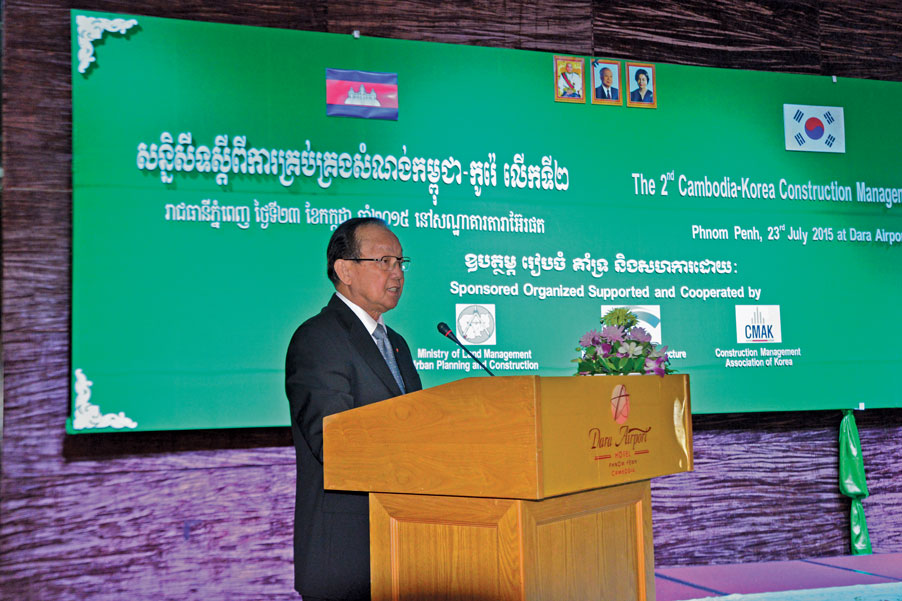
A 2nd CM conference was hosted in late July where CMAK representatives were able answer the concerns raised by the CCA and representatives from the private and public sectors on the impact of CM, which allowed for the completion of the proclamation.
Concerns about CM among Cambodian developers and the CCA have focused mainly on increased costs, minimum project scale size to fall under the system, the rights to select CM companies, the scope of CM services that owners can decide to apply for their projects, and the risks that developers will face if CM companies they hire go bankrupt.
This cooperative framework will enable the implementation of the Prakas on CM System which will be officially adopted in the near future, said H.E. Im Chhun Lim, Minister of Land Management, Urban Planning and Construction at the conference.
As well as their extensive liaison with the CCA and others, CMAK has also provided the ministry with a CM Manual to help all relevant stakeholders clearly understand CM. CMAK also brought a Building Code Framework to the ministry to assist with the drafting of the nation’s long-awaited construction law.
CMAK has also provided training on the CM System to 31 technical staff from the ministry, construction professionals and lecturers from three building-related universities to spread knowledge to others. The topics included; CM introduction, explanation of regulations relevant to CM, codes or building standards, design control, project cost control, management procedure, quality management, and safety management.
“I have great hope that this CM Manual and this Building Code Framework will be the foundations for additional regulations on the management of the Cambodian construction industry. It will enable this industry to be in line with current development as well as with national and international standards,” said H.E. Minister Im Chhun Lim.
The minister admitted the extent of the current challenge in implementing this CM system in Cambodia, since it is a new concept requiring ongoing discussion. However, he fully supported the statement by Mr. Yung Hwi-Bae, CMAK Chairman who said that, “Using CM in any construction project will reduce construction time and cost, and increase its quality.”
“Using proper construction management can save cost and time, and ensure quality and safety. It also includes construction risk management,” said Professor Hyun Soo Lee of College of Engineering, Seoul National University who represented CMAK at a meeting with the CCA last year. “But it is very hard to apply the South Korean construction methods here since Cambodia doesn’t have a well-organised construction law yet,” he added.
H.E. Huy Nara, Director General of the Ministry’s General Department of Construction, said the main role of the CM system is to ensure respective construction projects must have effective management unlike today where most of them are being anarchically built.
“So far, we have consultancies that control the architectural plan, topology, structural plan, and technology and many other sectors but these alone don’t provide for strong responsibility and management on those projects yet, he said. “So this CM proclamation aims to ensure complete management of construction projects from start to finish.”
In order to be effectively implemented on residential, business, large-scale and industrial buildings, H.E Huy Nara pointed out that CM in Cambodia demands additional development of laws, regulations, policies, and technology relevant to the current requirements of the industry. It also needs technology and skills development through sharing research results and education.
“A stable construction industry can be achieved dependent on the vision of project owners, engineers, architects and builders,” the director general added. “But this also requires organising the project management, design and construction process, labor management, use of materials, cost management, contracts, implementation schedules, and procedures for management of quality, and safety.”
The ministry has been actively revising existing laws and regulations, signing MoUs with the private sector (such as with the Cambodia Constructors Association (CCA) and CMAK) and cooperating with local and international building-related agencies to build a strong foundation for the booming sector.
According to the ministry, in the first 6 months of 2015, 915 projects were approved with an estimated investment value of $808 million. 2014 saw 1,960 projects worth an estimated $2.5 billion approved; a decrease of 9.60 per cent compared to 2013.
The rapid growth of the sector is largely due to all categories of building being developed. 91 residential borei sites have either been completed or are under construction in Phnom Penh to date.
Most of these buildings currently under development will need to use the CM system once the proclamation is approved and comes into effect.
- Video Advertisement -
 English
  ខ្មែរ
ខ្មែរ