How Substation+ Improves Aging Grid Management

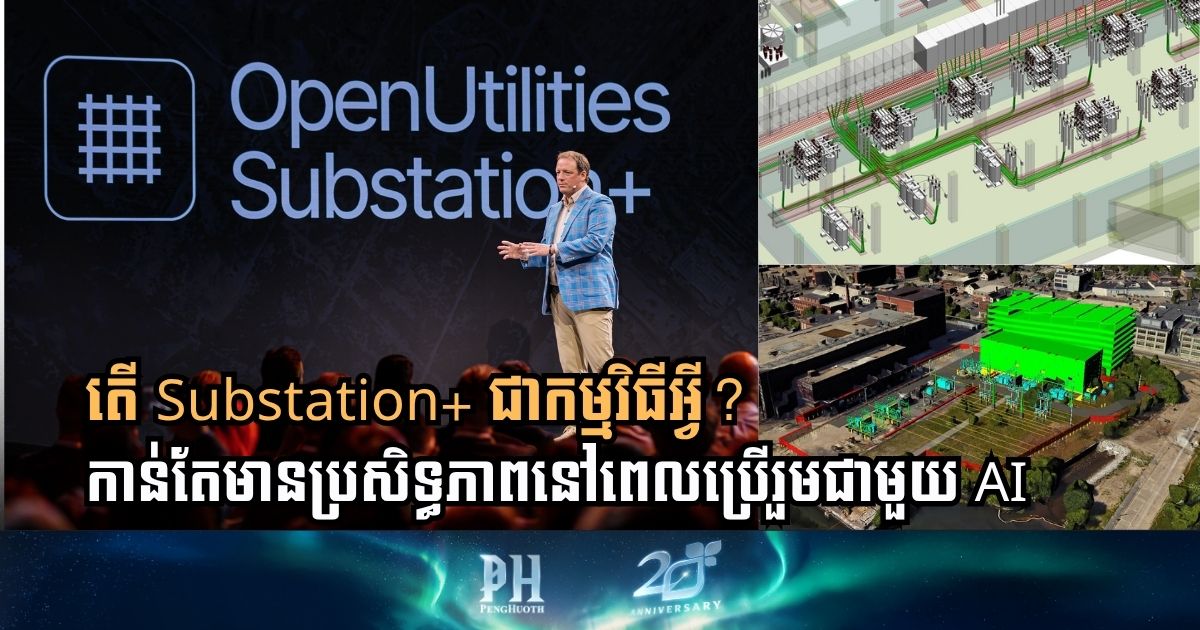
Bentley Systems has unveiled the OpenUtilities Substation+, a software equipped with iTwin feature, AI, and real-time collaboration to help improve aging grid management through faster issue detection and real-time workflow sync.

According to Director of Product Development at Bentley Systems Michael Antonishen, Substation+ is built to modernize how substations are designed, built, and maintained.

In a digitized world, substations act as the nervous system of the electrical grid – monitoring, controlling, and protecting the flow of electricity through the system.

With Substation+, utilities can use intelligent 3D modeling, AI-enabled design assistance, and collaborative workflows to ensure their aging infrastructure can be improved in time to meet today’s demands.

Up to the present day, most traditional substation design has relied heavily on 2D and 3D drawing software—legacy tools that, while functional, keep engineers tethered to traditional linear workflows, which can create bottlenecks, limit information sharing, and slow down projects overall.

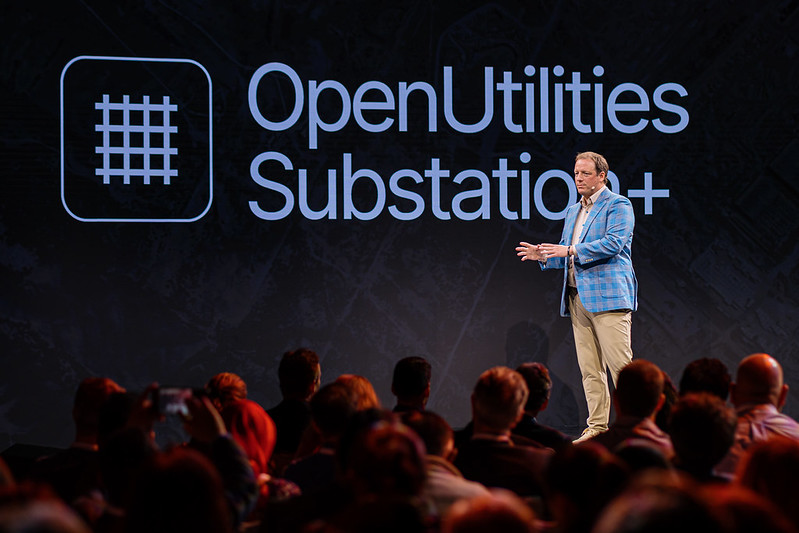
Bentley Systems SVP of Open Applications Francois Valois speaks during the main keynote Wednesday, Oct. 15, during Year in Infrastructure 2025 and Going Digital Awards. (Photo courtesy of Bentley Systems)

Built on Bentley’s iTwin platform, Substation+ is data-centric and designed for real-time collaboration across disciplines and teams. Work order branches allow many users to work on the same model simultaneously, syncing updates to a shared source of truth in the cloud – enhancing visibility of parallel workstreams and eliminating manual version management.

In addition to this, Substation+ sets itself apart through its ability to embed intelligence directly into 3D models and enable intuitive features for users of all skill levels. Unlike traditional CAD drawings, which simply represent visual geometry, the software offers detailed context about each component.

“Each model you’re building knows what’s a circuit breaker and what’s a transformer,” Antonishen explains. This semantic awareness enables automatic compatibility checks, clearance validation, and metadata integration—tedious tasks that engineers have traditionally performed manually.

An embedded Bentley CoPilot AI assistant further automates and improves the substation design process. Multiple autonomous agents work together to solve complex tasks, select appropriate equipment, and power decision-making. Engineers can upload dense design criteria documents and ask natural questions like, “Does this circuit breaker meet all design requirements?” The AI understands both the model properties and project requirements.

“Substation designers shouldn’t have to be expert 3D modelers or technology specialists,” Antonishen says. “Being able to use natural language to interact with the application and the model is both powerful and scalable.”

The data-centric and connected nature of Substation+, and other next-generation applications built on the iTwin platform, like OpenSite+, allows data to flow securely and seamlessly across the asset lifecycle. For example, engineers can reference data from Bentley products, such as OpenSite+ for civil design or SYNCHRO for construction management, and connect to enterprise systems like SAP or Maximo for asset management.

This approach proves especially valuable for brownfield projects—the majority of substation work—where existing documentation is often scattered or outdated.

“Large utility teams can work on the same projects at the same time, or on multiple projects at the same site at the same time, when building a model in multiple phases of the lifecycle,” says Antonishen. “It’s a combined ecosystem.”

- Video Advertisement -

Related Post

How Bentley Digital Twins is Reshaping Maritime Inspections

Major engineering firm Haskoning has revolutionized maritime infrastructure inspection by successfully completing a digital-first assessment of the Holyhead Deepwater Jetty in North Wales using Bentley Systems software. A critical asset supporting cruise vessels and contributing over GBP 4.75 million annually to the regional economy, the aging jetty required a comprehensive inspection of its 400 piles […]

Digital Twins: The New Shield Against El Niño’s Cascading Grid Threats

To combat the super El Niño looms for 2026, utility companies are now shifting away from traditional reactive repairs and toward proactive, data-driven resilience using Bentley Systems’ software. In 2025, utility companies are facing a dangerous new reality where weather disasters no longer happen in isolation. Modern power grids are increasingly vulnerable to cascading failures—where […]

AI and Connected Data: The Key to Rebuilding Europe’s Infrastructure

At the Bentley Illuminate 2026 conference, industry leaders revealed that Europe’s massive infrastructure goals—including Germany’s €500 billion investment cycle—rely on a digital transformation powered by Artificial Intelligence (AI) and connected data. As the continent faces aging assets and a shortage of engineers, technology is no longer optional; it is the primary engine for growth. The […]

AI Drones Take Over Bridge Inspections, Saving Millions

The United States is swapping human climbers for AI-powered drones to fix over 600,000 bridges along the Mississippi River, a faster, cheaper, and safer way to maintain crumbling infrastructure. Traditionally, inspecting a massive structure like St. Paul’s Robert Street Bridge is a nightmare. Engineers have to dangle from ropes, snap thousands of photos by hand, […]

The Tech Behind Bentley’s Immersive Digital Twins

In the world of massive infrastructure, the biggest challenge isn’t just building a bridge—it’s helping people visualize it before it exists. Bentley Systems is solving this through its iLab innovation hub, where lead designer Liana O’Cleirigh is deploying a suite of high-tech tools that turn complex engineering data into immersive, human-scale experiences. At the heart […]

How Data-Driven Workflows Are Changing Engineering Delivery

For decades, the engineering and construction industry has relied on the exchange of digital files—the familiar DWGs and PDFs—as the bedrock of project delivery. However, as global infrastructure grows in complexity, a new paradigm is emerging. Experts are calling for an evolutionary crossroads where the industry moves beyond static file handovers toward dynamic, data-driven workflows. […]