Property Tax Collection Extended to End 2014

The government has extended its deadline to collect property tax for the third time this year in response to many property owners still being unwilling to pay. After the deadlines of 30 September and 31 October passed, a new deadline of 31 December, 2014 was set.

In a notice released on 4 December, the General Department of Taxation said that while a majority of property owners had paid the tax, a minority had still yet to pay and the extension of the deadline was to ensure these outstanding dues could be collected.

The announcement also warned property owners who fail to pay the tax due or miss the deadline will be subject to penalties according to the tax laws. “They will risk facing both legal punishment and extra fines for late payment,” the statement said.

Tax department officials refused to comment on the penalty procedure, the number of property owners, and the amount of tax they had collected so far. They did however report a total of US$881 million in tax revenue collection last year, which included taxes on salaries, profits, vehicles, merchandise, services, and property.

But a lawyer at a regional tax advisory told the Khmer Times newspaper that the penalty for late filing is more than just a slap on the wrist. He said property owners who fail to file their due taxes on time are subject to a fine of US$500 plus between 10% and 25% of the property’s due tax.

“If the government is forced to do an audit, this goes up to US$500, plus 40% of the tax due,” he said, adding that fines accrue 2% interest a month on the total tax due.

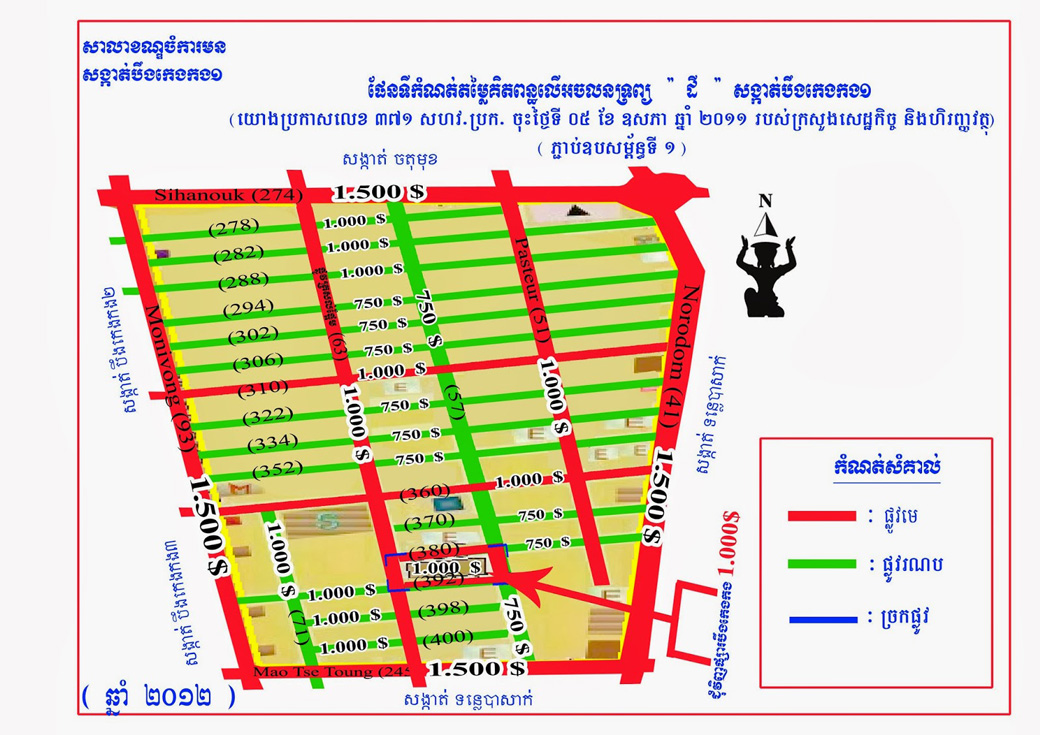
The property tax is an annual payment on homes, buildings and other structures charged at 0.1% of the property’s value as estimated by an evaluation committee. The tax, introduced in 2011, applies only to property worth more than 100 million riels (about US$25,000) located in some districts of Phnom Penh and some cities/provinces.

Property owners can pay their tax directly at the nearest city/province tax departments or at branches of Canadia Bank, or ACELEDA Bank.

Speaking to the Khmer Times, ACLEDA Bank Executive Vice-President So Phonnary said that property owners had made 8,500 payments, amounting to US$1.37 million, at ACLEDA through to the end of September.

Ms. Phonnary said she was also unaware as to why, four years since the property tax was first rolled out, some property owners are still late filing. “They are obligated – they must pay this tax by the deadline,” she said. “Maybe they didn’t know [about] the deadline?”

Real estate traders generally believe that the property tax will not affect the booming real estate market if it is collected fairly.

Kim Heang, General Manager of Khmer Real Estate agrees that collection of property tax collection doesn’t affect the market as it demonstrates the progression of the market progression in line with other nations, but also claimed it is too soon for Cambodia to implement it.

Heang, who bought a house at Borey New World worth US$175,000 and paid the property tax of 270,000 riels (US$67.5), observed that the property appraisal by the government didn’t align with the market price.

“The real market price and the valuated price by the government are different because there are some areas that the government appraises cheaper than the real market price and other areas that the government appraises higher than the market prices. But if we generalize those public rates, it is also acceptable,” he said. “However, I think the cheaper valuation is better because this kind of tax due should not be strictly implemented because it is too early for Cambodians to adapt,” he added.

While Touch Samnang, Deputy-Director of OCIC, the conglomerate behind dozens of property developments, supports the law, he claimed that transparency and fairness should be ensured among all properties.

Chrek Soknim, CEO of Century 21 Vtrust believes that the property tax collection creates both positive and negative effects on this young real estate market.

“For positives, I believe the tax collection will increase the national revenue, while citizens with many buildings and land will start utilizing those properties to generate income without leaving them inactive like before. This is good for the economy,” he said.

“But I am afraid some investors may hesitate to invest or trade property here due to the property tax duties while the market is rising slightly,” he added.

It should be noted that the collection of property tax collection was delayed from 2012 to 2013 and now to 2014 because the majority of property owners have not been willing to accept this new tax.

- Video Advertisement -

Related Post

Bentley Systems Wins Gold Stevie Award for AI Breakthrough in Engineering

Bentley Systems has won the Gold Stevie Award for Technology Breakthrough of the Year in the Construction and Civil Engineering Technology category at the 2026 Stevie Awards for Technology Excellence. The award recognizes Bentley’s Model Context Protocol (MCP) servers for STAAD. Pro and MicroStation, which bring agentic artificial intelligence into established infrastructure engineering workflows. Bentley’s […]

China Reaffirms Strategic Support for Cambodia’s Economic Development and Key Mega-Projects

China has reaffirmed its full commitment to encouraging Chinese state-owned and private enterprises to expand direct investments in Cambodia, aiming to drive the Kingdom’s next phase of socio-economic growth. The renewed investment pledge was solidified during a high-level bilateral meeting on September 7, 2026, between H.E. Sun Chanthol, Deputy Prime Minister and First Vice President […]

U.S. Business Delegation Explores High-Potential Investment Sectors and Incentives in Cambodia

Coordinated by the American Cambodia Business Chamber, American investors meet with Cambodian Investment Board leadership to evaluate green energy, logistics, and manufacturing opportunities while paving the way for a Virginia trade mission A trade and investment delegation from the United States conducted a series of high-level consultations with the Cambodian Investment Board on September 7, […]

Freeland Municipal Authority Uses Digital Twins to Reduce Water Loss

Freeland Municipal Authority (FMA) in Pennsylvania is using a digital twin to improve leak detection, reduce nonrevenue water, and strengthen the long-term resilience of its water system. Serving about 3,900 people, FMA had struggled to identify leaks and track water losses efficiently. The utility often relied on outside companies for leak detection, making the process […]

Royal Government Evaluates Proposal for Manhattan II Special Economic Zone in Svay Rieng

The 5th Single Window Meeting reviews plans to build on the legacy of the pioneer 315-hectare Manhattan SEZ across Cambodia’s premier border trade hub The Royal Government of Cambodia, through the Cambodian Investment Board of the Council for the Development of Cambodia, has convened the fifth Single Window Meeting of 2026 to evaluate a major […]

Cambodian Attends 21st APSF General Assembly in Seoul to Drive Regional Logistics Standardization

Public Works Ministry and logistics leaders present national progress on the APSF Roadmap 2030 and explore smart cold-chain systems across South Korea to elevate supply chain efficiency Seoul: Modernizing national supply chains and harmonizing trade standards remain critical imperatives for the Royal Government of Cambodia as it works to boost economic competitiveness and streamline cross-border […]