City Hall Unveils Improved Facilities

To enhance efficiency and centralise operations, Phnom Penh Municipality officially opened its new administrative building and underground parking facility in early April.

Construction on the City Hall-funded, 12-storey, 51-metre high building began in June 2015 and was completed in January 2016. With a total floor area of 11,310 square metres, this architectural masterpiece combined Khmer and modern influences and was designed by Cambodian architects.

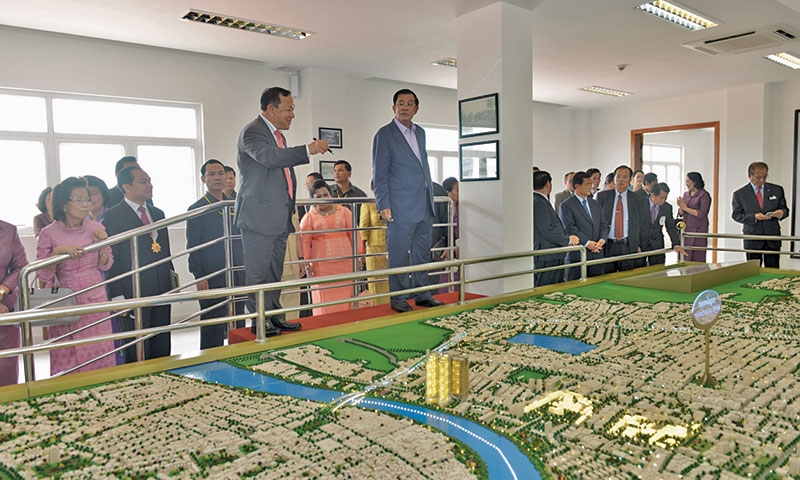
The 1st floor houses the One Window Service Centre and the 1st floor to 8th floor offices are occupied by the municipality’s general works. The 9th floor is home to the CCTV camera surveillance centre, the 10th floor accommodates the city’s 2035 urban master plan model while the 11th floor is designed for the conference centre.

This new building will help accommodate the estimated 340 city hall officials, City Hall spokesman Long Dimanche told the Phnom Penh Post last year. When all the district and commune officials are included, this number swells to 800.

Due to the ongoing issue of limited parking spaces, City Hall has also opened a 3-level underground parking lot. Completed in February 2016 it has a total floor area of 7,780 metres and is able to accommodate 239 cars. Besides the new building and parking facilities, city hall also undertook a large scale renovation of existing buildings and premises.

According to Phnom Penh governor H.E. Pa Socheatevong, Phnom Penh was first initiated as a city in 1375 at Wat Phnom Hill. The city was then modernised during the reign of King Ponhea Yat from 1431 to 1434 with improved irrigation and infrastructure systems.

24 years after Cambodia came under French protection in 1887, the capital was moved from Udong to a small area in today’s Daun Penh district when formal administrative and commercial zones were built surrounding Wat Phnom Hill. Various infrastructure projects including, roads, a railway, a port, schools, hospitals, public and sports buildings were constructed on a grand scale during this period.

Between 1953 and 1970, Phnom Penh underwent another period of modernisation guided by an urban master plan designed by the Sangkum Nistr Reyum government of that era. A nightmare of destruction descended on the capital from 1970 to 1975 before becoming a ghost city during the genocidal era between 1975 and 1979.

“Today, Phnom Penh stretches over 678 square kilometres divided into 12 districts and 96 communes and 909 villages. The capital’s constant population is 1.6 million people with another 0.8 million migrant workers and is growing at an annual rate of 3.15 percent with a population density of 2,287/km,” said the governor.

At the ceremony to inaugurate this new building, Prime Minister Hun Sen reminded all officials to strengthen their productivity in line with the nice new buildings.

“…the new office building here corresponds to the progress made so far in Phnom Penh. But the biggest problem then was not to have a fancy office, but to ensure work efficiency,” he said.

“I am still calling, despite very good working offices, for work efficiency. It seemed that in the 1980s, when we were in the most difficult situation with work places in bad shape, work efficiency was higher…” he stressed.

mso-fareast-font-family:Calibri;mso-fareast-theme-font:minor-latin;mso-ansi-language:
EN-US;mso-fareast-language:EN-US;mso-bidi-language:KHM”>In a letter City Hall sent to the Ministry of Interior for approval last year, the municipality has established 11 additional communes from 5 districts to enhance its efficiency.

- Video Advertisement -

Related Post

Construction of Bassac River Bridge Linking Chak Angre Krom and Prek Pra Reaches 73% Completion

The construction of the highly anticipated bridge across the Bassac River, connecting Chak Angre Krom to Prek Pra, has achieved a major milestone, reaching 73% completion by the end of May 2026. According to the inspection team on 01 June 2026, led by HE Soung Heng, Secretary of State and Project Director, to monitor the […]

Bakheng Water Treatment Plant Expansion Crosses Major Threshold to Secure Capital Clean Water Access

Phase Three Progress Surpasses Seventy % Mark as Cambodia Broadens Utility Infrastructure to Support Rapid Economic Growth The ongoing construction of the Bakheng Water Treatment Plant Phase Three has achieved a significant milestone, with the project now certified as more than 70 % complete. This infrastructure expansion is poised to critically enhance the water distribution […]

Takhmao City Wastewater Infrastructure Project Reaches One-Third Completion Milestone

The construction of the wastewater treatment system in Takhmao City, Kandal Province, has reached a significant milestone, achieving an overall progress of 33 percent as of the end of April 2026. This advancement was confirmed during a site visit on May 7, 2026, led by His Excellency Ros Vanna, Secretary of State of the Ministry […]

Cambodia and Japan Sign Consultancy Agreement for Koh Ksach Tonlea Bridge Project in Kandal Province

The Ministry of Public Works and Transport and the Japanese consortium CHODAI Co., LTD have formally signed a consulting services agreement for the Koh Ksach Tonlea Bridge construction project in Kandal Province. The signing ceremony took place on May 8, 2026, under the high presidency of His Excellency Peng Ponea, Minister of Public Works and […]

Japan Pledges $47 Million to Strengthen Flood Resilience and Wastewater Infrastructure in Phnom Penh

Japan has officially extended a $47 million credit facility to support a comprehensive flood protection and wastewater drainage development project in the Cambodian capital. This strategic funding follows a formal exchange of notes between the Royal Government of Cambodia and the government of Japan on April 23, 2026. The announcement was formalized during a recent […]

New $20 Million Cassava Processing Plant Breaks Ground in Kampong Speu to Boost Agri-Industrial Exports

The agricultural landscape of Cambodia reached a new milestone on the morning of April 27, 2026, as officials broke ground on a $20 Million cassava starch processing factory in Kampong Speu province. The ceremony, highlighted by the Ministry of Industry, Science, Technology, and Innovation, marks a pivotal advancement in the Kingdom’s efforts to move up […]