Russia to Help Cambodia Develop Nuclear Power

Russia is to help Cambodia build a nuclear power plant to produce cheaper energy in an effort to become increasingly energy self-reliant and increase competitiveness within the integrated region.

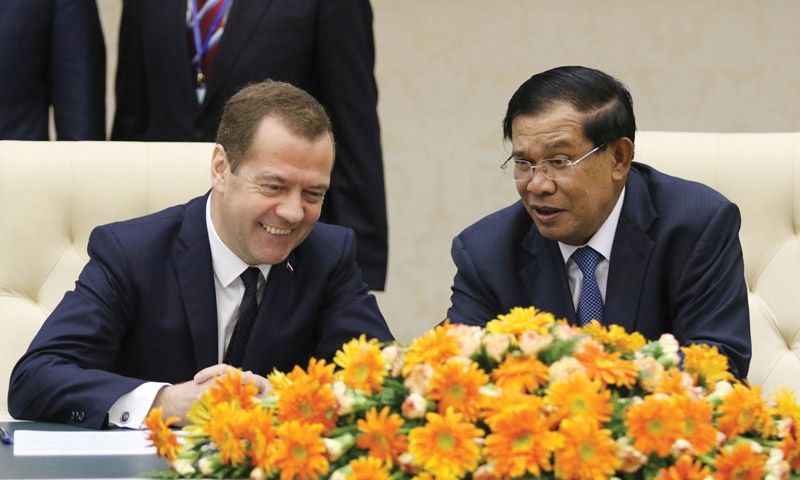
The MoU on “Cooperation in Nuclear Power Use for Peaceful Development “was one among 10 pacts signed between Cambodian Prime Minister Samdech Hun Sen and visiting Russian Prime Minister Dmitry Medvedev during his 3-day trip to Cambodia in November 2015. The visit also markedthe first visit to the kingdom by a senior Russian statesman since 1986.

No deta

ils about the nuclear power program have been released including the location, specific date and number of plants. But officials from both sides told the media it will require decades to build the plant(s) in a low-capability nation like Cambodia.

Cambodia continues to rely heavily on imported fuel and power from neighbouring Vietnam and Thailand. The energy tariff here is among the most expensive in Southeast Asia which deters many investors to the kingdom.

The nationwide electricity cut on the night of 26 November 2015 caused by a fault in the Vietnamese national grid clearly demonstrated Cambodia’s need for more affordable means of energy generation if it wishes to attract more investment.

Compared to conventional fuel power plants, nuclear power plants offers lower greenhouse gas emissions, powerful and efficient electricity, reliable, cheap electricity, low fuel cost, continuous and last-long supply, and easy fuel transportation as 28 grams of uranium releases as much energy as produced from 100 metric tons of coal.

All emerging economies are now facing a key issue which is the reliable, cheap and guaranteed source of energy to ensure their national development, Sergei Kirienko, head of Russia’s state-own nuclear plant builder Rosatom told media in Russia, Reuters reported.

“The Cambodian government is mulling, in future, a nuclear power station construction,” Kirienko said. “Perhaps, it is better to begin with a research reactor and a research centre in Cambodia.”

Under the agreement, the first package of Russian support to Cambodia will provide expertise, research and training about the power plants to build Cambodian human resources.

A group of Russian atomic engineers will come to train local engineers about radiation technologies and medicine, then build and operate an atomic research centre with multiple test reactors before moving to generating power.

While the World Energy Council’s annual index ranked Cambodia at 116th in accessibility and affordability of energy across the population, Russia is treated as a world leader in exporting nuclear technology to developing countries, said David Hess, a spokesman of the World Nuclear Association, according to the Phnom Penh Post.

Hess said Russia’s package deal to clients are favourable as they provide good financing procedures, including training to both technicians and regulators and often lease nuclear fuel rods, taking back used fuel for disposal. This makes the nuclear fuel cycle much simpler.

Despite the strong support from Russia, many energy experts, as well as the general public, are hesitant about Cambodia’s capacity to handle such high-risk atomic power generators when the country’s disaster response mechanism is still weak.

According to the International Atomic Energy Agency (IAEA), countries intending to implant nuclear energy should meet 19 criteria, including forming a nuclear regulator, a legislative framework, a robust grid, financing availability, environmental protection and others. Cambodia doesn’t meet any of these criteria yet.

Despite these roadblocks, David Hess of the World Nuclear Association isn’t surprised to learn that Cambodia wants atomic reactors to promote economic growth, noting that other ASEAN members are doing so to prepare for AEC.

After openly considering the nuclear energy option as a potential way to feed soaring domestic demand, PM Hun Sen publicly rejected nuclear energy development in 2014 following the Fukushima Daiichi nuclear disaster in Japan in 2011, the largest nuclear disaster since the Chernobyl disaster in 1986.

To date, significant Cambodian government investment energy generation has focused mainly on hydropower dams. However, it has already been studying nuclear power technology in order to keep up with other ASEAN states on energy sector.

Between now and 2022, Cambodia will invest between $900 million and $1 billion plus just in transmission and distribution alone, HE Keo Rottanak, Director of EDC, the country’s state-run energy operator told Construction & Property Magazine in 2014.

“…typically it takes about 8 to 10 years to realise a generation project. The fruits that we start to enjoy now are the result of the good work of the Prime Minister and the government over the last 10 years,” he said.

He also admitted the difficult balance between the needs for electricity development and environmental protection. “If we don’t develop hydropower, if we don’t use some coal, what other fuels do we have? It takes time for effort to coordinate the technical development, the financing, and of course the construction.”

Cambodia must increasingly be self-sustaining so it can meet domestic demand and provide the basis for economic development so industries, including construction, can benefit more, he added.

- Video Advertisement -

Related Post

Construction of Bassac River Bridge Linking Chak Angre Krom and Prek Pra Reaches 73% Completion

The construction of the highly anticipated bridge across the Bassac River, connecting Chak Angre Krom to Prek Pra, has achieved a major milestone, reaching 73% completion by the end of May 2026. According to the inspection team on 01 June 2026, led by HE Soung Heng, Secretary of State and Project Director, to monitor the […]

Bakheng Water Treatment Plant Expansion Crosses Major Threshold to Secure Capital Clean Water Access

Phase Three Progress Surpasses Seventy % Mark as Cambodia Broadens Utility Infrastructure to Support Rapid Economic Growth The ongoing construction of the Bakheng Water Treatment Plant Phase Three has achieved a significant milestone, with the project now certified as more than 70 % complete. This infrastructure expansion is poised to critically enhance the water distribution […]

Takhmao City Wastewater Infrastructure Project Reaches One-Third Completion Milestone

The construction of the wastewater treatment system in Takhmao City, Kandal Province, has reached a significant milestone, achieving an overall progress of 33 percent as of the end of April 2026. This advancement was confirmed during a site visit on May 7, 2026, led by His Excellency Ros Vanna, Secretary of State of the Ministry […]

Cambodia and Japan Sign Consultancy Agreement for Koh Ksach Tonlea Bridge Project in Kandal Province

The Ministry of Public Works and Transport and the Japanese consortium CHODAI Co., LTD have formally signed a consulting services agreement for the Koh Ksach Tonlea Bridge construction project in Kandal Province. The signing ceremony took place on May 8, 2026, under the high presidency of His Excellency Peng Ponea, Minister of Public Works and […]

Japan Pledges $47 Million to Strengthen Flood Resilience and Wastewater Infrastructure in Phnom Penh

Japan has officially extended a $47 million credit facility to support a comprehensive flood protection and wastewater drainage development project in the Cambodian capital. This strategic funding follows a formal exchange of notes between the Royal Government of Cambodia and the government of Japan on April 23, 2026. The announcement was formalized during a recent […]

New $20 Million Cassava Processing Plant Breaks Ground in Kampong Speu to Boost Agri-Industrial Exports

The agricultural landscape of Cambodia reached a new milestone on the morning of April 27, 2026, as officials broke ground on a $20 Million cassava starch processing factory in Kampong Speu province. The ceremony, highlighted by the Ministry of Industry, Science, Technology, and Innovation, marks a pivotal advancement in the Kingdom’s efforts to move up […]