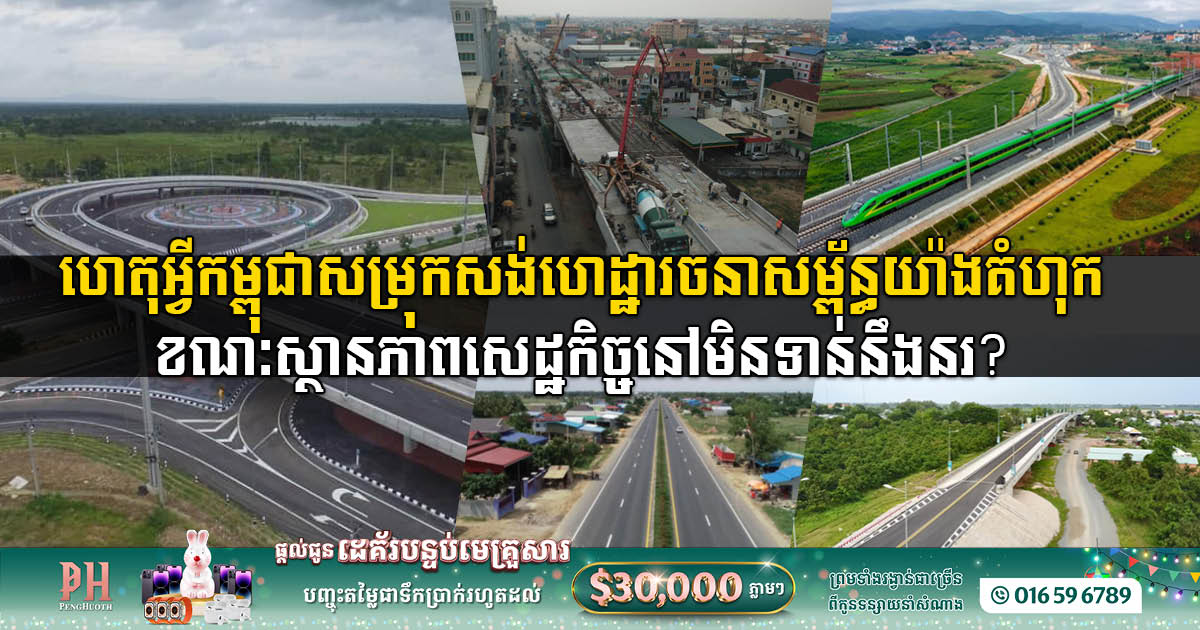
Why is Cambodia Pushing Out Multiple Infrastructure Projects Despite an Ongoing Global Crisis?

Amidst a global crisis, Cambodia remains committed to infrastructure development, with over US$30 billion in projects currently underway or on the table. The country’s railway system is a focal point, with plans to modernize the 382-kilometre Phnom Penh-Poipet railway system to become the kingdom’s first standard high-speed rail line. The project, estimated at over US$4 billion, is being studied by China Roads and Bridges Corporation (CRBC), and will feature a maximum speed of 160 km/hr and 33 stations. (Read more)

Chinese President Xi Jinping recently provided a grant of 300 million yuan (about US$44 million) to support railway development projects in Cambodia, further underscoring the country’s commitment to infrastructure improvement. (Read more)

Cambodia is also requesting China Metro Group Limited to study the feasibility of high-speed and light-rail high-speed rail projects for Phnom Penh and Siem Reap to reduce traffic congestion. (Read more)

Besides the aid from China, Cambodia is also now encouraging France to invest in the construction of the Phnom Penh-Ho Chi Minh high-speed rail line.

Prime Minister Samdech Hun Sen informed the French investment delegation that Cambodia allows French investors to 100% investment in the new high-speed railway from Phnom Penh to Ho Chi Minh City. (Read more)

In addition to the railway system, Cambodia is set to construct more expressways, with the Phnom Penh-Bavet Expressway as the second expressway in the country. Construction is expected to commence in June 2023, and the project will connect Phnom Penh at the third ring road to the Bavet Cambodian-Vietnamese border, with a total length of approximately 135 km and a construction cost of approximately US$1.6 billion. The Phnom Penh-Siem Reap Expressway is also in the pipeline, with a framework agreement set to be signed in September. (Read more)

Cambodia’s infrastructure development projects extend to other areas, such as national roads, bridges, and international airports, among others. The scale of these projects, totaling up to US$30 billion, is larger than Cambodia’s annual GDP of US$27 billion. The government’s long-term policy to stimulate the country’s economy through BOT investment is aimed at reducing public debt while boosting the economy and investment.

The Cambodian government’s focus on infrastructure development is also a strategic move to boost the country’s competitiveness in the region once the crisis is averted. With the national elections just over the horizon in July, Prime Minister Samdech Hun Sen’s vision for the country’s infrastructure development projects could bolster his standing among citizens.

As Cambodia seeks to build trust among investors and increase BOT investment in infrastructure, a new investment law and other incentives have been enforced. The success of the Phnom Penh-Sihanoukville Expressway project, a BOT project, could also instill confidence in new investors. Cambodia’s commitment to infrastructure development in the face of a global crisis is a testament to the government’s long-term vision for the country’s economic growth and development.

- Video Advertisement -

Related Post

A $117 Million Economic Lifeline: Prime Minister Hun Manet Inaugurates Newly Expanded National Road 7

The newly upgraded 4-lane highway connecting Skun and Kampong Cham town is projected to deliver a 15.27% economic return, slashing travel times and boosting agricultural trade… In a major boost to Cambodia’s internal logistics network, a vital 45.489-kilometer section of National Road 7 connecting the Skun roundabout to the Kizuna Bridge roundabout in Kampong Cham […]

Maritime Geopolitical Rivalry Intensifies as Vietnam Accelerates $4 Billion Deep Sea Port Project in the Far South

The massive infrastructure development on Hon Khoai Island serves as both an economic gateway for the Mekong Delta and a strategic maritime shield amid shifting regional dynamics Ho Chi Minh City: The geopolitical and trade landscape of Southeast Asia is entering a highly competitive phase as nations across the region race to build strategic advantages. […]

Field Assessments Underway for Kandal Province New Strategic Bridge

A joint delegation evaluates four potential sites for the Koh Khsach Tonlea crossing to enhance rural connectivity and market access In a significant step forward for Cambodia’s infrastructure development, a multi-institutional technical team has launched a comprehensive field survey to determine the optimal location for the upcoming Koh Khsach Tonlea Bridge project in Kandal Province. […]

Cambodia Completes Major Expansion of National Road 7 Connecting Skun and Kampong Cham

The $117 million infrastructure upgrade backed by China is set for an official inauguration by Prime Minister Hun Manet in July… The extensive upgrade of National Road 7, stretching over 45 kilometers to connect the hub of Skun with Kampong Cham town, has officially reached 100% completion. To mark this infrastructural milestone, a formal handover […]

Cambodia to Upgrade National Road 4 Section in Chbar Mon to Drive Regional Economic Growth

The Kampong Speu Provincial Administration recently announced a comprehensive infrastructure initiative aimed at upgrading the aesthetics and functionality of a key section of National Road 4 within Chbar Mon City. The project is strategically designed to transform the province into a vital economic and commercial center for the region. This development plan was detailed in […]

Bassac Riverbank Stabilization Project in Kandal Reaches 60% Completion

The ongoing infrastructure initiative to reinforce the Bassac riverbank in Sampov Poun City, Kandal Province, has achieved a significant milestone, with construction teams completing approximately 60% of the designated works. Local authorities and engineering crews remain heavily committed to accelerating the remaining phases to ensure the project concludes entirely on schedule. During a recent field […]